
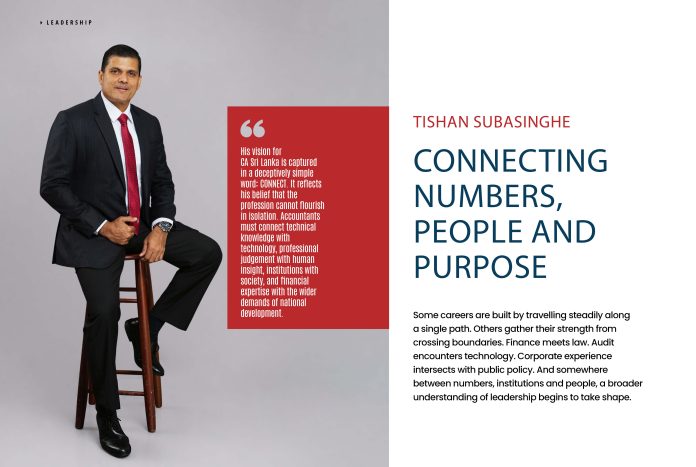
Some careers are built by travelling steadily along a single path. Others gather their strength from crossing boundaries. Finance meets law. Audit encounters technology. Corporate experience intersects with public policy. And somewhere between numbers, institutions and people, a broader understanding of leadership begins to take shape.
As the 28th President of the Institute of Chartered Accountants of Sri Lanka, Subasinghe brings to the office a professional journey spanning nearly three decades and extending well beyond the conventional boundaries of accountancy. A Fellow Member of CA Sri Lanka, he is also an Attorney-at-Law, a Certified Information Systems Auditor and an MBA graduate in Finance from the University of Colombo, where he was awarded a Subject Gold Medal. His professional experience has taken him from Sri Lanka to PwC assignments in Botswana, New York and Philadelphia, giving him exposure to business and professional environments across different markets.
Today, he serves as Managing Director of Moore Consulting and Joint Managing Partner of Moore Aiyar, having previously led Audit and Assurance at BDO Partners. His experience also extends into corporate boardrooms, regulation and national policy, including service on the Sri Lanka Accounting and Auditing Standards Board, the Securities and Exchange Commission and national initiatives concerned with regulatory reform and financial sector stability.
Yet it is perhaps the convergence of these experiences that most clearly defines his presidency.
His vision for CA Sri Lanka is captured in a deceptively simple word: CONNECT. It reflects his belief that the profession cannot flourish in isolation. Accountants must connect technical knowledge with technology, professional judgement with human insight, institutions with society, and financial expertise with the wider demands of national development.
At a time when Artificial Intelligence, sustainability, economic uncertainty and changing expectations are redefining the profession, Subasinghe sees Chartered Accountants not merely as custodians of numbers, but as custodians of trust.
Global CEO Magazine sat down with Tishan Subasinghe to explore his CONNECT vision, the future of the accounting profession, the impact of artificial intelligence, and the qualities that will define the next generation of business leaders.
Since assuming office as President of CA Sri Lanka in January 2026, how have you translated your “CONNECT” vision into action, and what progress has been made in strengthening engagement with members, industry, regulators and other stakeholders?
When I introduced CONNECT as the theme, it was based on a simple belief: progress is created when people, institutions and ideas come together with purpose. For me, CONNECT is not merely a slogan; it is a way of working and a commitment to ensuring that CA Sri Lanka remains closely connected to its members, students, the business community, regulators, policymakers and society at large.
Since assuming office, we have placed greater emphasis on creating meaningful platforms for dialogue and collaboration. We have strengthened our engagement with industry and regulators, expanded our conversations with SMEs, and continued to work closely with key stakeholders on areas such as sustainability, governance, technology, taxation and economic development.
We have also focused on ensuring that our members remain connected to the Institute and to one another. A professional body must constantly listen, understand changing needs and respond with relevance. Ultimately, CONNECT is about building an Institute that is more accessible, more collaborative and more responsive, especially one that brings people together to create solutions that contribute to the profession and the country.
The accounting profession is undergoing significant transformation driven by Artificial Intelligence, digital technologies, sustainability reporting and evolving stakeholder expectations. How is CA Sri Lanka preparing its members to thrive in this rapidly changing environment?
The profession is changing at a remarkable pace, and our responsibility is to ensure that our members are not simply prepared to respond to change, but are equipped
to lead it.
CA Sri Lanka is focusing on developing competencies in areas that are increasingly important to the future of business and the economy. These include Artificial Intelligence, digital transformation, data analytics, sustainability reporting, cybersecurity, technology governance and emerging regulatory requirements. We are also strengthening our professional education and continuous development programmes to ensure that learning remains relevant throughout a Chartered Accountant’s career.
However, technology is only one part of the transformation. The future will require professionals who can combine technical expertise with sound judgement, ethical leadership, strategic thinking and the ability to communicate effectively.
Our objective is therefore to develop Chartered Accountants who are technologically confident, commercially aware and ethically grounded professionals who can use technology intelligently while continuing to provide the human judgement, integrity and leadership that organisations and society will always need.
You have often emphasised that Chartered Accountants must evolve beyond traditional financial reporting roles. What new competencies and leadership capabilities will define the next generation of Chartered Accountants?
The Chartered Accountant of the future must be more than a technical expert. Technical competence will remain fundamental, but it will increasingly serve as the foundation upon which broader capabilities are built.
The next generation will need to understand technology, data, Artificial Intelligence, sustainability, geopolitics and the wider forces shaping business and society. They must be able to interpret information, challenge assumptions, identify risks and translate complex issues into sound strategic decisions. Equally important will be human capabilities such as communication, collaboration, empathy, adaptability and the courage to exercise professional judgement.
This is precisely the thinking behind CA Sri Lanka’s Curriculum 2025–30. We are moving towards a more future-focused model of professional education, one that goes beyond technical knowledge and places greater emphasis on digital capabilities, professional skills, ethical judgement, adaptability and the ability to apply knowledge in a rapidly changing business environment.
We want our students to be prepared not only to enter the profession, but to lead within it. Whether they become CEOs, CFOs, policymakers, board directors, entrepreneurs or trusted advisers, they must have the capabilities to navigate complexity and create meaningful value.
Leadership is not simply about holding a position; it is about taking responsibility, building trust and making decisions that create long-term value. I believe the Chartered Accountants who will make the greatest impact will be those who combine competence with character. The future belongs to professionals who can connect numbers with people, information with insight, and strategy with purpose.
As a Chartered Accountant, Attorney-at-Law, consultant and corporate leader, you bring a uniquely diverse professional background. How have these experiences influenced your leadership approach and strategic outlook?
My professional journey has given me the opportunity to view organisations and complex challenges through different lenses. As a Chartered Accountant, I have developed a deep appreciation of financial discipline, accountability and evidence-based decision-making. My legal background has strengthened my understanding of governance, regulation, rights and responsibilities, while my experience as a consultant and corporate leader has taught me the importance of people, execution and the ability to translate strategy into results.
These experiences have reinforced a fundamental belief: the most complex challenges rarely have a single dimension. Financial decisions have legal, ethical and human consequences. Governance is not simply about compliance; it is about building trust and strengthening institutions. And strategy has little value unless it can be translated into meaningful action.
This understanding of the interconnection between the legal and financial professions also led to a significant milestone in July 2026, when, for the first time in the history of both CA Sri Lanka and the Bar Association of Sri Lanka, the two institutions entered into a strategic agreement. I believe this partnership reflects the value of bringing complementary professions together to strengthen knowledge, collaboration and professional contribution to national development.
As a leader, I try to listen broadly, think strategically and remain grounded in practical realities. I do not believe leadership is about having all the answers. It is about recognising that no single perspective is sufficient, bringing the right people and expertise together, asking the right questions and creating the environment in which better solutions can emerge.
Having contributed to national policy, regulatory reforms and governance initiatives, what role do you believe Chartered Accountants should play in supporting Sri Lanka’s economic growth, institutional strengthening and investor confidence?
Chartered Accountants have a responsibility that extends well beyond the organisations in which they work. We are custodians of trust.
In a country seeking sustainable economic growth, stronger institutions and increased investor confidence, the contribution of Chartered Accountants is critical. We bring expertise in financial management, governance, risk, accountability, reporting and strategic decision-making, all of which are fundamental to building confidence in both the public and private sectors.
Our profession must actively contribute to policy discussions and national development, while maintaining independence, objectivity and professional integrity. We should be willing to engage constructively with government, regulators, businesses and other stakeholders to help develop practical and sustainable solutions.
Ultimately, investor confidence is built when institutions are transparent, accountable and well-governed. Chartered Accountants can make a significant contribution to that confidence by helping organisations make better decisions, strengthen their systems and demonstrate that value is being created responsibly and sustainably.
CA Sri Lanka has long been recognised for producing many of the country’s leading business and corporate leaders. How can the Institute further strengthen its role in developing future CEOs, entrepreneurs and boardroom leaders?
Our profession has always had a strong leadership legacy, and I believe we have a responsibility to build on that legacy while preparing leaders for a very different future.
The leaders of tomorrow will need far more than technical knowledge. They will need an understanding of strategy, innovation, entrepreneurship, technology, sustainability, geopolitics and, above all, people. They must also be able to lead with confidence in an environment defined by uncertainty, disruption and constant change.
This is why CA Sri Lanka is placing greater emphasis on leadership development and creating platforms that bridge professional knowledge with real-world leadership. The recently-launched CA Leadership Academy is an important step in this direction. Through programmes designed to develop corporate and director-level leadership capabilities, the Academy aims to equip Chartered Accountants and other professionals with the strategic perspective, practical insights and leadership capabilities required to navigate complexity and create sustainable value.
We must also encourage our members and students to look beyond traditional career paths and recognise the many opportunities available in entrepreneurship, technology, investment, public policy and board leadership.
Most importantly, we must develop leaders who understand that success is not measured only by financial performance. The leaders of the future must be capable of creating sustainable value, building resilient organisations and earning the trust of the people they lead.
Looking ahead, what are your key priorities for the remainder of your presidency, and what lasting impact would you like CA Sri Lanka to achieve under your leadership?
My priorities are centred on ensuring that CA Sri Lanka remains relevant, future-ready and connected to the needs of its members, the economy and society.
We will continue to focus on strengthening member engagement, advancing the profession’s role in technology and Artificial Intelligence, promoting sustainability and good governance, and deepening our engagement with business, government and other stakeholders. We also want to continue creating meaningful opportunities for our students and members to develop the knowledge and capabilities required for the future.
However, the impact I would like to leave is not defined by the number of initiatives introduced during my tenure. I would like to see a stronger sense of connection between the Institute and its members, between the profession and the economy, and between professional excellence and national development.
If, at the end of my presidency, CA Sri Lanka is more connected, more forward-looking and better positioned to serve its members and the country, I would consider that a meaningful achievement.
How is Artificial Intelligence reshaping the work of Chartered Accountants?
Artificial Intelligence is not replacing the Chartered Accountant; it is redefining what it means to be one. It is taking over more routine and repetitive tasks, allowing professionals to focus on what machines cannot truly replicate: judgement, ethics, critical thinking and human insight.
The Chartered Accountant of the future will not simply process information; they will interpret it, challenge it and use it to make better decisions. AI can provide the data and analysis, but it is professional judgement that transforms information into insight and insight into wise action. I believe the greatest opportunity is not to compete with AI, but to learn to work with it and use it to elevate the value we bring to business and society.
