
Public investment would be maintained at more 4% of GDP
Committee to assess suitability of entering into another IMF programme
The National People’s Power (NPP) Government yesterday unveiled its third Budget, placing economic transformation, increased production and wider public participation at the centre of its development agenda, while pledging to ensure that the benefits of economic stability are shared equitably among all sections of society.
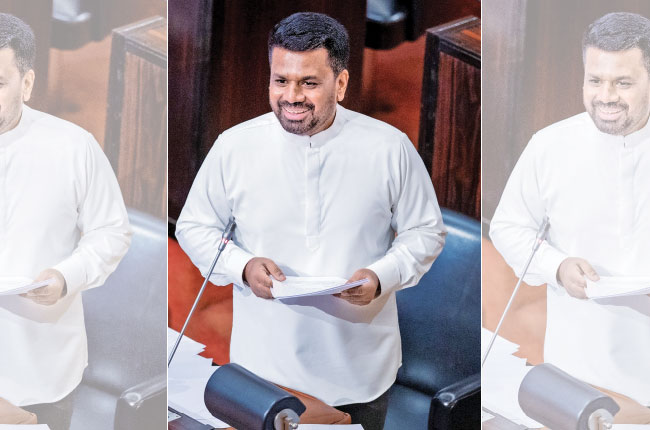
Presenting the 2027 Budget in Parliament, President Anura Kumara Dissanayake, in his capacity as Finance Minister, said the Government was determined to fast-track structural changes to build a highly productive and export-oriented economy capable of competing in international markets.
He identified attracting domestic and foreign private investment, diversifying export products and markets, and strengthening the country’s integration into international value chains as key priorities.
The President said measures were also being introduced to improve access to finance for Small and Medium Enterprises (SMEs) and establish a transparent and predictable investment climate that would encourage both local and foreign investors.Track Exec Orders
He said the National Single Window for Trade, introduced as a pilot project, would be expanded in two phases during 2027. The first phase, scheduled for the first half of the year, would connect exporters to the system, while importers and re-exporters would be integrated during the second half. An allocation of Rs.1,990 million has been made for the initiative.
Turning to energy security, President Dissanayake said the Government would seek to reduce the long-term foreign exchange burden arising from imported fuel while ensuring the uninterrupted supply of essential energy through diversified supply routes and energy sources.Track Exec Orders
He also announced that public investment would be maintained at more than four per cent of Gross Domestic Product (GDP) from 2027 onwards.
Outlining the Government’s approach to economic cooperation beyond the current International Monetary Fund (IMF) programme, the President said a committee headed by the Deputy Minister of Finance and Planning would assess the suitability of entering into another programme after the successful completion of the existing arrangement. The committee would also recommend the most appropriate form of engagement.
President Dissanayake said the 2027 Budget was designed around several key priorities, including preserving macroeconomic stability, enhancing the economy’s resilience, revitalising the rural economy and ensuring stability in energy markets.
Among the key budget proposals for 2027 are an allocation of Rs.53,450 million for the completion of Kadawatha-Mirigama section of the Central Expressway in 2027.
The government has also allocated Rs 35,000 million for digitalisation, the implementation of teacher capacity development programme, development of infrastructure including the development of Teacher Colleges, National Colleges of Education and school buildings.
Rs.450 million has been allocated for 2027 for the construction of faculties of Medicine and clinical buildings at the Peradeniya and Wayamba Universities with an investment of Rs.8,000 million.
Rs.700 million is to be allocated for 2027 for the restoration work of higher educational institutes damages by the Ditwah.
Electricity consumers will also receive 300,000 smart meters who consume more than 180 units on a grant of US$ 12 million from Asian Development Bank. Domestic consumers who newly install rooftop solar power systems will be provided subsidy of Rs.25,000 per kilowatt of battery storage capacity.It is to provide this subsidy for upto 10 kilowatts subject to maximum of Rs.250,000.The government will set apart Rs.3,500 million for this purpose.
Budget highlights at a glance…
* The Tourism Development Levy will be abolished with effect from April 1, 2027
* Special Commodity Levy on imported sugar will be increased by Rs.10 per kg
* CESS rates on 800 selected HS code lines will be reduced by 25%
*The 10% PAL on imported newsprint will be removed from January 1, 2027
* Supply of bunker fuel to ships engaged in international transport will be exempt from Social Security Levy (SSCL)
* Value Added Tax (VAT) on foreign currency transactions will be converted into Sri Lankan Rupees using the Central Bank’s Indicative Exchange RateSri Lanka travel
*Books and printed materials will be exempt from Value Added Tax (VAT) on imports and supplies.
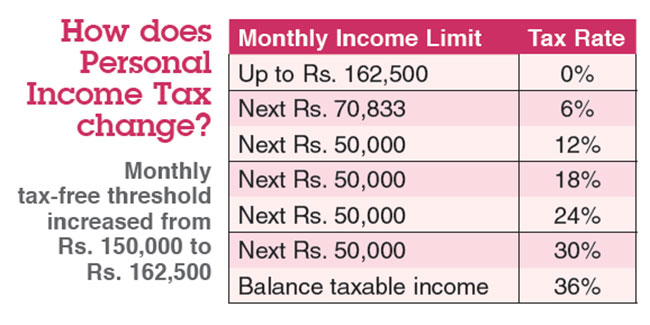
*Tax-free threshold to increase from Rs.150,000 to Rs.162,500 per month
*Tax brackets: Revised to widen taxable income brackets, with the 6% tax slab set at Rs.70,833 per month and subsequent slabs expanded from Rs.41,667 to Rs.50,000.
* Tax rates: Proposed rates are 6%, 12%, 18%, 24%, 30% and 36%, replacing the existing 18% rate immediately after the 6% bracket with 12%.
u Rs.67,687 million for interest subsidies and refinancing to banks for MSMEs
* Rs.80 billion for the first phase of railway electrification programme covering three key railway lines
* Positive primary balance of Rs.1,8444 billion recorded by end of September this year
* Highest ever current account surplus in history of US$ 1,719 million
* Foreign remittance tops US$ 7.6 billion by October this year
* Total foreign debt service will be US$ 2,986 million in 2027
* In 2025 Budget deficit recorded its lowest value in 68 years at 2.3 per cent
* Rs.367 billion profit recorded from loss making State owned Enterprises by August this year
* Rs.300 million for the commencement of the relocation of the Colombo prison complex
* Rs.9.5 billion to digitise the operations of the Sri Lanka PoliceSri Lanka travel
* Rs.500 million for concessionary loans to tourism service providers to purchase equipment, including boats and promote marine tourism.
* Monthly professional allowances for judges increased by Rs.25,000 in two phases from July 2027
*Monthly risk allowance for prison officers doubled from Rs.8,000 to Rs.16,000
* Academic allowance for university lecturers increased by Rs.25,000 in two phases
* Payments to external lecturers at vocational and technical institutions increased by 100%
* Rs.50 billion for the District Development Programme and the Decentralised Budget Programme, with Rs.2 billion allocated to each district
Source: dailynews.lk
