
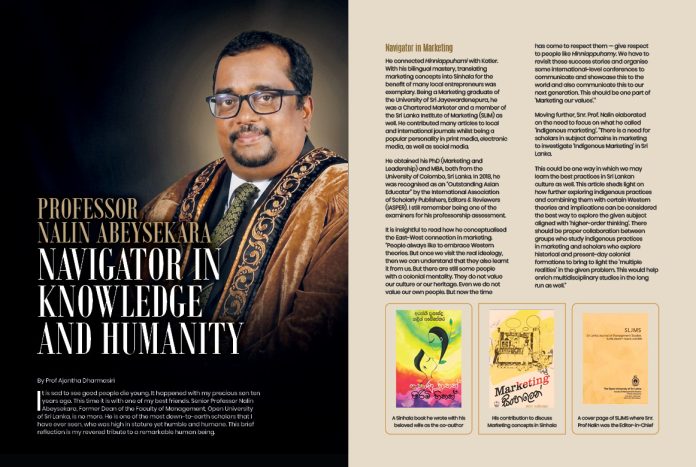
By Prof Ajantha Dharmasiri
It is sad to see good people die young. It happened with my precious son ten years ago. This time it is with one of my best friends. Senior Professor Nalin Abeysekara, Former Dean of the Faculty of Management, Open University of Sri Lanka, is no more. He is one of the most down-to-earth scholars that I have ever seen, who was high in stature yet humble and humane. This brief reflection is my revered tribute to a remarkable human being.
Navigator in Marketing
He connected Hinniappuhami with Kotler. With his bilingual mastery, translating marketing concepts into Sinhala for the benefit of many local entrepreneurs was exemplary. Being a Marketing graduate of the University of Sri Jayewardenepura, he was a Chartered Marketer and a member of the Sri Lanka Institute of Marketing (SLIM) as well. He contributed many articles to local and international journals whilst being a popular personality in print media, electronic media, as well as social media.
He obtained his PhD (Marketing and Leadership) and MBA, both from the University of Colombo, Sri Lanka. In 2018, he was recognised as an “Outstanding Asian Educator” by the International Association of Scholarly Publishers, Editors & Reviewers (IASPER). I still remember being one of the examiners for his professorship assessment.
It is insightful to read how he conceptualised the East-West connection in marketing. “People always like to embrace Western theories. But once we visit the real ideology, then we can understand that they also learnt it from us. But there are still some people with a colonial mentality. They do not value our culture or our heritage. Even we do not value our own people. But now the time has come to respect them — give respect to people like Hinniappuhamy. We have to revisit these success stories and organise some international-level conferences to communicate and showcase this to the world and also communicate this to our next generation. This should be one part of ‘Marketing our values’.”
Moving further, Snr. Prof. Nalin elaborated on the need to focus on what he called ‘indigenous marketing’. “There is a need for scholars in subject domains in marketing to investigate ‘Indigenous Marketing’ in Sri Lanka.
This could be one way in which we may learn the best practices in Sri Lankan culture as well. This article sheds light on how further exploring indigenous practices and combining them with certain Western theories and implications can be considered the best way to explore the given subject aligned with ‘higher-order thinking’. There should be proper collaboration between groups who study indigenous practices in marketing and scholars who explore historical and present-day colonial formations to bring to light the ‘multiple realities’ in the given problem. This would help enrich multidisciplinary studies in the long run as well.”
Navigator in Management
He was a firm advocate of a “creative economy” for Sri Lanka. Being a senior resource person in strategic management, marketing, and research methodology, he had research and lecturing exposure in Canada, the UAE, Singapore, Oman, and Qatar.
I enjoyed co-delivering the module titled “Theoretical Approaches to Management” for the doctoral candidates of the Postgraduate Institute of Management (PIM).
The way Snr. Prof. Nalin discussed the concept of “creative economy” is indeed insightful. “The popularity of songs such as Manike Mage Hithe and Why This Kolaveri Di on social media can be considered a message reiterating the power of creativity and innovation with the essence of new technology.
It is truly an internet generation that articulated fashion and trends in the world. There is a responsibility and mechanisms from stakeholders in the country to have a proper system to respect the creativity and imagination of our young generation. The song ‘Manike Mage Hithe’ stands out as a success story in Sri Lanka’s creative economy, serving as an eye-opener to the nation’s untapped potential.”
According to him, the concept of a creative economy refers to the income-generating capacity of creative ideas, talents, and activities. The creative economy encompasses many careers, in which the music industry also plays a vital part. As mentioned earlier, we have discussed the concept of a “creative economy” and its importance to Sri Lanka for decades but could not see any positive response from the administrators.
He served as the editor-in-chief of the Sri Lanka Journal of Management Studies (SLJMS), whilst being a reviewer for many international journals, including the Journal of Services Marketing, Journal of Management Development, Journal of Applied Research in Higher Education, and the International Review of Research in Open and Distributed Learning (IRRODL).
In writing the first editorial of SLJMS, he did not hesitate to pay tribute to one of our veteran teachers, the late Prof. Sudattha Ranasinghe. “It is with much pleasure that we present the publication of the first issue of the Sri Lanka Journal of Management Studies (SLJMS). More importantly, this launch is aligned with the inauguration ceremony of the Faculty of Management Studies at the Open University of Sri Lanka. We would like to dedicate the first issue of this precious journal to the late Professor Sudattha Ranasinghe, Professor of Management Studies, Open University of Sri Lanka, with utmost respect. The contribution made by the late Professor Sudattha Ranasinghe towards the upliftment of the Department of Management Studies, Faculty of Humanities and Social Sciences in particular, and the Open University of Sri Lanka in general, is noteworthy and immeasurable.”
Navigator in Humanity
It was a pleasure to have a casual chat with him. Most of the time, it revolved around humanity. I have seen his creative contributions through Sinhala poetry as well as other artistic engagements. We shared our thoughts on how to uphold values in a society where perks and privileges have overtaken principles and precepts. We were both of the common view that we should contribute our fullest towards the upliftment of humanity, no matter who gets the credit.
I saw a down-to-earth scholar in him, with gratitude as a key virtue. He was a lifelong learner. The way he respected seniors and sought guidance from them, on the one hand, was very visible. On the other hand, the way he guided juniors with humility by setting examples was also very visible. He was not hesitant to appreciate our culture and tradition. He longed to wear a national dress with pride, and as his beloved wife sadly said, he did that on his final journey.
In one of his most recent writings (early April this year), Snr. Prof. Nalin expressed his thoughts on developing Sri Lanka. “Sri Lanka must carefully understand and respond to the challenges arising from its ongoing changes. Sri Lanka should establish an immediate task force comprising responsible stakeholders to engage in discussions on ongoing concerns. Recognising that it is not a comprehensive solution, the World Happiness Index can nevertheless act as an important indicator in guiding a paradigm shift in how we approach education and economic development. For a country seeking to reposition itself globally, Sri Lanka must adopt stronger, more effective strategies across multiple sectors. Building a resilient and prosperous future requires sound policymaking and clear strategic direction.”
Continuing Legacy
“Your life was a blessing, your memory a treasure. You are loved beyond words and missed beyond measure.” What Renee Wood said is very fitting for our valued legend. Life is not only to live but to leave a legacy. Snr. Prof. Nalin aptly did that through his knowledge-creating and knowledge-sharing life.
The best tribute to Snr. Prof. Nalin is to continue his unfinished contribution towards the betterment of humanity. “In order to succeed, people need a sense of self-efficacy, to struggle together with resilience to meet the inevitable obstacles and inequities of life,” so said Albert Bandura, the most admired living psychologist of our times. This was very true of Snr. Prof. Nalin Abeysekara .
I will not have the luxury of engaging in a long tele-chat with a deep thinking friend, starting from something ordinary leading to extraordinary insights, usually revolving around humanity.. Goodbye my beloved friend. May you attain supreme bliss of Nibbana.
Prof Ajantha Dharmasiri is a Senior Professor in Management at Postgraduate Institute of Management (PIM), University of Sri Jayewardenepura
