
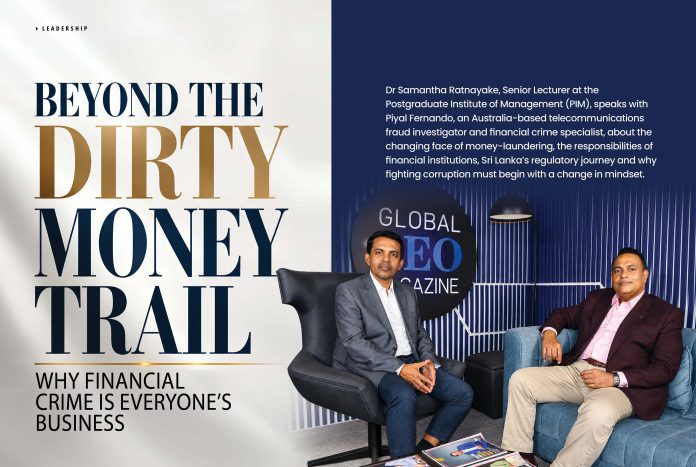
Dr Samantha Ratnayake, Senior Lecturer at the Postgraduate Institute of Management (PIM), speaks with Piyal Fernando, an Australia-based telecommunications fraud investigator and financial crime specialist, about the changing face of money-laundering, the responsibilities of financial institutions, Sri Lanka’s regulatory journey and why fighting corruption must begin with a change in mindset.
Piyal, welcome to Leadership Dialogue. You are a Sri Lankan professional who has built considerable expertise in Australia in fraud investigation, financial crime, anti money-laundering and counter terrorism financing. For our readers who may not be familiar with your journey, could you begin by giving us an overview of your professional and academic background?
PF:
Thank you, Dr Samantha. I am grateful to Global CEO Magazine for giving me this opportunity.
I migrated to Australia in 2006, having completed my bachelor’s degree at the University of Kelaniya. In Australia, I joined the telecommunications sector as a fraud investigator, which gave me significant exposure to fraud investigation and the broader financial crime landscape.
I subsequently completed a master’s degree in Fraud and Financial Crime at Charles Sturt University in Australia. I then pursued a second master’s degree, also at Charles Sturt University, in Anti Money-Laundering and Counter Terrorism Financing.
Alongside my academic qualifications, I have built considerable practical experience in fraud investigation, particularly within the telecommunications sector. That combination of academic knowledge and practical exposure has shaped my understanding of how financial crime is evolving.
Anti-money-laundering, fraud, illicit money transfers and the involvement of criminal networks constitute an enormous subject. It is also particularly relevant to Sri Lanka today. How should we understand the changing nature of money-laundering?
PF:
Traditionally, when people heard the term “money-laundering”, they tended to associate it with the underworld, drug traffickers and dangerous criminal networks. As a result, ordinary people often thought it was something completely removed from their lives.
That perception needs to change.
Money-laundering is no longer confined to what we traditionally considered the criminal underworld. Increasingly, it can involve white collar environments and apparently legitimate activities. It can potentially exploit trusted businesses, charitable organisations, religious institutions and other structures that people would not normally associate with financial crime.
That is why awareness is so important.
Money-laundering can intersect with everyday economic activity. Individuals, businesses and institutions therefore need to be much more alert to the risks and understand how legitimate systems can potentially be misused.
Financial crime can involve cross border transfers, international trade and numerous institutional channels. How do financial crime and money-laundering connect, particularly in areas such as trade?
PF:
Money-laundering forms part of the broader financial crime landscape. One of the difficulties is that authorities or institutions may successfully identify the initial financial offence but fail to investigate whether there is a money-laundering dimension behind it.
Consider trade-based activity. An importer may, for example, misdescribe goods or manipulate invoices in an attempt to reduce duties or taxes. Customs authorities may detect that offence, and that is important.
However, the investigation should not necessarily end there.
Authorities also need to consider whether the transaction forms part of a wider financial crime or money-laundering arrangement. Over invoicing, under invoicing, misrepresentation of goods and manipulation of trade transactions can potentially be used to move or disguise value.
The important lesson is that agencies should look beyond the immediate offence. Tackling the first layer of financial crime without examining the movement and ultimate destination of funds can mean addressing only part of the problem.
This edition of Global CEO Magazine places particular emphasis on financial institutions and their contribution to economic development. From your experience, what should leaders in banking and financial services be particularly conscious of?
PF:
Having worked in the financial sector before migrating to Australia, I understand the commercial pressures facing financial institutions.
Financial institutions need to generate profits and compete for customers. For many years, there was a strong emphasis on the idea that “the customer is king”. Customer experience remains extremely important, but problems can arise when customer convenience comes at the expense of appropriate risk management and due diligence.
Fraudsters understand systems. They look for weaknesses and exploit them.
Internationally, we have seen financial institutions face significant regulatory consequences when weaknesses in anti-money-laundering controls and customer due diligence have been identified.
For Sri Lankan financial institutions, the message is therefore straightforward: remain customer focused, but never lose sight of risk.
Every product and customer relationship carries a particular level of risk. Institutions need appropriate controls, customer due diligence and ongoing monitoring. If risk management is weakened simply to make processes easier or faster, criminals may exploit those gaps and use trusted financial institutions to move illicit funds.
Customer experience and compliance should not be treated as competing objectives. Strong institutions must be capable of delivering both.
That raises a much broader question. Financial crime, corruption, governance and compliance ultimately affect economic growth and even the international perception of a country. How important is this to Sri Lanka’s development?
PF:
It is extremely important. My personal belief is that if Sri Lanka genuinely wants to create a society that rejects corruption, the process cannot happen only from the top. It must also begin from the bottom.
We need to develop the right attitudes from childhood. Creating laws and institutions is essential, but building a culture that rejects corruption is equally important.
I have also noticed an encouraging change in Sri Lanka. Previously, when I spoke about money-laundering, awareness among many people was relatively limited. More recently, I have seen significantly greater interest in understanding anti-money-laundering issues, including within government and professional circles.
This matters because a country’s effectiveness in combating money-laundering, terrorism-financing and related financial crimes can influence its international standing.
Sri Lanka’s framework is assessed in the context of international standards, including those associated with the Financial Action Task Force and the Asia Pacific Group on Money-Laundering. Such assessments place attention on the effectiveness of laws, regulations, institutions and enforcement mechanisms.
A credible financial system has implications far beyond compliance. International investors consider governance and institutional integrity when making investment decisions. Correspondent banks consider risk when establishing and maintaining relationships. International lenders and other institutions also pay attention to the strength and credibility of a country’s financial architecture. Therefore, progress in combating corruption,
money-laundering and financial crime can contribute to confidence in Sri Lanka.
It will not be an easy journey. Laws alone are not enough. We need effective procedures, institutional capacity, professional training, enforcement and, importantly, a change in mindset.
However, I believe Sri Lanka has begun moving in a positive direction. Strengthening these areas can support the broader objective of rebuilding the economy and enhancing the country’s international credibility.
As a Sri Lankan professional who has developed his career overseas, you clearly have a strong desire to contribute to your home country. What would you like to leave our readers with as your concluding thought?
PF:
Sri Lanka gave me my educational foundation, and although I have built my professional career overseas, I have never forgotten where I came from.
My genuine objective is to bring back some of the knowledge and experience I have gained internationally and share it with Sri Lanka. That is one of the reasons I return regularly and try, in whatever way I can, to contribute through knowledge sharing.
Although I live in Australia, I am proud to say that I am Sri Lankan. I want Sri Lanka to become a country whose people, wherever they may live in the world, can speak about their homeland with confidence and pride.
Financial crime prevention may appear to be a highly technical field, but ultimately it is about something much larger: protecting the integrity of institutions, strengthening trust and helping build a country in which legitimate enterprise can prosper.
If the expertise Sri Lankans acquire around the world can be brought home and shared, even in small ways, I believe we can contribute towards building a stronger Sri Lanka.
I sincerely thank Global CEO Magazine and Dr Samantha Ratnayake for creating this platform. I am always willing to share whatever knowledge and expertise I have gained, with my home country.
