
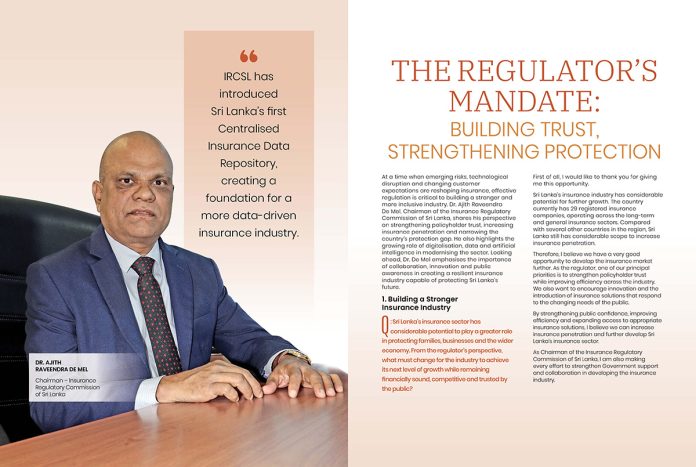
At a time when emerging risks, technological disruption and changing customer expectations are reshaping insurance, effective regulation is critical to building a stronger and more inclusive industry. Dr. Ajith Raveendra De Mel, Chairman of the Insurance Regulatory Commission of Sri Lanka, shares his perspective on strengthening policyholder trust, increasing insurance penetration and narrowing the country’s protection gap. He also highlights the growing role of digitalisation, data and artificial intelligence in modernising the sector. Looking ahead, Dr. De Mel emphasises the importance of collaboration, innovation and public awareness in creating a resilient insurance industry capable of protecting Sri Lanka’s future.
1. Building a Stronger Insurance Industry
Q: Sri Lanka’s insurance sector has considerable potential to play a greater role in protecting families, businesses and the wider economy. From the regulator’s perspective, what must change for the industry to achieve its next level of growth while remaining financially sound, competitive and trusted by the public?
First of all, I would like to thank you for giving me this opportunity.
Sri Lanka’s insurance industry has considerable potential for further growth. The country currently has 29 registered insurance companies, operating across the long-term and general insurance sectors. Compared with several other countries in the region, Sri Lanka still has considerable scope to increase insurance penetration.
Therefore, I believe we have a very good opportunity to develop the insurance market further. As the regulator, one of our principal priorities is to strengthen policyholder trust while improving efficiency across the industry. We also want to encourage innovation and the introduction of insurance solutions that respond to the changing needs of the public.
By strengthening public confidence, improving efficiency and expanding access to appropriate insurance solutions, I believe we can increase insurance penetration and further develop Sri Lanka’s insurance sector.
As Chairman of the Insurance Regulatory Commission of Sri Lanka, I am also making every effort to strengthen Government support and collaboration in developing the insurance industry.
2. Protection Gap: Who Protects the Unprotected?
Q: A significant proportion of Sri Lankan individuals and businesses remain inadequately insured against risks ranging from health and retirement to natural disasters and business disruption. What do you see as the most important protection gaps in Sri Lanka, and how can regulation encourage greater insurance penetration, innovation and financial inclusion without compromising consumer protection?
There are many areas within Sri Lanka’s insurance industry that have considerable potential for development. Cyclone Ditwah demonstrated the scale of the protection gap and the importance of strengthening insurance coverage against major catastrophes. Following the disaster, more than 24,500 insurance claims were reported, with their total value exceeding Rs. 58.5 billion.
Experiences such as this demonstrate that there is significant scope to extend protection across the country, particularly through property and life insurance. Agriculture is another important area where insurers have considerable opportunities to provide greater protection.
I therefore believe that we have significant protection gaps across life, health, property and other areas of insurance. We need to address these gaps by strengthening policyholder trust and increasing public awareness of the importance of insurance.
We have been conducting large-scale insurance awareness programmes across the country as part of this effort, including programmes in different regions to improve public understanding of insurance and its role in financial protection. IRCSL has continued this nationwide campaign under the theme “Insurance for All: For a Secure Future.”
As I mentioned earlier, if we can increase policyholder interest and trust, improve efficiency across the industry and make greater use of technologies such as artificial intelligence, I am confident that we can strengthen the insurance industry, increase penetration and ultimately reduce the protection gap.
3. Regulating the Insurance Industry of Tomorrow
Q: Technology, AI, climate change, cyber threats and new distribution models are fundamentally changing insurance. How should Sri Lanka’s regulatory framework evolve to encourage innovation while ensuring that insurers remain financially resilient, well governed and accountable to policyholders?
These are developments that we want to bring into the insurance industry, and we are making every effort to do so. At the same time, we want to continue strengthening the effectiveness and responsibility of the regulator.
Digitalisation is an important part of this transformation. IRCSL has introduced Sri Lanka’s first Centralised Insurance Data Repository, creating a foundation for a more data-driven insurance industry. The objective is to progressively strengthen the availability and use of industry data so that decisions can increasingly be based on reliable information.
We have also introduced the Digital Motor Insurance Card, another important step in modernising the industry. The initiative is intended to improve the verification of motor insurance, strengthen transparency and help address issues such as fraudulent documentation.
These initiatives are ultimately intended to strengthen policyholder trust and confidence while improving the efficiency and transparency of the insurance market.
Technology also has considerable potential in areas such as agricultural insurance. Internationally, technology is increasingly being used to improve risk assessment and insurance accessibility in agriculture, and Sri Lanka has further opportunities to develop in this area.
There is much more for us to do. Transformation will take time, but I am confident that, slowly but surely, these changes will strengthen Sri Lanka’s insurance industry and help us build a more resilient and better-protected nation.
Key Takeaways
1. Public trust is fundamental
Stronger policyholder confidence, improved efficiency and greater public awareness are essential to increasing insurance penetration in Sri Lanka.
2. Protection gaps require urgent attention
Stronger policyholder confidence, improved efficiency and greater public awareness are essential to increasing insurance penetration in Sri Lanka.
3. Regulation must support modernisation
Digitalisation, reliable industry data, artificial intelligence and improved transparency can strengthen regulation while encouraging innovation and financial inclusion.
