
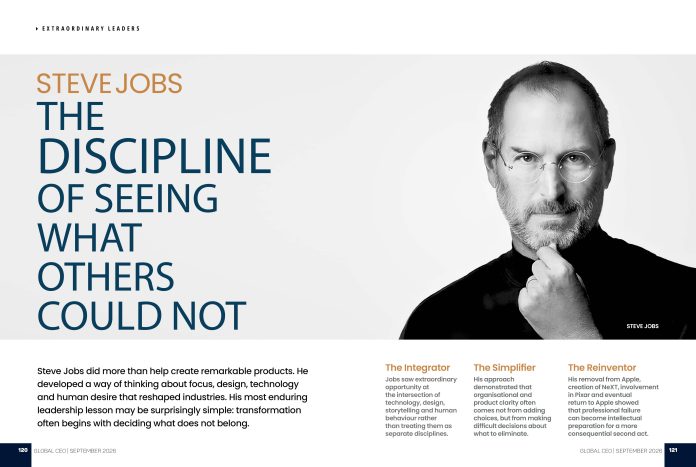
Steve Jobs did more than help create remarkable products. He developed a way of thinking about focus, design, technology and human desire that reshaped industries. His most enduring leadership lesson may be surprisingly simple: transformation often begins with deciding what does not belong.
The Integrator
Jobs saw extraordinary opportunity at the intersection of technology, design, storytelling and human behaviour rather than treating them as separate disciplines.
The Simplifier
His approach demonstrated that organisational and product clarity often comes not from adding choices, but from making difficult decisions about what to eliminate.
The Reinventor
His removal from Apple, creation of NeXT, involvement in Pixar and eventual return to Apple showed that professional failure can become intellectual preparation for a more consequential second act.
There is a peculiar courage in removing things
Businesses are usually rewarded for adding: more products, more features, more markets, more meetings, more choices. Steve Jobs built much of his leadership philosophy around the opposite instinct. Strip away the unnecessary. Decide what matters. Then concentrate extraordinary energy upon it.
That instinct helps explain why Jobs remains an unusually instructive figure in business long after his death in 2011. His significance lies not merely in the Macintosh, iPod, iPhone or iPad, but in the philosophy connecting them: technology should become more powerful while feeling less complicated.
It was a conviction shaped partly through detours
Jobs famously left Reed College after six months but continued attending classes that interested him, including calligraphy. Years later, he connected that apparently impractical curiosity with the typography built into the Macintosh. At Stanford in 2005, he reflected that the connections in a life are rarely visible in advance: “You can only connect them looking backward.” (news.stanford.edu)
For leaders conditioned to justify every experience through immediate return on investment, the lesson is significant. Curiosity is not always efficient. Yet innovation frequently emerges where disciplines collide.
Jobs lived at precisely such an intersection. He understood computing, but he was equally fascinated by design, music, typography and storytelling. His distinctive contribution was not necessarily inventing every technology himself. It was recognising how technology could be assembled, simplified and presented so that ordinary people would want to live with it.
Then came the rupture
Jobs was pushed out of Apple in 1985, the company he had co-founded with Steve Wozniak. What might have become the closing chapter instead became an education. He founded NeXT and, in 1986, bought the computer graphics division that became Pixar.
(news.stanford.edu)
At Pixar, technology met narrative in another form. The experience reinforced an idea that would become central to Jobs’s second act: sophisticated technology matters most when it serves human experience.
When he eventually returned to Apple following its acquisition of NeXT, he came back not simply as the founder returning home, but as a leader who had experienced failure, reinvention and creative life beyond the institution that had once defined him.
His response was focus
This is where Jobs offers one of his most relevant lessons to contemporary CEOs. Strategy is often mistaken for choosing what an organisation will do. Jobs understood that serious strategy also requires choosing what it will not do.
That discipline travelled all the way to the product.
When Jobs introduced the iPhone in January 2007, he presented a device combining a phone, an internet communicator and an iPod around a multi-touch interface controlled by the user’s fingers. (Apple) Behind that apparently intuitive experience lay extraordinary complexity. But the complexity belonged inside the machine, not in the customer’s hands.
That distinction contains a wider leadership principle
Great organisations absorb complexity so that customers do not have to.
Jobs’s leadership, however, should not be reduced to an uncomplicated heroic narrative. His demanding personality and uncompromising standards remain part of the discussion about his legacy. Leadership can produce extraordinary work while still raising difficult questions about how excellence is pursued and what organisations should expect from their people.
Perhaps that tension is itself instructive. The task for modern leaders is not to imitate Jobs’s personality. It is to examine the principles beneath his decisions and separate enduring insight from personal style.
Among those principles was an unusual willingness to trust judgement before consensus had formed around it.
Markets can tell organisations what customers already understand. Transformative innovation sometimes requires imagining what people might value before they possess the vocabulary to request it.
Jobs operated repeatedly in that uncertain territory
His life also altered his relationship with time. Speaking at Stanford after confronting cancer, he told graduates that remembering mortality helped him avoid being trapped by expectations and fear. His message was not really about death. It was about clarity.
(news.stanford.edu)
And clarity may be the thread running through his entire leadership story.
Clarity about what to build. Clarity about what to abandon. Clarity about where technology should meet humanity. Clarity about the finite amount of time available to create something worthwhile.
Many executives spend their careers asking how much more their organisations can do.
Steve Jobs leaves behind a more uncomfortable question.
What could become possible if we had the courage to remove everything that was getting in the way?
Five Leadership Lessons
1. Focus is an act of leadership
Resources become powerful when concentrated. Leaders must protect organisations from the temptation to pursue every attractive opportunity and instead determine what deserves exceptional attention.
2. Let disciplines collide
Jobs’s interest in calligraphy, design, computing, music and storytelling illustrates why intellectual curiosity matters. Breakthrough ideas often emerge between established fields rather than comfortably within them.
3. Simplify the customer’s world
Sophisticated organisations inevitably contain complexity. Leadership should prevent that complexity from becoming the customer’s burden. Simplicity at the surface often requires greater discipline underneath.
4. Failure can become preparation
Being removed from Apple could have defined Jobs’s career. Instead, NeXT and Pixar broadened his experience before his return. A setback becomes strategically valuable when leaders extract knowledge rather than merely survive it.
5. Conviction must precede certainty
Transformational ideas rarely arrive carrying proof that they will succeed. Leaders need evidence and discipline, but sometimes they must also act before markets, organisations or customers fully understand what is becoming possible.
