
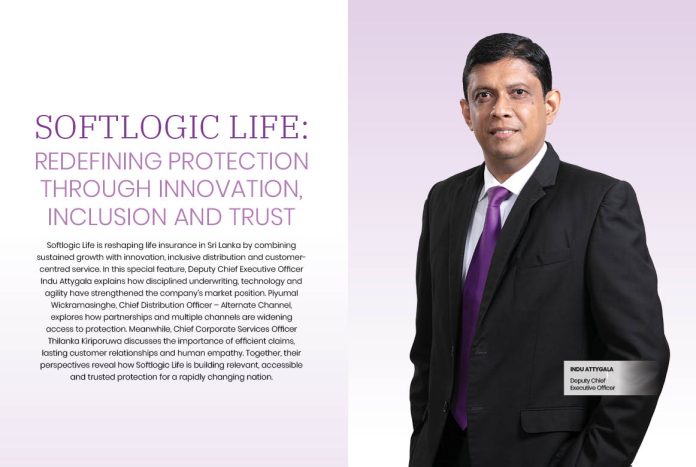
Softlogic Life is reshaping life insurance in Sri Lanka by combining sustained growth with innovation, inclusive distribution and customer-centred service. In this special feature, Deputy Chief Executive Officer Indu Attygala explains how disciplined underwriting, technology and agility have strengthened the company’s market position. Piyumal Wickramasinghe, Chief Distribution Officer – Alternate Channel, explores how partnerships and multiple channels are widening access to protection. Meanwhile, Chief Corporate Services Officer Thilanka Kiriporuwa discusses the importance of efficient claims, lasting customer relationships and human empathy. Together, their perspectives reveal how Softlogic Life is building relevant, accessible and trusted protection for a rapidly changing nation.
Indu is an experienced insurance professional with over 30 years of industry experience across Sri Lanka and Indonesia. He began his career in 1993 in Fire Insurance underwriting and has held senior roles in general and life insurance, specialising in sales, agency development, and distribution. He joined Softlogic Life as General Manager – Business Development in 2017. He holds an MBA from the University of Northampton, UK, along with several international insurance and agency management qualifications.
Q: Softlogic Life has emerged as one of Sri Lanka’s leading life insurers, reaching Rs. 40 billion in Gross Written Premium while delivering strong profitability. What has enabled the company to sustain this growth, and what do you believe genuinely differentiates Softlogic Life in an intensely competitive market?
I think our growth makes more sense when you look at it over a longer period rather than through any single year’s performance. We have grown GWP from around Rs. 20 billion in 2021 to over Rs. 40 billion in 2025. That did not happen because of one product, one channel or one particularly good year. It came from consistently making the right choices around customers, distribution, technology and the quality of the business we write.
A big part of that is our willingness to question how insurance has traditionally been done. We have always believed insurance needs to be simpler, more accessible and more relevant to people’s lives. That thinking influences everything from how we design products to how quickly we settle claims and how we use technology.
But innovation alone is not enough. You need the fundamentals behind it. We have built a diversified distribution model, maintained disciplined underwriting and invested heavily in our people and technology. That has allowed us to grow while remaining financially strong.
What differentiates Softlogic Life, in my view, is the combination of scale and agility. As we have become larger, we have worked hard not to lose the ability to move quickly, experiment and respond to customers. Ultimately, our growth has to translate into something meaningful for the customer. We now cover 1.8 million Sri Lankan lives and paid Rs. 19.4 billion in claims and benefits during 2025. Those numbers matter because they show that as the business grows, the protection we provide grows with it.
Q: Softlogic Life has built its identity around innovation, simplicity and challenging conventional approaches to insurance. How has this philosophy changed the way the company designs protection, engages customers and delivers the insurance experience, and where do you see the next major opportunity for disruption?
For us, challenging the traditional model starts with a very simple question, which is, why should insurance be difficult for the customer?
Historically, insurance has often been associated with complicated products, paperwork, long processes and conversations people would rather postpone. We have tried to approach it from the opposite direction. Start with a real customer need, remove unnecessary complexity and then use technology where it genuinely makes the experience better.
Claims are a good example. That is the moment when the promise of insurance becomes real. Today, 90% of our claims are settled within one day, supported by AI-driven technology. The important point is not that we use AI. The important point is that a customer who may be dealing with an illness or hospitalisation can receive money faster and with less friction.
We are applying the same thinking to underwriting, digital engagement and health protection. Increasingly, we want the relationship with a customer to move beyond paying a premium and making a claim. Insurance can play a much more active role in helping people understand risk, manage their health and prepare financially for different stages of life.
I believe healthcare is where one of the biggest opportunities lies. Sri Lankans are living longer, medical costs are rising and people’s protection needs are changing. The traditional idea that health insurance should simply cover an event within a defined period needs to evolve.
The next disruption will therefore be creating protection that stays relevant throughout a person’s life and using technology to make that protection easier to access, understand and use.
Q: Sri Lankan consumers are changing rapidly, with greater expectations around health, technology, convenience and financial security. How is Softlogic Life preparing for these changing needs, and what will define the company’s next phase of growth and leadership?
The customer we are serving today is very different from the customer the insurance industry was built around 20 years ago. People expect things to happen faster. They want greater transparency and control. They are also thinking differently about health, longevity and financial security.
One major priority for us is health protection. As people live longer and healthcare becomes more expensive, customers need solutions that remain meaningful throughout their lives. We see an opportunity for insurance to move from simply responding when something goes wrong towards helping customers manage health and financial risk much earlier.
Technology will be another important part of that journey. We are already using AI and automation across underwriting and claims, but the objective is not to remove people from insurance. It is to remove friction. If technology can eliminate paperwork, make a decision faster or give an adviser better information, it allows our people to spend more time on the conversations where human judgement and empathy actually matter.
Scale also creates new opportunities. The acquisition of Allianz Life Insurance Lanka has expanded our reach, while the long-term investment from Norfund and OP Finnfund strengthens our capacity to invest and grow.
But I would not define the next chapter purely by size. Leadership is ultimately about relevance. If we can anticipate what Sri Lankan families will need five or ten years from now and start building those solutions today, then growth will follow. That is the kind of leadership we want Softlogic Life to represent.

Piyumal is an accomplished insurance professional with extensive experience in life and general insurance. He joined Softlogic Life in 2014 as Chief Manager of Motor Insurance and played a key role in implementing the award-winning Click2Claim initiative. Since 2016, he has held senior roles in Life Operations and currently heads Alternate Distribution, overseeing Bancassurance, Direct, Affinity, and Online channels. He holds an MBA from Cardiff Metropolitan University and a BA (Hons) in Business Management from Middlesex University.
Q: Softlogic Life has built a diversified distribution model that extends beyond the traditional agency channel into bancassurance, direct, affinity, online and micro insurance. How has this multi-channel approach strengthened the company’s ability to reach different customer segments, particularly those historically underserved by life insurance?
There is no single way in which Sri Lankans want to buy insurance, and that is why having multiple distribution channels matters. For one customer, the most natural conversation may happen with an insurance adviser. Another may first encounter insurance through a bank. Someone else may prefer to begin the journey online, while a customer in an underserved community may need a much simpler and more affordable protection solution delivered through a completely different partnership.
Our approach has been to meet customers where they already are rather than expecting everyone to come to insurance in the same way.
Bancassurance gives us access to customers who already have an established financial relationship. Affinity partnerships allow us to build protection around particular communities or customer needs. Direct and digital channels make it easier for customers who value convenience and speed. Microinsurance is particularly important because it helps us address affordability and accessibility for segments that conventional insurance models have historically struggled to reach.
The real strength, however, comes from connecting these channels rather than operating them as separate businesses. A customer may discover a solution digitally but still want to speak to someone before making a long-term financial decision. Another may begin through a partner and later engage directly with us. We need to make those transitions simple.
Sri Lanka still has a significant protection gap. Closing it will require the industry to move beyond a one-size-fits-all approach to distribution. Our responsibility is to make protection available through the channels people trust, at price points they can manage and in a form they can understand. That is how distribution can genuinely contribute to greater insurance inclusion.
Q: As customers increasingly expect insurance to be available wherever and whenever they need it, how is Softlogic Life combining partnerships, digital channels and human advice to create the next generation of insurance distribution?
I don’t believe the future is digital versus human. The winning model will combine both. Technology is extremely good at removing friction. A customer should be able to obtain information, complete straightforward processes, make payments and access services without unnecessary delays. Digital platforms also allow us to reach customers who may never walk into a branch or actively seek out an insurance adviser.
But life insurance is different from many products people buy online. You are asking someone to think about their health, family, income and what happens when life does not go according to plan. Those decisions often benefit from a knowledgeable person who can listen, understand the circumstances and provide appropriate advice.
That is why we see technology as something that makes advisers and partners better, rather than something designed simply to replace them.
The other major opportunity is partnerships. Insurance does not always need to begin with an insurance conversation. Banks, digital ecosystems, employers, affinity groups and other trusted platforms already have relationships with millions of Sri Lankans. By working with the right partners, we can introduce protection naturally at relevant points in people’s lives.
Data will make this model even stronger. Used responsibly, it can help us understand customer needs better, identify protection gaps and make the engagement more relevant rather than constantly offering everybody the same product.
The next generation of distribution will therefore be much more connected. Customers may move between digital, partner and human channels without really thinking about which “channel” they are using. Our job is to make that journey seamless while ensuring that good advice and trust remain at its centre.

Chief Corporate Services Officer
Thilanka is a versatile corporate services professional with over 15 years of experience spanning Micro Insurance, Human Resources, Customer Service, Logistics, Administration, Facilities Management, Retail, and General Operations. He holds a Master’s in Business Studies from the University of Colombo, LLB Hons (UK) , is a CIM (UK) qualified member, and holds diplomas in Human Resources and Information Technology. He currently oversees Micro Insurance Channel & key Corporate Services functions, including Customer Service, Administration, Purchasing, Facilities Management, Investigations, Loyalty, and CRM Operations.
Q: Insurance is ultimately judged not when a policy is sold, but through every interaction that follows. How is Softlogic Life differentiating itself through customer service, retention, loyalty and claims-related experiences to build relationships that extend throughout a customer’s life?
The true test of an insurance company begins after a policy is sold. Customers may not interact with their insurer every day, but when they do, the interaction is often significant. They may be seeking clarification, updating a policy, entering hospital or making a claim during one of the most difficult periods in their lives. How we respond in those moments determines whether we earn their trust for the next 20 years and beyond. Claims are therefore central to the customer experience at Softlogic Life. In 2025, we paid Rs. 19.4 billion in claims and benefits, including Rs. 13.2 billion in health and protection claims, while settling 90% of claims within one day. Speed matters because customers facing a medical emergency or difficult family circumstances should not also have to worry about repeatedly following up with their insurer.
However, customer experience cannot begin and end with claims. Our objective is to build relationships that evolve with our customers throughout their lives. This requires us to make servicing simpler, communicate clearly, understand how customers’ circumstances and protection needs change, and remain relevant even when they are not making a claim.
Retention and loyalty are not created by a single programme or interaction. They are earned through consistent delivery: being accessible, explaining matters clearly, resolving issues efficiently and, above all, keeping our promises. These fundamentals may appear simple, but delivering them consistently across every customer touchpoint is what differentiates a trusted insurer.
Being named Service Brand of the Year 2025 was meaningful recognition of our efforts. Nevertheless, service is not an award that allows an organisation to consider its work complete. Customer expectations continue to evolve, and we must continue to evolve with them. Our ambition is straightforward: every interaction with Softlogic Life should reinforce the customer’s confidence in choosing us. When that confidence is strengthened consistently over time, retention and loyalty become the natural outcomes of trust.
Q: As insurance becomes increasingly digital and automated, how does Softlogic Life use technology to create speed and simplicity while preserving the empathy, personal attention and trust customers expect from a life insurer?
Technology should make insurance feel more human, not less. Much of what frustrates customers about financial services arises from inefficient processes rather than from people—repeatedly providing the same information, waiting for approvals, submitting unnecessary documents or being uncertain about the status of a request. By removing these points of friction, technology enables our people to devote more time and attention to customers.
Our use of AI and automation in claims illustrates this approach. These capabilities help us assess and process claims significantly faster, contributing to 90% of claims being settled within one day. However, behind every claim is a person who may be in hospital, recovering from an illness or supporting a family through a difficult period. Technology provides speed and consistency; our people provide reassurance, clarity and empathy. We apply the same principle across customer servicing. Routine transactions should be simple, convenient and increasingly digital because that is what customers rightly expect. At the same time, when a customer has a complex question, requires advice or is facing a sensitive situation, timely access to a knowledgeable person remains essential.
The strategic challenge is not simply deciding how much to automate, but determining where automation creates genuine value and where human engagement matters most. We should use technology when it reduces customer effort, improves accuracy, shortens response times or provides greater transparency. Human interaction should be focused on the moments where judgement, advice and empathy make the greatest difference.
Trust in life insurance is built over decades. Technology can help us fulfil our promises faster and more consistently, but trust itself remains fundamentally human. Our aim is to combine digital efficiency with personal attention so that customers experience both the convenience they expect and the care they deserve.
