
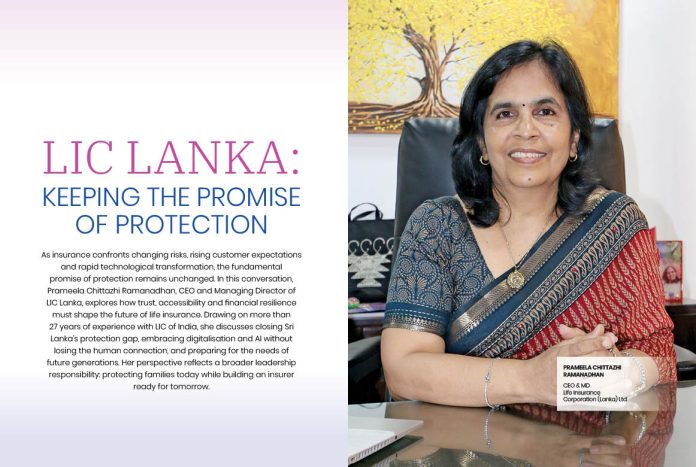
As insurance confronts changing risks, rising customer expectations and rapid technological transformation, the fundamental promise of protection remains unchanged. In this conversation, Prameela Chittazhi Ramanadhan, CEO and Managing Director of LIC Lanka, explores how trust, accessibility and financial resilience must shape the future of life insurance. Drawing on more than 27 years of experience with LIC of India, she discusses closing Sri Lanka’s protection gap, embracing digitalisation and AI without losing the human connection, and preparing for the needs of future generations. Her perspective reflects a broader leadership responsibility: protecting families today while building an insurer ready for tomorrow.
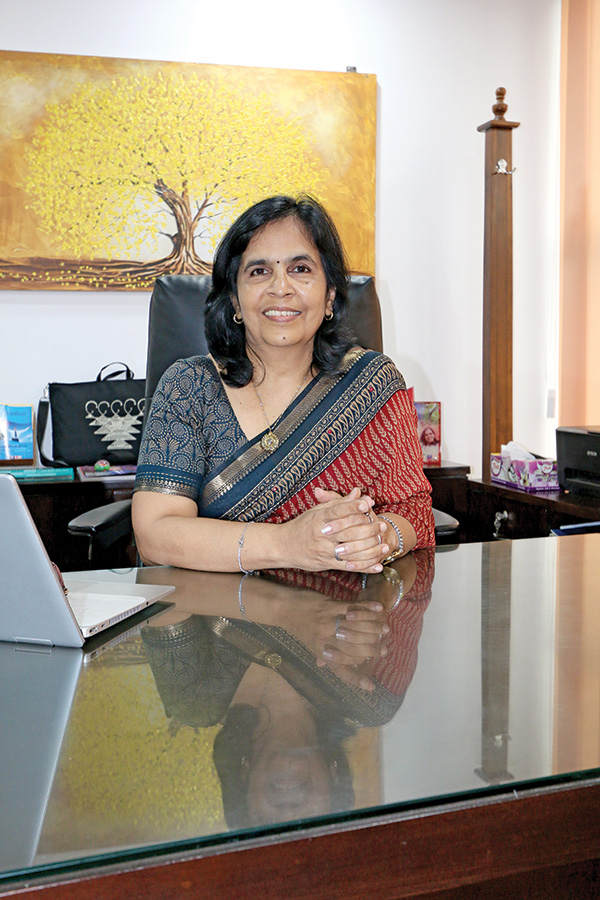
Prameela Chittazhi Ramanadhan was appointed CEO and Managing Director of LIC (Lanka) Ltd in February 2025, bringing over 27 years of experience with LIC of India. A Law graduate, MBA holder, and Fellow of the Insurance Institute of India, she specialises in life insurance marketing, operations, and distribution. Her leadership focuses on organisational transformation, financial inclusion, governance, leadership development, and sustainable business growth.
1. The Leadership Responsibility Behind Protection
Q: Life insurance is ultimately a promise to protect families when they are most vulnerable. How does LIC Lanka translate that responsibility into its strategy, and what do you believe distinguishes the company in the way it builds trust and long term security for Sri Lankan families?
Yes, life insurance is a promise — and promises are meant to be honoured. That is a huge responsibility, not only to our customers and their families, but to the nation as well.
At Life Insurance Corporation (Lanka) Ltd., or LIC Lanka as we are known, we believe deeply in fulfilling those promises. For the past 24 years, we have been doing so, quietly and consistently.
For me, some of the most satisfying moments are the real moments of truth — when a bereaved family receives the claim cheque promptly or seeing policyholders who have faithfully paid their premiums for 15 or 20 years and then receiving their maturity benefits.
It is this trust and confidence that our policyholders have placed in us that has kept LIC Lanka going through the years. We are also proud that, based on the industry figures published by the Insurance Regulatory Commission of Sri Lanka, we have maintained the highest claim settlement ratio in value. For us, that is not just a number; it is a reflection of our commitment to honouring the promises we make.
As we look ahead, our responsibility is to carry that trust forward — by becoming more accessible, more customer-focused and more responsive to the changing needs of Sri Lankan families. Our ambition is not simply to grow as a company, but to remain an organisation that families can confidently depend on, today and for generations to come.
2. Turning Global Strength into Local Protection
Q: LIC Lanka draws on the heritage, experience and scale of LIC of India while serving the specific needs of Sri Lankan customers. How does this combination of international strength and local understanding enable LIC Lanka to provide greater confidence, resilience and value to its policyholders?
Sri Lanka and India are, in many ways, similar in their life insurance needs and market dynamics. India, however, has moved ahead at a much faster pace in digitalisation, product innovation and insurance penetration, providing valuable learnings and a reference point as Sri Lanka scales up the industry.
At LIC Lanka, we draw strength from the extraordinary heritage and scale of Life Insurance Corporation of India — 70 Years of Trust and Service, 260 Million individual policies in force, over 5,000 offices and total assets exceeding $ 600 billion USD. We combine that global-scale experience with a deep understanding of Sri Lankan families and their needs. This gives us the confidence to innovate, the resilience to withstand uncertainty and, most importantly, the credibility to honour our promises.
3. Transforming Insurance Without Losing the Human Connection
Q: Digitalisation, AI and changing customer expectations are transforming life insurance. How is LIC Lanka using technology to make protection simpler, faster and more accessible while preserving the personal relationships, empathy and trust that remain essential when protecting what matters most?
Digitalisation and AI are rapidly transforming the insurance industry. At LIC Lanka, we believe that Simplicity, Speed and Scale will increasingly define how effectively we serve our customers and grow our business.
AI is no longer something for the future; it has become part of everyday life. It is reshaping the way we underwrite, service policies, engage with customers and support our sales teams through lead management and sales assistance.
However, life insurance is fundamentally a people business, built on long-term relationships, empathy and trust. Technology should strengthen these relationships, not replace them. The human in the loop will therefore remain an integral part of our technology journey.
At LIC Lanka, we are consciously pursuing a model of Human–AI collaboration, where technology makes protection simpler, faster and more accessible, while our people continue to provide the empathy, understanding and personal connection that customers value.
Our digital transformation will be future-ready, but equally responsible. We are mindful of the guardrails around data privacy, cybersecurity, governance and customer protection as we build the next generation of LIC Lanka.
4. Reaching Those Who Remain Unprotected
Q: Many Sri Lankan families still face significant protection gaps, particularly around income security, health, retirement and unexpected life events. How is LIC Lanka working to broaden insurance awareness and accessibility, and what more must the industry do to bring meaningful protection to underserved communities?
The protection gap is a significant concern for the nation and for policymakers as well. When adequate insurance protection is not available, the financial burden of unexpected events — whether loss of life, health emergencies, property damage or other unforeseen circumstances — ultimately falls on families and, in many situations, on the Government. That is why I believe insurance for all is not a luxury; it is a national necessity.
It is encouraging to see the Insurance Regulatory Commission of Sri Lanka (IRCSL) taking proactive steps to improve insurance awareness and penetration across the country. The Regulator stepping out of its traditional role and taking the message of the importance of insurance to every nook and corner of the country through awareness campaigns is, in my view, quite remarkable. It speaks volumes about the importance being given to building an insurance-conscious nation. The industry has also come together in this pioneering effort, because this is one area where we should compete in business but collaborate for the greater good.
I also strongly believe that insurance literacy should begin early. Introducing the basic principles of insurance and financial protection into the school curriculum can help mould a financially responsible next generation. We should also see much more innovation in areas such as affordable health protection and retirement and pension solutions, because these are going to become increasingly important as the needs of our society evolve.
One concern I see is the relatively short-term appetite of many insurance seekers. Life insurance is designed for life and should not be viewed merely as another short-term savings or investment instrument. My personal view is that whole-life protection should be the starting point of any sound financial plan. Once that basic protection is secured, individuals can look at other savings and investment products to meet their different capital needs. But protection of the economic value of one’s life should be non-negotiable.
There is also a paradox about buying life insurance. You should buy it when you feel you need it the least. Life insurance is much like a seat belt or an airbag in a car. We rarely think about that when everything is going well. But the moment we actually need them, it may be too late to put them in place. That is why I always advocate buying protection when you are young and healthy, when the cost is generally more affordable.
At LIC Lanka, we try to translate this philosophy into products that address both immediate financial needs and long-term protection. LIC’s Jeevan Ananda is a good example. It provides lifetime protection, while allowing the policyholder to choose a shorter premium-paying period and receive a maturity payout at the end of the selected term. Importantly, the life cover continues beyond the maturity date, providing a layer of protection for the rest of the policyholder’s life.
5. Protecting What Will Matter Tomorrow
Q: The risks and financial pressures facing families are changing rapidly. Looking towards the next decade, what new protection needs do you believe will become most important, and how is LIC Lanka preparing today to remain relevant, resilient and trusted in protecting future generations?
The rapid change in the nature and impact of risks is, in many ways, quite alarming. But I also believe that volatility creates an opportunity for the insurance industry to rethink, innovate and prepare for risks that may not have existed in the same form before.
We are entering an increasingly unpredictable world. Rising geopolitical tensions, changing equations between nations and economic uncertainties are creating new dimensions of risk. At the same time, we have to brace ourselves for the growing impact of climate change, environmental hazards and other unforeseen events. The question for insurers is no longer simply how we respond to yesterday’s risks, but how we anticipate tomorrow’s risks.
In my view, Insurance for All as being championed by IRCSL must remain a priority until it becomes a reality. Looking ahead through a Life Insurer’s lens, health insurance and retirement and pension solutions are two areas where I expect to see significant traction and innovation. As people live longer, healthcare costs increase and traditional family structures evolve. Financial security after retirement and protection against health-related expenses will become increasingly important.
Another factor that will shape the next decade is how Gen Z and Gen Alpha perceive insurance. Their expectations of simplicity, transparency, speed and digital accessibility are very different. The industry will have to change the way it communicates with them. We cannot expect the next generation to understand insurance through the same language and processes that worked for previous generations.
At LIC Lanka, we are preparing for this change by making technology, product innovation and a young, future-ready workforce some of our key priorities. We want technology to make insurance more accessible and convenient, while innovation enables us to respond to changing customer needs. At the same time, we need young talent who understand both the new world and the fundamental values on which insurance has always been built.
As LIC Lanka enters its 25th year, we carry with us something that cannot be created overnight — the trust of Sri Lankan families built over more than two decades. That trust is our strongest asset, but it also comes with a responsibility. We have to earn it again with every generation.
Ultimately, insurance is about managing uncertainty. And therefore, remaining relevant, resilient and resurgent is not something outside insurance — it is coded into the very nature of our business. Our responsibility is to anticipate change, embrace it and continue to be there when future generations need us most.
I am deeply grateful to our customers who have placed their trust in us and walked with us throughout these 24 years. That trust is not something we take for granted—it is a responsibility we carry forward. As we enter the next chapter, our commitment is to earn that trust every day through better service, greater care and meaningful value.
