
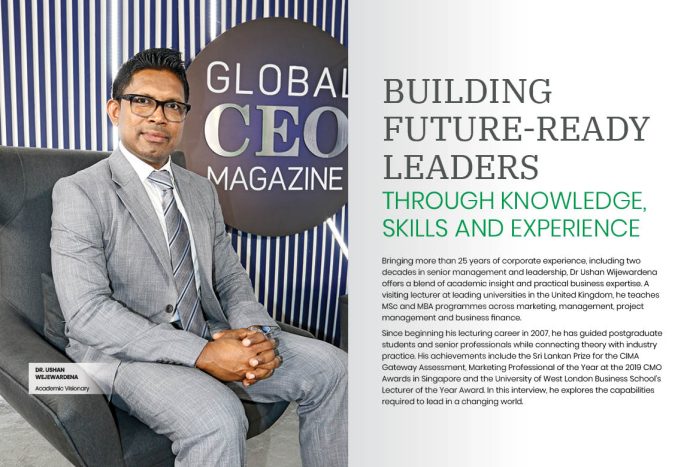
Bringing more than 25 years of corporate experience, including two decades in senior management and leadership, Dr Ushan Wijewardena offers a blend of academic insight and practical business expertise. A visiting lecturer at leading universities in the United Kingdom, he teaches MSc and MBA programmes across marketing, management, project management and business finance.
Since beginning his lecturing career in 2007, he has guided postgraduate students and senior professionals while connecting theory with industry practice. His achievements include the Sri Lankan Prize for the CIMA Gateway Assessment, Marketing Professional of the Year at the 2019 CMO Awards in Singapore and the University of West London Business School’s Lecturer of the Year Award. In this interview, he explores the capabilities required to lead in a changing world.
Dr Ushan Wijewardena is a visiting lecturer at universities across the United Kingdom, teaching MSc and MBA programmes. He brings more than 25 years of corporate experience and extensive expertise in marketing, management, finance and leadership, combining academic knowledge with practical insight to prepare students and professionals for sustainable success.
Q: Having worked in senior corporate roles before moving more deeply into academia and consultancy, how has your business experience shaped the way you teach management and prepare students for leadership?
I have worked in the corporate sector for more than 25 years. Lecturing was never initially intended to become my full-time career. I regarded it as an opportunity to share my knowledge and experience with students who would eventually become the next generation of business leaders.
My journey into lecturing began after I completed my marketing degree and the Chartered Institute of Marketing qualification in the United Kingdom. To maintain my Chartered Marketer status, I had to complete a required number of Continuing Professional Development hours. At the time, I received several invitations to teach marketing, and that was how my lecturing career began.
While lecturing, I continued to work in senior management positions across several corporate organisations in Sri Lanka. Initially, I found teaching enjoyable, but I soon realised that it also gave me an important opportunity to nurture future leaders.
The ability to combine practical corporate experience with theoretical knowledge has made a considerable difference to my teaching. I do not simply see the individuals in my classroom as students; I see them as the future leaders of the business world. Therefore, I try to give them an understanding of how management theories operate in real organisations and how decisions affect employees, customers and businesses.
When I moved to the United Kingdom, I continued my academic career as a visiting lecturer, working across several universities. The experience I gained in Sri Lanka, together with my exposure to multinational organisations and international business environments, has been extremely valuable.
Today, I teach students from different countries, cultures and continents, primarily at postgraduate level through MSc and MBA programmes. It has been a rewarding journey. One of the most meaningful contributions an experienced professional can make is to share knowledge and experience with the next generation.
Q: Business education is being transformed by artificial intelligence, digitisation and rapidly changing workplace expectations. What should universities and business schools do differently to develop graduates who will remain relevant in the decades ahead?
A few decades ago, artificial intelligence was not even part of our everyday vocabulary. Education and business depended primarily on human intelligence. Today, however, AI has become influential in education, professional practice and almost every aspect of life.
We cannot exclude AI from business or education. Universities and business schools must update their curricula to incorporate artificial intelligence and prepare students to use it effectively. Nevertheless, I always advise students to give priority to human intelligence and use AI as a supporting tool.
Students must not allow technology to replace independent thought, creativity, judgement or personal responsibility. AI can assist with research, analysis and the development of ideas, but students must still understand the subject, evaluate information critically and produce work that reflects their own intellectual abilities.
This has become particularly important because many university programmes now rely heavily on assignments rather than traditional examinations. Although this approach encourages research and independent learning, it can also create opportunities for students to misuse technology.
Educational institutions are introducing policies and limitations governing the use of AI. Universities must also continue to address plagiarism and other forms of academic misconduct. These concerns are not limited to students or to one country; they have become global challenges affecting the wider academic community.
AI has enormous potential, but it must be used responsibly and within clearly understood boundaries. My advice to students is simple: place your human intelligence above artificial intelligence. Use AI to support and strengthen your capabilities, but never allow it to replace your own learning, judgement and originality.
Academic authority does not mean preventing students from using new technologies rather it means establishing clear expectations about what students are required to demonstrate If a degree is intended to demonstrate knowledge, analytical ability and independent judgement, assessment must be designed in a way that can genuinely measure those capabilities. Universities should therefore reconsider assessment methods that rely excessively on unsupervised takehome written assignments and introduce a broader combination of case studies presentations practical projects discussions examinations and oral or viva style assessments where appropriate.
Q: You have extensive experience in marketing, brand management and sales. In an environment where consumers are increasingly informed and digitally connected, what separates brands that merely compete from those that build lasting trust and loyalty?
Marketing theory consistently emphasises the importance of serving the customer. Organisations must therefore build genuinely customer-centric business models and long-term customer loyalty programmes.
Businesses can use digital marketing, brand management techniques and other modern tools, but their success ultimately depends on how effectively those ideas are implemented. Theories and strategies have little value unless they are translated into meaningful customer experiences.
Throughout my career, I have worked in brand management and held senior roles in marketing and general management across different industries. The most important lesson I have learnt is that every organisational activity must ultimately focus on the customer.
The same principle applies to education. As a lecturer, my primary focus is the student.
Universities and business schools must understand their students’ needs and prepare them for the realities of the future. Student satisfaction should not mean simply making education easier. It should mean providing students with the knowledge, capabilities and confidence required to succeed.
Successful brands place customers at the centre of their decision-making. They design products, services, communication and experiences around the customer’s needs. Lasting trust is created when an organisation consistently delivers what it promises and demonstrates that it understands and values the people it serves.
Technology may change the way organisations interact with customers, but the fundamental principle remains the same: understand your customer, serve your customer and build every offering around creating genuine value for that customer.
Q: Having taught and worked in both Sri Lanka and the United Kingdom, what differences have you observed in management education? What lessons could Sri Lanka adopt to strengthen the connection between academia and industry?
I do not see a major difference between the foundations of the Sri Lankan and British education systems. I completed much of my education in Sri Lanka, although many of my qualifications were awarded by British institutions. We now operate within an increasingly global educational environment.
The important difference is often not the content of the curriculum but the way lectures are delivered, the teaching techniques employed and the opportunities students receive to apply their knowledge in practical situations.
In these areas, the United Kingdom may have an advantage because its education system generally offers greater practical exposure and encourages more active student engagement. However, having taught students from Europe, the Americas, Africa and Asia, I believe that Sri Lanka’s education system compares favourably with many systems around the world.
Sri Lanka needs further improvement in areas such as digitisation and practical engagement. Educational institutions should create stronger connections with industry and give students more opportunities to work on genuine business problems, case studies and professional projects.
Sri Lankan students seeking international education must also focus on developing their wider capabilities. Academic qualifications alone are not sufficient. Students need effective communication and presentation skills, language proficiency, confidence and a strong professional personality.
Some students may regard an overseas qualification primarily as a pathway towards settling in another country. While that may be part of their long-term plan, education must remain their immediate priority. They should obtain the greatest possible value from their lecturers, universities and available facilities.
A qualification should represent genuine learning and personal development, rather than simply serving as an entry requirement for another objective. Sri Lankan students have access to strong educational foundations. Their responsibility is to develop the skills required to use those foundations successfully in a global environment.
Q: Looking at the next generation of managers and entrepreneurs, what qualities do they need beyond academic qualifications to become effective leaders in an uncertain, technology-driven and globally connected business environment?
Leadership must begin within the individual. There is a familiar belief that leaders are not simply born; they can also be developed. People should not assume that they cannot become leaders because they currently lack certain skills. We all possess the potential for leadership, but we must consciously develop it.
The first requirement is self-awareness. Individuals must identify the areas in which they need to improve and take responsibility for their own development. They should not leave that responsibility entirely to lecturers, parents, employers or managers. Personal development must begin with the individual, and it should begin today.
Future leaders need confidence, communication skills, adaptability, discipline and the willingness to continue learning. They must also combine academic knowledge with practical experience and extracurricular involvement.
My own journey has demonstrated the value of maintaining that balance. During my school years, I served as head prefect and school captain and received several awards. In my corporate career, I received recognition in marketing and for successful campaigns. I was also awarded the Sri Lankan Prize for the CIMA Gateway Assessment. More recently, I received a Lecturer of the Year award from a university in the United Kingdom.
Awards should not become the sole purpose of a person’s journey. Nevertheless, recognition can provide encouragement and motivate an individual to continue improving and contributing at a higher level.
My advice to students, managers and aspiring entrepreneurs is to aim for excellence. Whether you are at school, completing an undergraduate degree or pursuing an MSc or MBA, do not settle for mediocrity. Set ambitious goals and work consistently towards them.
As the saying goes, shoot for the stars. Even if you do not reach the highest point immediately, you will move far beyond where you began. The most important step is to take responsibility for your development, strengthen your skills and begin that journey today. It is never too late to start.
Key Takeaways
1. Human intelligence must lead technology:
AI should support learning, creativity and decision-making rather than replace independent thinking and personal judgement.
2. Education must connect theory with practice:
Universities should strengthen industry engagement, practical learning and the development of communication, presentation and employability skills.
3. Leadership begins with self-development:
Aspiring leaders must cultivate confidence, adaptability, discipline and lifelong learning while taking personal responsibility for their progress.
