
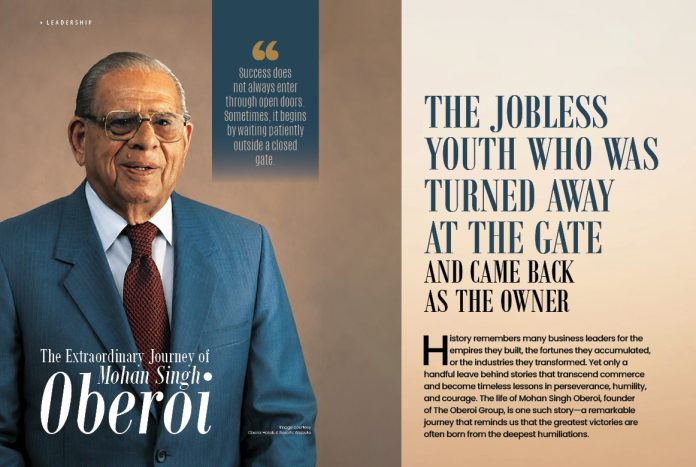
History remembers many business leaders for the empires they built, the fortunes they accumulated, or the industries they transformed. Yet only a handful leave behind stories that transcend commerce and become timeless lessons in perseverance, humility, and courage. The life of Mohan Singh Oberoi, founder of The Oberoi Group, is one such story—a remarkable journey that reminds us that the greatest victories are often born from the deepest humiliations.
It is difficult to imagine that the creator of one of the world’s most prestigious luxury hotel chains was once a young man who could not even cross the threshold of a hotel.
The year was the early 1920s. India was still under British rule. Opportunities were scarce, and poverty was an everyday reality for millions. Mohan Singh Oberoi had already endured hardships that would have discouraged many. His father had died when he was only a few months old, leaving his widowed mother to raise him under extremely difficult circumstances. Life taught him resilience long before it offered him opportunity.
As a young man, Oberoi found employment in a shoe factory. It was modest work, but it provided stability for his growing family. However, fate intervened once again when the factory closed, leaving him unemployed. With a wife, Ishran Devi, and a newborn daughter depending on him, despair would have been understandable. Instead, he chose hope.
Believing that a new beginning awaited him in Shimla, then one of British India’s most important hill stations, he travelled there in search of work. His destination was the prestigious Cecil Hotel, one of the finest hotels in the country.
What happened next would shape the course of his life
As the twenty-three-year-old approached the entrance, the gatekeeper looked at his simple clothes and modest appearance and refused to let him enter. In the world of luxury hospitality, appearances mattered, and the young man standing outside simply did not seem to belong.
Many people would have accepted the rejection and quietly walked away Oberoi did not.
Rather than arguing or surrendering, he waited patiently outside the hotel until the manager appeared. When the opportunity finally presented itself, he politely introduced himself and asked for employment. His confidence, sincerity, and command of English impressed the manager sufficiently to offer him a junior position the very next day.
That moment changed everything
The Cecil Hotel became far more than a workplace. It became his university.
While others completed routine tasks, Oberoi observed everything around him with extraordinary curiosity. He watched how distinguished guests were welcomed, how staff anticipated customer needs, how luxury experiences were created, and, perhaps most importantly, how a successful hotel generated profits.
He understood something that many employees never do: every organisation is an open classroom for those willing to learn beyond their job description.
His exceptional work ethic soon distinguished him from his colleagues. Rather than merely following established procedures, he constantly searched for ways to improve efficiency. One of his earliest innovations involved using coal dust more effectively to fuel hotel boilers, significantly reducing operating costs. It was a seemingly simple idea, yet it demonstrated an ability to think strategically rather than merely operationally.
Senior management quickly recognised his talent
Promotion followed promotion as his responsibilities expanded beyond administration into broader aspects of hotel management. Every new role deepened his understanding of finance, operations, customer service, procurement, marketing, and human resource management. Long before business schools popularised case studies on leadership, Mohan Singh Oberoi was living one every day.
Then came the defining decision that separated an ambitious employee from an entrepreneur
During the difficult years of the Great Depression, the historic Clarkes Hotel in Shimla became available for purchase. It was an extraordinary opportunity—but one far beyond Oberoi’s financial means.
Most people saw impossible debt
Oberoi saw possibility.
His wife displayed extraordinary faith in his vision by selling her jewellery to help finance the purchase. The remaining funds were borrowed, placing the young entrepreneur under enormous financial pressure.
Failure would have meant losing everything
Success required unwavering discipline.
The couple lived modestly, sacrificing personal comforts while every available rupee was reinvested into improving the hotel and strengthening the business. Oberoi understood that lasting wealth is rarely built through lavish spending but through disciplined reinvestment and patient growth.
Remarkably, the debt was repaid within just two years
That achievement became the cornerstone upon which an entire hospitality empire would rise.
Over the following decades, Oberoi steadily expanded his business, acquiring hotels, introducing higher standards of service, investing in employee development, and embracing international best practices while preserving the warmth of Indian hospitality. He believed that luxury was not defined solely by magnificent buildings or expensive furnishings but by genuine care, attention to detail, and an unwavering commitment to exceeding guest expectations.
His philosophy transformed The Oberoi Group into one of the world’s most respected hospitality brands, earning international recognition for service excellence and timeless elegance.
Yet perhaps the most poetic chapter of his life remained to be written.
Years after being denied entry into the Cecil Hotel because of his appearance, Mohan Singh Oberoi acquired the company that owned the hotel.
The young man once stopped at its gates had become its owner
There was no public celebration of revenge, no bitterness, and no triumphal declaration. Instead, there was quiet dignity—a reminder that success is most powerful when it speaks for itself.
His story carries lessons that extend far beyond business. It teaches us that rejection is not a verdict but an invitation to persevere. It reminds us that appearances reveal little about a person’s potential. It demonstrates that education is not confined to classrooms but can be found wherever curiosity exists. Above all, it shows that extraordinary achievements are built through patience, continuous learning, calculated risk-taking, resilience, and uncompromising integrity.
Today, The Oberoi Group stands among the world’s finest luxury hospitality companies, welcoming discerning travellers from across the globe. Behind every elegant suite, every impeccable service experience, and every symbol of excellence lies the quiet determination of one man who refused to let a closed gate determine his destiny.
Beyond his remarkable achievements in business, Mohan Singh Oberoi also believed that successful entrepreneurs had a responsibility to contribute to national development. Having earned the respect of industry and government alike, he entered public life and served as a Member of the Rajya Sabha, India’s Upper House of Parliament, for two terms. He was also elected to the Lok Sabha from Hazaribagh as a candidate of the Jharkhand Party, serving between 1968 and 1971.
Recognition followed naturally. During British rule, he was awarded the title Rai Bahadur in 1943 in recognition of his contributions to the hospitality sector. Decades later, independent India honoured him with the Padma Bhushan, one of the country’s highest civilian awards, in 2001, acknowledging the extraordinary role he had played in placing Indian hospitality on the global stage.
On 3 May 2002, Mohan Singh Oberoi passed away in New Delhi at the age of 103, bringing to a close more than a century of an extraordinary life. Tributes poured in from business leaders, politicians, and hospitality professionals across the globe. He was remembered not merely as the founder of a celebrated hotel chain, but as the visionary who transformed India’s hospitality industry into a global benchmark for luxury and service. His son, Prithvi Raj Singh Oberoi, succeeded him as Chairman of The Oberoi Group, carrying forward the values of excellence, integrity, and uncompromising quality that had become the hallmark of the Oberoi name.
References
The Oberoi Group. (n.d.). About our founder: Rai Bahadur Mohan Singh Oberoi. Retrieved July 7, 2026, from The Oberoi Group – About Our Founder
Encyclopaedia Britannica. (n.d.). Mohan Singh Oberoi. Retrieved July 7, 2026, from https://www.britannica.com/biography/Mohan-Singh-Oberoi
Lewis, P. (2002, May 4). Mohan Singh Oberoi, 103, a pioneer in luxury hotels. The New York Times. Retrieved from https://www.nytimes.com/2002/05/04/business/mohan-singh-oberoi-103-a-pioneer-in-luxury-hotels.html
Saxena, N. (2002, May 3). Noted hotelier M. S. Oberoi passes away. The Times of India. Retrieved from The Times of India – Noted hotelier M. S. Oberoi passes away
Wikipedia contributors. (n.d.). Mohan Singh Oberoi. In Wikipedia. Retrieved July 7, 2026, from https://en.wikipedia.org/wiki/Mohan_Singh_Oberoi
