
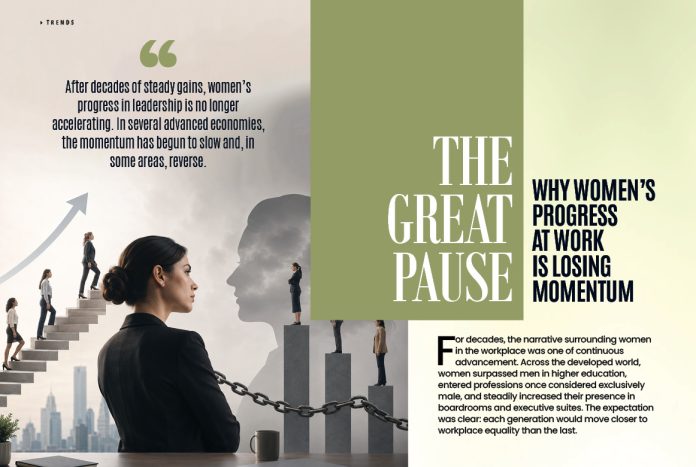
For decades, the narrative surrounding women in the workplace was one of continuous advancement. Across the developed world, women surpassed men in higher education, entered professions once considered exclusively male, and steadily increased their presence in boardrooms and executive suites. The expectation was clear: each generation would move closer to workplace equality than the last.
Today, however, fresh evidence suggests that this progress is slowing and, in some respects, beginning to reverse.
The shift is significant because it comes after years of sustained improvement. According to the Women in Work Index 2025 published by PwC, which measures gender equality across 33 OECD countries using indicators such as female labour force participation, full time employment, unemployment and the gender pay gap, progress has stalled for the first time in more than a decade. The report found that the proportion of women employed full time across the OECD declined from 78.1 per cent in 2023 to 76.8 per cent in 2024, marking the first recorded fall since the index began tracking the data fifteen years ago.
The slowdown is equally visible at the highest levels of corporate leadership
A 2024 study by S&P Global Market Intelligence, which tracks executive appointments and corporate governance across listed companies, found that women’s share of executive positions in publicly listed American companies declined in 2023, ending almost twenty years of uninterrupted growth. The research also showed that women secured only 38 per cent of new board appointments among companies in the S&P 500 Index during 2025, compared with 42 per cent the previous year, extending a retreat that began after the peak reached in 2020.
Several high profile appointments have reinforced this trend. Goldman Sachs promoted a smaller proportion of women to partner in its 2024 promotion round than in the previous cycle, while succession discussions at several leading financial institutions have featured fewer female candidates than expected only a few years ago.
Beyond leadership positions, economists are observing changes in workforce participation itself
PwC reports that university educated women with young families are leading much of the recent decline in labour force participation. In the United States, participation among mothers with young children recorded its sharpest fall in four decades, suggesting that highly qualified women are increasingly stepping back from full time careers during important stages of professional development.
The financial consequences are also becoming more visible
After narrowing steadily for decades, the gender pay gap widened in both 2023 and 2024 in the United States, according to the PwC Women in Work Index 2025. Similar widening was observed in several other advanced economies, including Canada and France, interrupting what had previously been a long period of gradual improvement.
Perhaps the most surprising development concerns professional ambition
The Women in the Workplace 2025 report, jointly published by McKinsey & Company and LeanIn.Org, analysed data from more than 120 organisations employing over one million people and surveyed approximately 9,000 employees across corporate America. The report found that while men’s interest in promotion continued to rise, women’s ambitions had levelled off. By 2025, almost nine in ten men expressed a desire for promotion, whereas women’s interest remained largely unchanged. Among women entering the workforce, only 69 per cent expressed interest in seeking a larger role, compared with considerably higher levels among their male counterparts.
These findings challenge the long-held assumption that women are simply waiting for opportunities to advance. Increasingly, many appear to be reassessing what career success means.
Several factors help explain this shift
Labour economists point to the lasting effects of the Covid pandemic. During lockdowns, women accounted for a disproportionate share of job losses in lower paid sectors, temporarily narrowing wage gaps. As employment patterns normalised, many women returned to work, contributing to the recent widening in pay differentials. At the same time, caring responsibilities continue to fall disproportionately on women, particularly mothers of young children.
Child care remains one of the greatest structural barriers. Although governments across several developed countries have expanded subsidies, supply has failed to keep pace with demand. Germany, for example, continues to face a shortage of more than 300,000 nursery places for children under the age of three, according to data cited in The Economist.
Corporate culture is also changing. In parts of the United States, diversity, equity and inclusion programmes have become politically contentious. Some organisations have reduced or restructured initiatives designed to improve female representation, creating uncertainty around long-term commitments to workplace diversity.
Yet the broader picture remains encouraging
Women continue to outperform men in university enrolment across most advanced economies, and an extensive body of research continues to demonstrate that organisations with diverse leadership teams make better strategic decisions, strengthen governance and achieve stronger long-term financial performance.
The current slowdown should therefore be viewed not as the end of progress, but as an important warning. Equality is not a permanent achievement that advances automatically. It requires sustained commitment from governments, employers and society alike.
The remarkable gains made during the past generation transformed modern workplaces. Preserving that progress and ensuring that the next generation moves forward rather than backwards may become one of the defining leadership challenges of this decade.
