
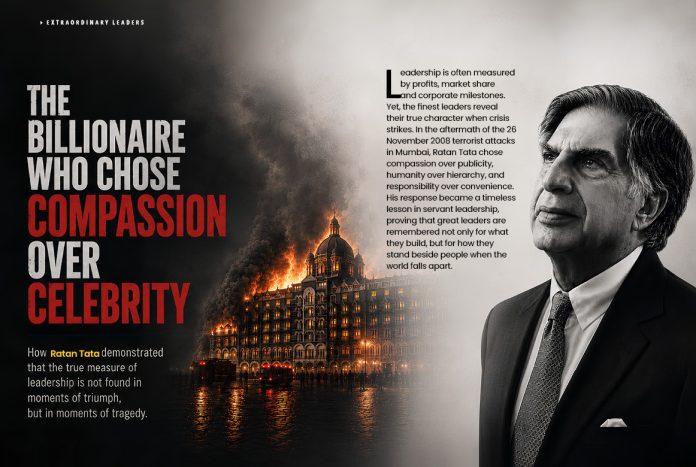
Leadership is often measured by profits, market share and corporate milestones. Yet, the finest leaders reveal their true character when crisis strikes. In the aftermath of the 26 November 2008 terrorist attacks in Mumbai, Ratan Tata chose compassion over publicity, humanity over hierarchy, and responsibility over convenience. His response became a timeless lesson in servant leadership, proving that great leaders are remembered not only for what they build, but for how they stand beside people when the world falls apart.
The night of 26 November 2008 changed India forever
As gunfire echoed through Mumbai and flames rose from the iconic Taj Mahal Palace Hotel, the world watched in horror. For nearly sixty hours, terrorists laid siege to one of India’s most treasured landmarks, claiming innocent lives and leaving deep scars on countless families.
For Ratan Tata, Chairman of the Tata Group, this was far more than an attack on a hotel.
It was an attack on his people
The Taj was more than a luxury destination. It was a living symbol of Indian hospitality, resilience and national pride. More importantly, it was home to thousands of employees who welcomed guests each day with quiet professionalism and genuine warmth. Many refused to abandon their posts during the attack, helping guests reach safety despite the grave danger to themselves. Some paid the ultimate price.
When the siege finally ended, the world expected the Tata Group to begin rebuilding bricks and mortar.
Ratan Tata chose first to rebuild lives
Rather than remaining in boardrooms or communicating solely through official statements, he personally visited hospitals where survivors and injured employees were receiving treatment. He met grieving families, listened more than he spoke, and offered comfort without cameras or ceremony. Those encounters were not carefully choreographed public relations exercises. They reflected a leader who believed that compassion cannot be delegated.
His concern extended far beyond those employed by the Taj
Recognising that tragedy had touched the wider community, the Tata Group established extensive relief and rehabilitation initiatives. Support reached employees, their families, contract workers, security personnel, railway staff, Police officers and even street vendors whose livelihoods had been destroyed during the attacks. Financial assistance, counselling, education support and long-term rehabilitation formed part of a comprehensive effort to restore dignity as well as stability.
Perhaps the most remarkable aspect of the response was its breadth.
Leadership did not stop at the boundaries of the payroll
Those who had no formal employment relationship with the Tata Group were not forgotten simply because they were absent from a spreadsheet. They were fellow human beings whose suffering demanded compassion.
This philosophy had long been embedded within the Tata tradition
For generations, the Tata Group had viewed business not merely as an engine of wealth creation but as a force for nation building. Jamsetji Tata laid the foundations for that philosophy. J. R. D. Tata strengthened it. Ratan Tata carried it into the twenty first century with quiet conviction.
In the weeks that followed, attention gradually shifted elsewhere. News headlines faded. Television crews departed. Public interest moved on.
Ratan Tata did not.
Recovery continued long after the cameras disappeared
The Taj Mahal Palace Hotel itself rose again, restored with extraordinary care and dignity. Its reopening symbolised more than architectural renewal. It represented the triumph of courage over fear and hope over hatred. The building stood once more as a beacon overlooking the Arabian Sea, but its greatest strength was never its magnificent dome or elegant corridors.
Its greatest strength was the people who returned
The events of Mumbai also revealed another important truth about leadership. During catastrophe, authority alone is insufficient. Employees do not seek perfection from their leaders. They seek presence. They look for someone willing to stand beside them when uncertainty overshadows every decision.
Ratan Tata understood this instinctively
He did not transform tragedy into a personal story of heroism. He allowed the courage of employees, first responders and ordinary citizens to remain at the centre of the narrative. His role was not to occupy the spotlight but to ensure that those affected never faced their darkest days alone.
Years later, when leadership scholars discuss crisis management, the Mumbai response remains one of the clearest demonstrations that compassion is not separate from business excellence. It is an essential part of it.
Balance sheets may record financial performance
History remembers something deeper.
It remembers the leaders who chose humanity when humanity was needed most.
Ratan Tata’s legacy is therefore measured not only in companies transformed, industries modernised or global acquisitions completed. It is equally measured in hospital visits, comforting conversations, quiet acts of generosity and an unwavering belief that every employee deserves dignity, especially during life’s most difficult moments.
In an age that often celebrates the loudest voices, his example reminds us that the most enduring leadership is frequently the quietest.
True greatness does not seek applause.
It simply shows up when people need it most.
Leadership Lessons
1. People must always come before profits.
Organisations recover more quickly when leaders place human wellbeing at the heart of every decision.
2. Compassion is a strategic strength.
Empathy builds trust that no financial investment can purchase.
3. Leadership is measured during adversity.
Character becomes visible when circumstances are at their most difficult.
Editor’s Note: This article is based on documented events surrounding the 26 November 2008 Mumbai terrorist attacks and the Tata Group’s publicly reported relief and rehabilitation efforts. Narrative elements have been written in a literary style, but no fictional incidents or unverified dialogue have been added.
