
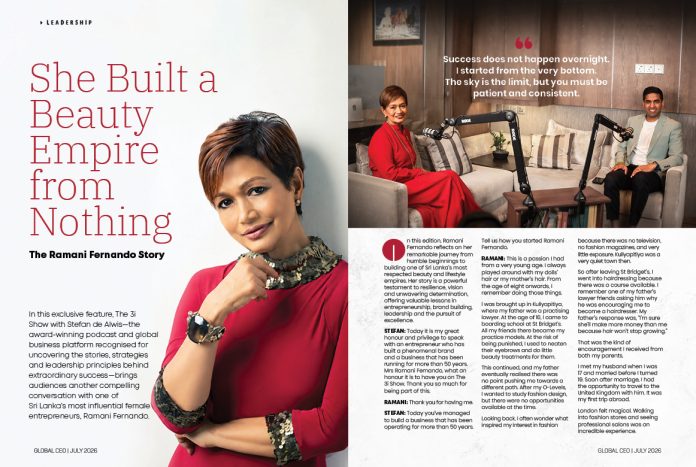
In this exclusive feature, The 3i Show with Stefan de Alwis—the award-winning podcast and global business platform recognised for uncovering the stories, strategies and leadership principles behind extraordinary success—brings audiences another compelling conversation with one of
Sri Lanka’s most influential female entrepreneurs, Ramani Fernando.
n this edition, Ramani Fernando reflects on her remarkable journey from humble beginnings to building one of Sri Lanka’s most respected beauty and lifestyle empires. Her story is a powerful testament to resilience, vision and unwavering determination, offering valuable lessons in entrepreneurship, brand building, leadership and the pursuit of excellence.
STEFAN: Today it is my great honour and privilege to speak with an entrepreneur who has built a phenomenal brand and a business that has been running for more than 50 years. Mrs Ramani Fernando, what an honour it is to have you on The 3i Show. Thank you so much for being part of this.
RAMANI: Thank you for having me.
STEFAN: Today you’ve managed to build a business that has been operating for more than 50 years. Tell us how you started Ramani Fernando.
RAMANI: This is a passion I had from a very young age. I always played around with my dolls’ hair or my mother’s hair. From the age of eight onwards, I remember doing those things.
I was brought up in Kuliyapitiya, where my father was a practising lawyer. At the age of 10, I came to boarding school at St Bridget’s. All my friends there became my practice models. At the risk of being punished, I used to neaten their eyebrows and do little beauty treatments for them.
This continued, and my father eventually realised there was no point pushing me towards a different path. After my O-Levels, I wanted to study fashion design, but there were no opportunities available at the time.
Looking back, I often wonder what inspired my interest in fashion because there was no television, no fashion magazines, and very little exposure. Kuliyapitiya was a very quiet town then.
So after leaving St Bridget’s, I went into hairdressing because there was a course available. I remember one of my father’s lawyer friends asking him why he was encouraging me to become a hairdresser. My father’s response was, “I’m sure she’ll make more money than me because hair won’t stop growing.”
That was the kind of encouragement I received from both my parents.
I met my husband when I was 17 and married before I turned 19. Soon after marriage, I had the opportunity to travel to the United Kingdom with him. It was my first trip abroad. London felt magical. Walking into fashion stores and seeing professional salons was an incredible experience.
STEFAN: Your parents’ encouragement clearly played an important role in your journey. What would you say to young people today who have a passion but may not receive the same support?
RAMANI: Today is very different. There are many more opportunities.
If you have a passion, I would encourage parents to support their children in pursuing it. Not everyone has to become a doctor, lawyer or engineer. There are countless opportunities in creative industries and many ways to build a successful career.
The sky is the limit, but you must be patient and consistent. Success does not happen overnight. I started from the very bottom.
STEFAN: Tell us about those early days.
RAMANI: I had completed a course here in Sri Lanka, and when I arrived in London, I thought I knew hairdressing.
I applied for a job and was given a test. Afterwards, the salon owner tapped me on the shoulder and said, “You need to learn more and then come back.”
So I left and walked a little further down the road. There I saw a notice looking for junior hairdressers. I got the job.
At the time, my husband Ranjith was very supportive and encouraged me throughout.
As a junior, I swept floors, mopped, made endless cups of tea and coffee, and assisted senior stylists. The salon in Harrow employed around 25 hairdressers and was extremely successful.
The greatest experience came from helping the senior stylist. I watched everything she did — cutting, styling and serving clients. I learned by observing.
STEFAN: What did those early experiences teach you about leadership and success?
RAMANI: To be honest, I didn’t even know what a brand was at the time.
I simply took one step at a time. Nobody pressured me to start a business or make money. My husband encouraged me to do what I loved.
Those early experiences taught me the importance of understanding every aspect of the business. Even today, when we bring in junior staff, I expect them to go through a similar process. It gives them a sense of belonging and teaches them respect for the workplace.
It may seem old-fashioned, but it has worked for me.
STEFAN: Do you think young entrepreneurs should gain experience working for someone else before starting their own businesses?
RAMANI: Definitely.
At our academies, students learn the fundamentals of hairdressing and beauty, but dealing with customers is completely different.
My advice is always to work under someone experienced for two or three years. Learn how the business operates, gain practical experience and then think about starting on your own.
STEFAN: You also experienced rejection when you first applied for work in London. How did you deal with that?
RAMANI: It honestly didn’t bother me very much.
Perhaps I was young and inexperienced. I simply thought, “All right, I’ll keep going.”
When I joined the second salon, I quickly realised how much I still had to learn. That experience taught me humility and showed me how much more professional the industry was overseas.
STEFAN: You eventually returned to Sri Lanka and started your own business.
RAMANI: Yes. While working in London, I was promoted within six months to junior stylist.
When I returned to Sri Lanka, I started in a room at home with one chair and one sink.
People began noticing the new hairstyles and techniques I had brought back. Word spread quickly, and I struggled to keep up with demand.
By then, I also had two children, so it was a busy period.
I introduced techniques such as blow-drying, which were relatively new here at the time. The business grew through word of mouth.
One thing I learned was that you cannot remain stagnant. You must continue evolving. I returned to London regularly for refresher courses.
STEFAN: When you started from that small room at home, did you ever imagine building one of Sri Lanka’s leading beauty brands?
RAMANI: No. I would be lying if I said yes.
I never thought that far ahead. I simply focused on doing the work and enjoyed earning my own income while raising my family.
STEFAN: What kept you motivated?
RAMANI: Because I loved it.
Even today, I love going into the salons and interacting with the younger staff. It has always been my passion.
STEFAN: One of the keys to your success has been your ability to remain relevant as the industry evolves. How have you achieved that?
RAMANI: By constantly learning.
I attended refresher courses and international competitions.
The first time I entered a competition in Hong Kong, I felt completely out of my depth. I realised how much more there was to learn.
But instead of giving up, I worked harder. The following year I returned and won an Outstanding Hairstylist Award.
After that, I encouraged my staff to participate as well. We built a culture of learning and continuous improvement.
Today, the industry is far more competitive, but that competition pushes everyone to become better.
STEFAN: Today there is significant competition in the industry. How do you continue to remain relevant and competitive?
RAMANI: I don’t know whether I’m ahead of the competition, but I am fortunate to have excellent staff.
What I always tell them is that we can have the most modern salons, but if we don’t know how to treat people properly, we will never succeed.
You must be professional, humble and genuinely care about your customers.
STEFAN: You operate multiple locations across the country. How do you maintain consistency?
RAMANI: It is not easy.
I have managers who have been with me for many years and they understand what I expect.
I speak with them regularly. If there is a complaint, I become involved personally. If there is praise, I make sure it reaches the staff.
It is an ongoing relationship and that helps maintain standards.
STEFAN: You also operate several academies. How important is learning and development?
RAMANI: Learning is everything.
Even now, I enjoy training because it helps me stay updated and become better myself.
As the business expanded, establishing training schools became essential. Today we have academies in Colombo, Kandy and Negombo.
STEFAN: During your 50-year journey, what were some of the biggest challenges you faced?
RAMANI: One of the hardest things is when senior staff leave.
When someone who has worked with you for many years moves
on, it is very difficult. You lose not only the employee but often some clients as well.
Fortunately, many of our people have stayed with us for 10, 15, 20 and even 30 years.
COVID-19 was another major challenge. It was an extremely difficult period.
My biggest concern was continuing to support my staff. Somehow, we managed to get through it.
STEFAN: What has helped you build such a loyal customer base?
RAMANI: Humility and professionalism.
I always tell my staff that we cannot behave as though we know everything. We must continue learning and provide excellent service.
Success takes time. It requires discipline, commitment and hard work.
Many people today want instant results, but lasting success doesn’t work that way.
STEFAN: As a woman entrepreneur, did you face barriers along the way?
RAMANI: Not really.
Perhaps because I was my own boss. I worked hard to earn the respect of the people around me, and that respect became very important.
STEFAN: What leadership qualities have mattered most to you?
RAMANI: Honesty and discipline.
You cannot take shortcuts. People respect you when they see you operating honestly and professionally.
You also have to think differently and deliver something special. Customer care is critical. If you provide excellent service, customers stay with you.
STEFAN: What have been the biggest lessons you have learnt during your 50 years in business?
RAMANI: Share what you know.
Train your staff. Treat them well.Many of the young women who work for me are mothers with families and responsibilities. You have to understand their situations and support them where possible.
You must also run your business honestly. Meet your obligations, pay your taxes, comply with regulations and operate with integrity.
That was something my husband always emphasised.
STEFAN: How would you like to be remembered?
RAMANI: As a kind and giving person.
STEFAN: Finally, what advice would you give young entrepreneurs starting their journey?
RAMANI: Keep going.
Don’t think of your work as a job. Think of it as something you genuinely enjoy.
If you are talented, honest and committed, the money will come. Don’t chase money. Focus on delivering quality work and serving people well.
Word of mouth remains the most powerful form of marketing.
STEFAN: It has been a real honour to have you on the show today. Running a successful brand for more than 50 years is no ordinary achievement. Your journey will undoubtedly inspire many entrepreneurs and business leaders.
