
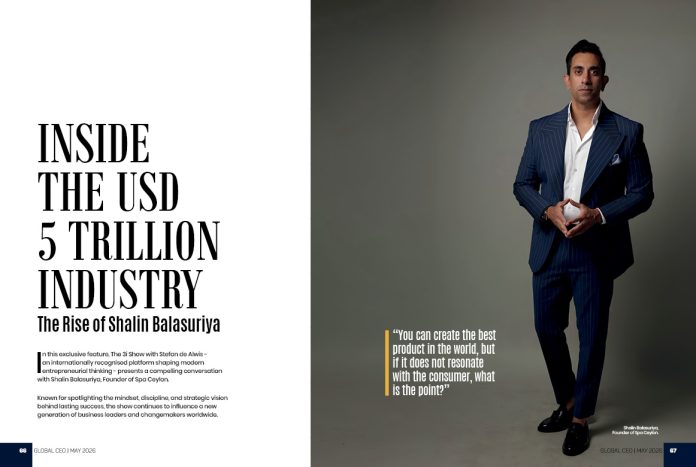
In this exclusive feature, The 3i Show with Stefan de Alwis – an internationally recognised platform shaping modern entrepreneurial thinking – presents a compelling conversation with Shalin Balasuriya, Founder of Spa Ceylon.
Known for spotlighting the mindset, discipline, and strategic vision behind lasting success, the show continues to influence a new generation of business leaders and changemakers worldwide.
In this edition, Shalin reflects on his journey of transforming a heritage-inspired concept into the world’s largest luxury Ayurveda brand. His story offers powerful insights into resilience, brand building, and purpose-driven leadership—timely lessons for navigating today’s competitive and ever-evolving global business landscape.
Hello everyone, and welcome to another episode of your favourite podcast, The 3i Show, with myself, Stefan de Alwis. Today, it is a very exciting day.
We have a phenomenal gentleman with us in the studio. When you think of homegrown brands that have gone global, from Sri Lanka to the world, you can only think of a few. And this brand and this gentleman have surely made Sri Lanka known globally by starting a beautiful brand called Spa Ceylon.
Shalin, it is great to have you with us today on The 3i Show. What you have done is remarkable.
Today, we hear of brands, not many brands, perhaps you can only count them on one hand, that have gone from Sri Lanka to the world. And today, you have done something phenomenal, where you have not only made Sri Lanka known worldwide, but have built the world’s largest luxury Ayurveda brand. Today, you are in over 130 locations across 37 countries. Am I correct?
Almost there. We are at 152 across 37 countries and growing. Hopefully, the world comes on and we can keep going. I have a couple of openings lined up.
I was supposed to be travelling this month, which I have had to push back, or push forward rather. So yes, things are going well, other than a few ups and downs that the world is going through right now. But we are growing, and we are excited to grow.
I know you have shared your story on different platforms, but perhaps, briefly, you can quickly tell us how Spa Ceylon was birthed.
My mother, Janat Balasuriya, was kind of like the patron of beauty and cosmetics in Sri Lanka. She established Sri Lanka’s first cosmetic brand and Sri Lanka’s first salon.
So my brother and I grew up in a household where we saw her pretty much create Sri Lanka’s first beauty brand from her pantry. We saw how it was built. We saw how it scaled.
Most importantly, we saw how it made people feel. My mother always said this whole beauty industry is not about vanity. It is about how people feel when they feel like they look a certain way or look good, and so on and so forth.
And there is a lot of satisfaction that comes from it, that you are able to give someone confidence. You are able to give someone a good feeling. So in this environment, my brother and I went to university and came back.
We started working with my mother’s company, which was Janet. She helped scale that as well. And when I came back and started working, after a few years in, the war was ongoing here.
There was not much growth in Sri Lanka. So we wanted to build a brand that had the links to go international. And that is when we started conceptualising and then saw a need in the world for something that was natural, something that was grounding.
And then we looked back to Sri Lanka and found this amazing science of Ayurveda, where, if it is packaged well and taken to the world in a way that people could understand it, and delivered in a luxurious way, we felt that it had a lot of potential.
And that was the start of Spa Ceylon. We are now 16 years in, and this has been amazing.
So during this early period of your journey and starting a new brand, what was the best piece of advice you received when launching the brand?
Actually, I do not think we had a lot of advice. A lot of people said we were pretty silly to try to do what we were doing because they were saying Ayurveda was considered a poor man’s medicine. It is like you cannot make that luxury. No one is going to understand it when taking it out to the world.
You should not be doing it. Who is going to want to use a product like this that comes from a tiny country like Sri Lanka? All that stuff. So there were a lot of naysayers.
But I guess the best advice came from Mum, not really in words, but seeing what she had achieved. And we saw the impact that something like this could have on people. And if you could do it here, why not take it out to the world? And the insight to create the brand came from really looking at human behaviour.
People, as the world was getting more techie, as the world was getting more chaotic, were looking for balance. People were looking for a way to reconnect with the world.
This was the early 2000s. Yoga was starting to take off, which ended up as a multi-billion-dollar industry itself. So there were signs that this could be something big.
And Ayurveda is amazing, the science of balance. It is the science of life, as they call it. And that is exactly what the world needed then and continues to need today.
So it was a really good fit. We just needed it to be fine-tuned. It needed identity. And in creating that identity, we again came back to this beautiful little island of ours and realised there is so much art, so much culture, so much vibrancy, so much colour, everything in there.
So much so that we are so different from any other brand out there. When I am in Europe and we are doing a visit, you hit the mall in the beauty section, or the beauty floor, and everything is white, and then you slowly pass Spa Ceylon and, bam.
So it is kind of like that. You are in people’s faces. You are vibrant.
You are colourful. You have bold fragrances. And that has made us stand out.
Yes, when you drive past any of your stores, you do not miss it. So, I mean, in the early days when you came across the concept of this idea, today a lot of people rely on numbers.
They do their business plan. And then they have an optimistic view, a pessimistic view. And then they decide whether to go ahead.
Was it similar in that aspect? Or did you just have this instinct saying, no, I see a gap in the market, and I am just going to go for it?
It was very calculated. There was a lot of research that went into it.
There was a lot of development that went into it. There was a lot of, I would not say financial calculations, but strategic planning that went into launching the brand. And, of course, fine-tuning the brand across the last 16 years.
So that has always been at the core of what we do. Yes, there is a lot of that feeling from being in the industry for a long time, seeing what Mum did and all that. But everything is thought of very scientifically, very strategically, and executed in the same way.
Brilliant, because today, a lot of, especially young entrepreneurs and people who have an initial concept or idea, sometimes want to kind of just rush into it. And then maybe halfway down the line, they hit a roadblock. So what advice could you give to some of these young guys who are thinking, OK, they have an idea, they want to jump in and start?
How should they go about it?
A lot of the young guys who want to start things up and have this idea to start this business or that business or the other business, I first tell them, what is your knowledge base? And I say, your knowledge base should be ground-up and consumer-backed. So if you want to get into the clothing business, go and work on the retail floor of a clothing brand.
Because if you do not know how a customer picks clothing, how size curves work, how displays work, all that being creative and being able to create amazing clothing can only get you so far. You need to know the business. And the best place to learn the business is where the customer interacts with the product.
So that would be my starting point for anyone. If you want to get into any industry, start learning about the industry, but go to the point where the customer interacts with the product.
Because you can create the best product in the world, in your opinion, but if it does not resonate with the consumer or anyone else, what is the point? Right. Who is going to pay money for it? So it is about identifying a consumer and building for them rather than building for yourself.
So when it comes to Spa Ceylon, who is your target market?
So at that point, or the launch point, it was these people looking for balance. So you are looking at young professionals, people who are, again, well-travelled, well-educated, now looking for alternatives to taking their busy life and giving them a break from it, where they want to live their life, where they want a certain amount of this corporate hustle and all that, but at the same time need something to pull them back and keep them grounded. So what has happened over the years is, as our ranges grow with that, that range of people has, I mean, that segment has grown.
So we have gone into skincare, we have gone into perfume, we have gone heavily into wellness, so it has grown. And different segments do cater to different people, but the initial thought was that.
Brilliant. So, I mean, you just said something very powerful, which is probably why the brand is still evolving and growing and spread across the globe. You managed to stay relevant within these years with new products, new inventions, be it. How do you go about that?
Look, you have got to stay plugged into your consumer’s lifestyle.
And we live in a world now where the consumer lifestyle changes drastically. So where you meet them changes. When their lifestyle changes, their needs change.
And the way they see the world changes. And you have to show up at every point ready to pivot and give them what they need. So it is a deep understanding of your consumer and being agile enough to change, that is the absolute key for anyone in any business today.
Brilliant. As you mentioned earlier, you are in 150 plus locations across 30 plus countries. What would you say was one thing that you did that really accelerated the growth of Spa Ceylon into this global brand?
Look, initially, it was us using a franchise model, because we were going into a very capital-intensive model where we were setting up stores.
Because if you go to one of our stores, it is very experiential. And that was initially the biggest driver of the brand, the experiential stores. So the capex on the stores was high.
And if we were to go out and open all our stores on our own, that could have been, one, logistically a nightmare. And second, it would have been a very extensive capex rise. So the franchise model really helped us to still keep the look and feel of the stores, but then give the capex and the responsibility of opening stores to other people.
And that helped us scale. However, things are changing now. A lot of markets we are taking back and taking control of because of the marketing development needed.
We feel centralised marketing works better. But for the initial scale, the franchise really did work.
And so now, as you take over certain stores, what is the vision and the future you see for Spa Ceylon?
We will be the largest wellness brand beyond Ayurveda in the world.
Wow. So how do you compete with these global giants like Estée Lauder or L’Oréal, or other brands that may be in Ayurveda?
Staying unique. Staying very tied to what we are delivering for the consumer. See, the science of Ayurveda alone is something very, very unique and gives people what they are looking for now. If you look at where the world is going, a lot of tech, a lot of AI, a lot of automation. And the more that happens, the more people are going to need to feel like they are grounded. The more people are going to feel like they need some touch and connection to nature. Yes. And that is what we are all about.
And the rituals that come with it and the whole immersive experience of what Spa Ceylon is are amazingly connected to nature. And that is why we stand out, and that is why we see a lot of potential. The crazier the world gets, the more relevant we get.
Fantastic. I mean, you spoke about being unique. Maybe you can give some practical tips on how you stay unique.
Our biggest source of remaining unique has to be this amazing, beautiful island we call home. Yes. We live on this island. A lot of the world has not discovered it. It has thousands of years of culture. It has amazing fruits, flowers and herbs growing on our soil.
It has this amazing science of our Ayurveda that has been around again for generations. All that coming together, there are still so many stories to tell. There is still so much design to leverage.
There are still so many ingredients to tap into. And all that is from our home. It is indigenous to us. So there, straight away, we have uniqueness everywhere we go.
Amazing. And you also mentioned that, you know, today, they are saying in five years’ time, the world we see as it is will be completely different because of AI and new tech that is coming in.
Do you see this as something that is going to be a danger to what you are doing? Or are you also evolving? Are you planning to use AI in the wellness space? Can you do it?
No, that is what I think. As much as AI and all this side of things grow, we are human beings. Our humanity will always crave our connection to one another and our connection to the earth, to nature. Because no amount of AI can allow us to live without this world we have been born into. And that connection is what we bring to our breath. And that sense of balance, of balancing out your tech and your madness with this connection to earth, is what we bring in. And so, as the world becomes more techie and more AI-driven and more synthetic, if you call it that, or more built up, I think we become even more relevant.
Today, there might be someone watching and thinking, okay, I want to build the next greatest brand and take it from Sri Lanka to the world. What tips could you give them in taking a brand from Sri Lanka and making it global?
The great thing about Sri Lanka is that it is large enough. Sorry, it is small enough to incubate. It is large enough to scale before you take off. Use that fact about Sri Lanka.
The other big thing is, like I said before, Sri Lanka has a lot of uniqueness, yes, that the world does not know. And in a world where you need to stand out to be noticed, use that uniqueness to stand out. Whether it is the science, whether it is the culture, whether it is the environment, whatever it is that you can take from this beautiful country you were born in, use it.
And whatever industry you are going into, really understand your consumer because that is where it lies. And I think between that, you have the potential to create a great brand.
Wonderful. So today, I think you are leading this company with your brother. Is that correct? So what are some of the tough leadership decisions you have had to make that have shaped the growth of the organisation?
Possibly the toughest thing we have gone through is COVID. So pre-COVID, the brand was a little different in terms of the fact that we were very brick-and-mortar heavy.
We were, if you take a Sri Lankan example, if you take out all the international stores, what, 70% tourism-reliant? Yes. So it was very central to Colombo, plus the tourism areas and the tourism industry-related.
And then suddenly, everything went to zero. And we had to figure out how to rebuild, with no access to stores and no access to tourism. That is when we made a big decision that we would go wider in the local audiences.
We started communicating in Sinhala and Tamil. We started going wider. And that was a real turning point for the brand in Sri Lanka.
Right now, we have customers all the way from Jaffna to Hambantota. We have opened stores in places we never thought we would open, like Kurunegala, Negombo, Kiribathgoda, and all those places.
And everyone knows the brand. There is not a Sri Lankan who says, oh, I do not know what Spa Ceylon is all about. And that was a real turning point for us.
And again, a lot of people say, do not do it. You are going to lose the luxury edge, people are not going to see you as premium anymore, and so on and so forth.
But we managed to balance it out. We managed to really increase the width of the brand. And when finally, whether it was COVID or the economic crisis, or all that happened ended and tourism came back, it just catapulted us to the next level.
So it has been interesting, scary, fun, and exhilarating, right?
Absolutely. So what is one secret that you can share that is important when deciding to scale your business?
Look, firstly, you need to have that big dream. If you are not starting with that big dream, you cannot then break it down into smaller pieces and say, okay, then first this, then this, then this.
And that is where we are. You need to have a sense of where you are going and then break it down into smaller goals. You need to build great teams if you want to scale.
Teams need to build great processes if you want to scale. And you need to really work hard at what you are doing and really pay attention to what is happening in your consumers’ lives.
Logistically, because you have locations all over, how do you manage things logistically? Is it tough?
Again, lots of good processes. Communication in this day and age is great. So that makes a big difference, whether it is videos or being able to monitor something. But at the end of the day, it comes down to really good processes and really good systems.
Brilliant. As a well-seasoned entrepreneur who is doing really well, what are some of the personal habits that really drive you and motivate you to do what you do?
Look, to start off with, I love what I do. I wake up excited to do what I do. It is exhilarating to do what I do. So from there onwards, you do not put it down as work. You are just working towards a goal.
I also love to build teams that feel the same amount of energy and make them part of this journey. So everyone knows where we are going. Everyone is part of the journey.
Everyone is excited about it. And when you work in an environment like that, or in a day-to-day environment, it changes the way you are. It changes the way people are.
Because look, 8 to 10 hours a day, people spend at what they call their work. And if it is not something you love or you enjoy, what a waste of life.
That is right. So there have never been moments where you did not want to show up?
Look, you have a bad day. But you pick yourself up. Because at the end of the day, not showing up is not an option.
Because the bigger you build, the more people you are responsible for. That is right. You are responsible for a lot of people within your company.
You are responsible for a client base outside your company. Not showing up is never an option. You have your bad days. You pick yourself up and get there. But if you love what you do, you are going to have more good days than bad days. And those hours you spend at work are not going to feel like you are doing something that is difficult to do or that gives you too much stress or whatever it is.
Even the stress becomes part of the process, you see. And like I said, it is an absolutely fun ride. And if I can give the same energy to the teams I work with, it becomes real.
People see the luxury side of entrepreneurship when someone has made it. But what is one brutal truth about entrepreneurship that you would advise young founders?
Well, the one big one is that it comes with a lot of responsibility. Apart from responsibility to yourself, when you take up entrepreneurship, you are pretty much putting all your eggs in one basket.
You are responsible to your family to bring home sustenance. You are responsible to the people who work with you so that they can take something home to their family. You are responsible to your consumers to deliver what you promise. And that is the utmost thing about entrepreneurship, the responsibilities that come with it.
What is one leadership lesson you live by?
Leaders should care about their team and understand their team. If you do not care about and understand your team, you are not going to get anything out of it.
