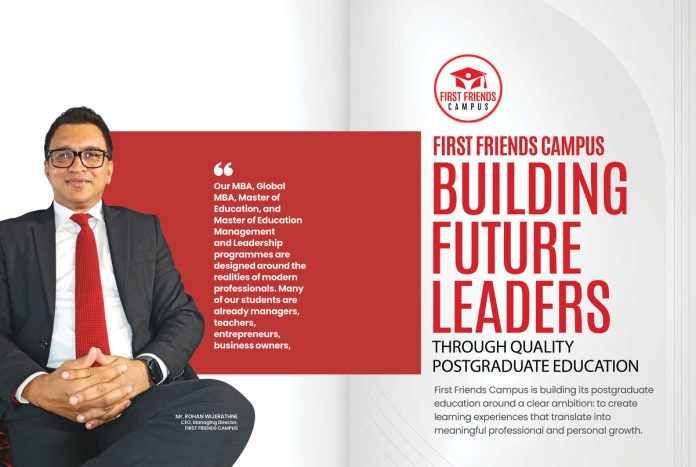
First Friends Campus is building its postgraduate education around a clear ambition: to create learning experiences that translate into meaningful professional and personal growth.
Through programmes spanning business, education and leadership, the institution combines academic rigour with flexible learning, practical application, international exposure and strong student support. Its approach recognises the realities facing today’s working professionals while preparing them for a future shaped by artificial intelligence, innovation and rapidly changing industries.
With an emphasis on leadership, entrepreneurship and lifelong development, First Friends Campus is looking beyond qualifications towards lasting impact. Global CEO Magazine interviewed the leadership of First Friends Campus to explore this evolving vision.
First Friends Campus offers a diverse portfolio of postgraduate qualifications, including the MBA, Global MBA, Master of Education, and Master of Education Management and Leadership programmes. What distinguishes these qualifications from other postgraduate programmes available in Sri Lanka?
When I started building First Friends Campus, my objective was never simply to create another educational institution that offers qualifications. I wanted to create a place where education genuinely changes people’s lives and careers.
That philosophy continues to guide our postgraduate education today.
Our MBA, Global MBA, Master of Education, and Master of Education Management and Leadership programmes are designed around the realities of modern professionals. Many of our students are already managers, teachers, entrepreneurs, business owners, and senior professionals. They come to us with experience, but they are looking for the knowledge, confidence, and international exposure required to reach the next stage of their careers.
What distinguishes our programmes is the combination of international academic opportunities, flexible learning, strong academic support, and a practical approach to education.
Personally, I do not believe a master’s degree should simply add three letters after someone’s name. It should change the way that person thinks, leads, communicates, and makes decisions.
At First Friends Campus, that transformation is what we try to achieve.
For me, the true success of a postgraduate programme is not measured on graduation day. It is measured by what the graduate achieves in the years that follow.
How does First Friends Campus keep its postgraduate programmes relevant to changing industry needs?
One thing I strongly believe is that education cannot remain still when the world is moving so quickly.
Today, Artificial Intelligence, digital transformation, sustainability, and global competition are changing almost every industry. The way we did business ten years ago is very different from how businesses must operate today, and the next ten years will bring even greater changes.
As a business leader myself, I experience these changes in real life. I constantly have to look at technology, marketing, customer behaviour, staff development, growth strategies, and new opportunities.
Therefore, when I look at postgraduate education, I look at it not only from an academic perspective but also from an employer’s and entrepreneur’s perspective.
I often ask myself, “What knowledge does a leader actually need today?”
Artificial intelligence is a good example. AI is no longer something only IT professionals should understand. A CEO, manager, teacher, entrepreneur, or marketing professional should understand how AI can improve productivity, support decision-making, and transform organisations.
But technology alone is not leadership. Future leaders will also need critical thinking, emotional intelligence, ethics, creativity, and the ability to understand people.
Our aim is to expose students to contemporary challenges and encourage them to think about the future rather than simply memorising theories from the past.
We should not educate students only for today’s jobs. We should prepare them for opportunities that may not even exist yet.
How does First Friends Campus provide flexible and practical postgraduate learning for working professionals?
This is something I understand personally because I know what it means to manage a very demanding schedule.
Many of our postgraduate students are working full-time. Some manage businesses, teams, families, and many other responsibilities. Their biggest challenge is often not the desire to study — it is finding a way to continue their education while managing everything else in life.
That is why flexibility is extremely important to us.
Through online live classes, digital academic support, and professionally planned schedules, we try to make postgraduate education accessible to working professionals.
However, I always say that flexibility should not become an excuse for reducing academic quality.
A postgraduate qualification should challenge you.
Students must research, analyse, question ideas, and develop their own professional judgement.
Assignment-based assessments and practical learning activities allow students to connect academic theories with their own workplaces and professional experiences.
In fact, I think working professionals sometimes have a unique advantage because they can immediately relate what they learn to real situations.
You may attend an MBA class in the evening and the following morning face a business situation where that same concept becomes relevant.
That is when education becomes powerful — when learning moves from the classroom directly into your professional life.
How does First Friends Campus integrate practical and industry-based learning into its postgraduate programmes?
I have always believed there is sometimes too much distance between education and the real world.
A person can understand management theory very well, but when they are placed in front of a difficult employee, a financial problem, an unhappy customer, or a major strategic decision, the situation becomes completely different.
That is why practical thinking is very important in postgraduate education.
We encourage the use of case studies, organisational examples, strategic discussions, research, and real-world scenarios.
Another major strength of postgraduate education is the experience that students themselves bring into the classroom.
Imagine a class with a banker, a teacher, an HR professional, a business owner, and a senior manager. Each person sees a problem differently.
When they begin discussing a case study, the learning becomes much richer because everyone brings a different professional perspective.
I also strongly value engagement with experienced industry professionals and guest lecturers.
Sometimes one hour with an experienced entrepreneur or industry leader can teach a student lessons that come from twenty years of real experience.
Academic knowledge gives you the framework, but practical experience teaches you how to use that knowledge when reality does not follow the textbook.
We want our students to understand both.
How do your postgraduate programmes develop leadership and strategic thinking skills?
I always say that having a designation does not make someone a leader.
You can print “Manager”, “Director”, or even “CEO” on a visiting card. But real leadership is demonstrated by how you think, how you treat people, how you respond to challenges, and how you make decisions when the situation is difficult.
Leadership requires vision.
One of the biggest changes we try to encourage in postgraduate students is the shift from operational thinking to strategic thinking.
An employee may ask, “What should I do today?”
A manager may ask, “How do I complete this project?”
But a leader should also ask, “Why are we doing this? Where are we going? What will happen next? Is there a better way?”
That difference in thinking is very important.
Through strategic analysis, case studies, research, and professional discussions, our postgraduate students are encouraged to look at problems from different angles and make informed decisions.
Personally, one of my own leadership habits is to constantly think ahead. I believe much of a leader’s real work happens before execution. You think, plan, evaluate the risks, and then your team implements the strategy.
We want to develop that type of mindset in our students.
Good leaders manage the present. Great leaders prepare their organisations for what comes next.
How does First Friends Campus support students in enhancing their career prospects?
From the beginning, I wanted First Friends Campus students to look beyond geographical limitations.
Today, careers are increasingly global. A person may study in Sri Lanka, work for an international organisation, manage a team in another country, or build a business serving customers around the world.
Therefore, international exposure and academic collaborations are extremely important.
We continuously work to create academic pathways and international education opportunities that allow students to expand their horizons.
But I also believe partnerships and qualifications alone are not enough.
The student’s experience is equally important.
Sometimes a student joins us after being away from education for ten or fifteen years. They may be a successful professional, but initially they are nervous about studying again.
Others may be completing their first international qualification.
These students need guidance.
At First Friends Campus, we try to remain connected with students throughout their journey. Academic guidance, communication, and student support are areas I personally consider very important.
I always remind my team that behind every student registration is a person’s ambition.
Someone may be trying to get a promotion.
Someone may be trying to become a lecturer.
Someone may be planning to migrate.
Someone may want to start a business.
We must understand that responsibility.
Students do not simply give us a course fee. They trust us with part of their future. That is something we should never take lightly.
How does First Friends Campus foster innovation and entrepreneurship among postgraduate students?
Entrepreneurship is a subject that is personally very close to me.
I believe entrepreneurship begins with the ability to see something differently.
Many opportunities come from problems.
Sometimes people look at a problem and complain about it. An entrepreneur looks at the same problem and asks, “Can I create a solution?”
That mindset is valuable even if you never start your own company.
Organisations need employees and leaders who can innovate, improve systems, and identify opportunities.
At First Friends Campus, we encourage students to challenge existing methods and think beyond traditional approaches.
I personally do this constantly in my own organisations.
I believe being creative and doing something unique takes more time, planning, and courage than simply following what everyone else is doing. But that is how organisations grow. I encourage postgraduate students to analyse markets, identify gaps, understand customer needs, and think about how technology and innovation can create new solutions.
I also tell students that not every idea will succeed.
Entrepreneurship involves calculated risk and sometimes failure.
But failure should teach you something.
The biggest risk in a rapidly changing world may actually be refusing to change at all.
We want our graduates to become people who create progress rather than simply wait for change to happen around them.
How does First Friends Campus use technology to enhance postgraduate learning and student engagement?
Technology has completely changed education.
Today, a working professional in another country can join a live academic discussion, interact with a lecturer, and continue postgraduate studies without leaving their career.
That was much more difficult in the past.
At First Friends Campus, we have embraced online live learning and digital academic support because it allows us to make education more accessible.
However, I do not believe that simply giving students a username and password to a learning platform means you are providing quality online education.
Education still requires human interaction.
Students need to ask questions. They need discussions. They need lecturer support and academic guidance.
Therefore, our focus is on using technology to improve accessibility while maintaining engagement.
Artificial Intelligence will also play a major role in the next stage of education.
It can help personalise learning, support research, and create new ways for students to access knowledge.
But educational institutions also have a responsibility to teach students how to use these technologies ethically and intelligently.
Technology should make students better thinkers. It should not replace thinking.
I believe the future belongs to institutions that successfully combine technology with academic quality and genuine human connection.
How does First Friends Campus support students through mentoring, networking and career development?
I believe one of the most important things an educational institution can give a student is connection.
Sometimes success comes from knowledge.
Sometimes it comes from an opportunity.
And sometimes it comes from meeting the right person at the right time.
Postgraduate education creates an excellent environment for professional networking because students come from many different industries.
Within our academic community, you may meet entrepreneurs, educators, managers, and other professionals.
I want to strengthen this professional community even further at First Friends Campus.
My vision is that a First Friends graduate should always feel that they are part of a growing network.
As our alumni community expands, I believe there are enormous opportunities for mentoring, career guidance, professional collaboration, and business networking.
I also strongly believe in mentoring.
Throughout my own journey, I have learned many lessons through experience. Some lessons came from success, and some came from mistakes.
When experienced professionals share those lessons with younger leaders, it can save them years of difficulty.
Education gives you knowledge, but the right guidance can sometimes change the entire direction of your life.
That is the type of postgraduate community we want to build.
How will postgraduate education evolve in Sri Lanka, and what role will First Friends Campus play in shaping future leaders?
I think postgraduate education in Sri Lanka will change significantly over the next ten years.
The new generation of students will ask more questions.
They will not choose a qualification simply because it has the word “Master’s” in the title.
They will ask:
Is it internationally relevant?
Can I study while working?
Will I gain practical knowledge?
How will this help my career?
Will this prepare me for the future?
Educational institutions must be ready to answer those questions.
Artificial Intelligence, technology, flexible learning, international academic partnerships, and career-focused education will become increasingly important.
For First Friends Campus, I see a very exciting future.
We started with a vision, and over the years we have continuously expanded our academic opportunities and built a growing educational community.
But I always tell my team that growth should never only be about student numbers.
Being bigger does not automatically mean being better.
Our focus is to continuously improve academic quality, student support, international opportunities, technology, and the overall student experience.
Personally, I have a much bigger vision for First Friends Campus.
I want us to become an educational institution that Sri Lankan students are proud to be associated with — an institution that creates real opportunities and develops leaders who can compete globally.
Sri Lanka has intelligent, creative, and ambitious people.
Sometimes what they need is the right education, exposure, guidance, and confidence.
Our responsibility at First Friends Campus is to help unlock that potential.
We want to develop the next generation of business leaders, educators, entrepreneurs, and professionals who will not simply wait for the future.
We want them to lead it.