
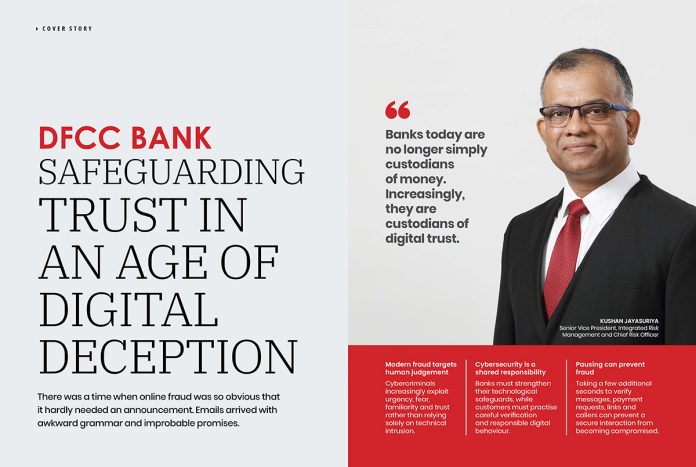
There was a time when online fraud was so obvious that it hardly needed an announcement. Emails arrived with awkward grammar and improbable promises.
Unknown callers spoke of lottery winnings or inheritance funds from distant countries. Fake websites looked visibly counterfeit, assembled with just enough effort to deceive the careless, but rarely enough to pull the wool over the eyes of the cautious.
Back then, the boundary between legitimate communication and fraud, while imperfect, was still visible to most people. That boundary now appears to be disappearing, and at a frightening pace.
Today’s scams are no longer built around obvious deception. They are built around familiarity. They arrive disguised as trusted institutions, delivery notifications, investment opportunities, customer service requests, or urgent financial alerts. They mirror real brands with alarming precision and rely increasingly on behavioural manipulation rather than technical intrusion.
In many ways, this marks a fundamental shift in the nature of cybercrime. The modern scam does not force entry into systems. It convinces people to open the door themselves, much like inviting a trusted visitor into their home. And that changes the nature of cybersecurity entirely.
For years, conversations around digital security focused primarily on infrastructure. Firewalls, antivirus systems, encryption protocols, authentication layers, and monitoring tools became the defining architecture of cyber defence. These remain critically important. Yet the fraud landscape has evolved faster than the public understanding of how cyber risk now operates.
Today, many attacks succeed not because systems fail, but because human judgement is deliberately targeted. Scammers understand urgency. They understand distraction. They understand fear, authority, loneliness, and trust. Increasingly, fraud is engineered not to “hack” technology first, but to manipulate behaviour and emotions.
A message claiming your account is at risk. A phone call requesting urgent verification. A payment request tied to a time-sensitive opportunity. These are not isolated tactics. They are psychological triggers designed to override hesitation.
This is why awareness alone is no longer enough. People already know scams exist. What they are often unprepared for is how convincing, contextual, and emotionally persuasive modern scams have become.
What makes the current environment even more concerning is the growing industrialisation of fraud itself. Behind many scams now sits an organised digital economy operating at scale in the shadows.
One of the most significant enablers of this shift is the dark web, a hidden marketplace where cybercriminal activity is bought, sold, refined, and distributed with increasing sophistication. Stolen personal data, banking credentials, phishing kits, malicious software, scam templates, and impersonation tools are traded with disturbing efficiency. In many cases, “fraud-as-a-service” models now allow individuals with limited technical expertise to launch highly convincing attacks using infrastructure developed by organised cybercriminal networks.
The barrier to entry has collapsed. Scams that once required advanced technical capability can now be executed using purchased toolkits, stolen databases, and automated systems designed for scale. For customers, this changes the nature of risk profoundly. Fraud is no longer isolated or opportunistic. It is adaptive, coordinated, and increasingly professionalised.
As this environment evolves, so too must the role of financial institutions. Banks today are no longer simply custodians of money. Increasingly, they are custodians of digital trust.
This shift has reinforced the importance of approaching digital trust at DFCC Bank as both a technological and behavioural challenge.
Across the banking sector, institutions are expanding cybersecurity frameworks beyond internal systems and infrastructure. Increasingly, the focus includes the wider digital environment in which customers operate.
Modern banks now monitor fake websites, phishing pages, impersonation accounts, and misuse of brand identity across digital platforms. External attack surfaces are scanned continuously to identify vulnerabilities before they can be exploited. Dark web monitoring has also become an increasingly important capability, with financial institutions monitoring underground marketplaces and cybercriminal forums for leaked credentials, compromised customer information, and indicators of planned attack campaigns.
These systems matter. They strengthen institutional preparedness. They improve response capability. They help institutions move faster than threats. Yet despite increasingly advanced safeguards, one reality remains unavoidable: technology alone cannot fully solve a behavioural problem.
The most effective cybersecurity control is often not technological at all. It is behavioural.
Simple habits continue to make a significant difference – pausing before responding to urgent requests, verifying communications independently, refusing to share passwords or OTPs, checking URLs carefully, and avoiding unofficial applications or suspicious links. These actions may appear basic, but they directly interrupt the psychological mechanics most scams depend upon.
This is why digital hygiene is becoming increasingly important. Much like physical safety depends on routine habits, digital safety now depends on behavioural discipline practised consistently over time. In practice, this requires a shift away from instinctive speed and towards deliberate verification.
That shift matters because speed has become one of the defining characteristics of the digital economy itself. Payments happen instantly. Communication is immediate. Decisions are compressed into seconds. Fraudsters exploit this environment deliberately. Urgency remains one of the most effective tools in digital fraud because it suppresses reflection. The faster people react, the less likely they are to verify.
This is why one of the most important cybersecurity responses today is surprisingly simple: slow down.
Pause before clicking. Pause before approving. Pause before responding.
In many cases, the difference between a secure interaction and a compromised one lies not in technical expertise, but in taking a few additional seconds to exercise judgement.
The future of cybersecurity cannot rest entirely with institutions, nor entirely with customers. It must increasingly become a shared discipline. Financial institutions must continue strengthening systems, improving fraud detection, enhancing authentication mechanisms, and investing in awareness. Customers, meanwhile, must recognise that digital judgement is now part of everyday financial responsibility.
This matters because the threat landscape will continue evolving. Artificial intelligence will likely make impersonation more convincing. Fraud attempts will become more personalised. Emotional manipulation will increasingly merge with technical sophistication.
The question is no longer whether fraud will evolve. It will.
The more important question is whether awareness, behaviour, and institutional safeguards can evolve faster.
Digital banking has transformed access, convenience, and financial inclusion in remarkable ways. That progress should not be feared, nor reversed. But trust in digital systems cannot be sustained through technology alone.
It requires awareness. It requires vigilance. Increasingly, it also requires verification to become instinctive.
Because in a world where scams are designed to feel believable, trust itself has become part of cybersecurity. And protecting that trust may become one of the defining responsibilities of modern banking.
By Kushan Jayasuriya
Senior Vice President, Integrated Risk Management and Chief Risk Officer
