
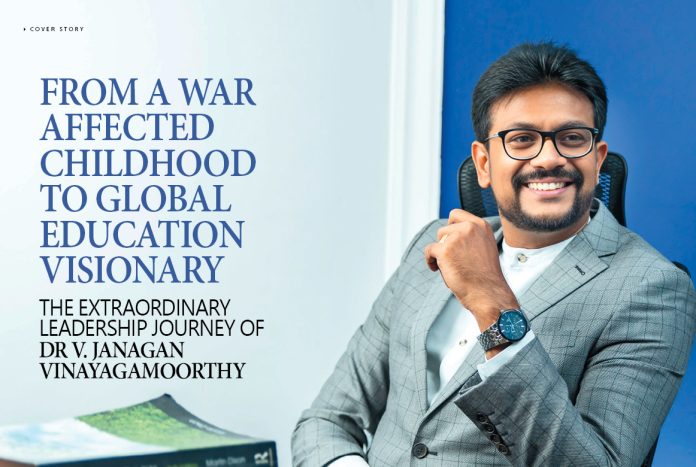
In this exclusive cover story, Global CEO Magazine explores the inspiring transformation of Dr Janagan Vinayagamoorthy, the Chairman of IDM Nations Campus International, whose life journey embodies resilience, purpose and visionary leadership. Born into the uncertainties of Sri Lanka’s civil war and shaped by the hardships of displacement, Dr Janagan discovered early that there was one possession that could never be taken away: education. That realisation became the foundation of his lifelong mission.
From a young lecturer to the leader of one of Sri Lanka’s largest and most innovative higher education networks, his story reflects an unwavering commitment to expanding access to education, especially for students in rural and culturally sensitive regions. Guided by clarity, empathy and adaptability, he built a multi campus institution grounded in strong governance, academic excellence and technology driven innovation.
Under his leadership, IDMNC has emerged as a pioneer in artificial intelligence enhanced learning, future skills education and transnational academic pathways. His global vision goes far beyond institutional growth. With branches now established in the United Arab Emirates, India, Bangladesh and Pakistan, Dr Janagan is positioning Sri Lanka as a rising exporter of education, creating cross border learning hubs and strengthening the country’s influence in regional knowledge economies.
His commitment to student progression extends well beyond graduation. For him, the accurate measure of success is not just completing a course but ensuring students progress into meaningful careers, entrepreneurship or international study opportunities. Through industry partnerships, global pathways and cutting edge curriculum innovation, IDMNC continues to elevate the student experience and align education with real world demands.
As Sri Lanka seeks new economic engines, Dr Janagan believes the education sector can become a national powerhouse, capable of attracting international students, generating revenue, building global talent pipelines and enhancing long term competitiveness. His strategic insights highlight the urgent need for policy reform, international branding and investment in future skills infrastructure.
Q: Dr Janagan Vinayagamoorthy, your career spans lecturing, management, accounting and entrepreneurship. What early experiences, both personal and professional, inspired you to pursue such a multidisciplinary path and ultimately shaped your rise as a leader in the education sector?
My journey is deeply rooted in the realities of Sri Lanka’s civil war, a period that shaped both my character and my convictions. In those uncertain years, when families were displaced and life could change overnight, one thing remained untouched: education. Everything else could be taken from us in an instant, but knowledge followed wherever we went. That truth became the foundation of my entire philosophy.
Living through displacement taught me that education is far more than a pathway to employment. It is a source of dignity, stability and hope, especially for young people facing hardship. It is the one asset that cannot be destroyed, stolen or lost. This belief stayed with me as I moved from lecturing into management, accounting and eventually entrepreneurship. No matter how diverse my roles became, the memory of those early struggles guided my understanding of what education must represent.
My journey across different fields was shaped by necessity, strengthened by curiosity and driven by purpose. Lecturing taught me the heartbeat of the classroom and the aspirations of students. Management and accounting revealed the importance of systems, transparency and institutional discipline. Entrepreneurship encouraged me to think boldly, build sustainably and innovate continuously. Together, these experiences formed the leadership lens through which I see the world today.
Ultimately, the war taught me the most profound lesson of my life: education is the only possession that travels with you, even when everything else falls away. This belief continues to guide my mission to build an education system that empowers every young person, strengthens communities and ensures that no student is limited by circumstance or geography. It is the purpose that drives every decision I make and the reason I remain committed to expanding access to quality education for all.
Q: When you look back at your early years at IDM Nations Campus International, what defining moments and core values guided your evolution from a young lecturer to the Chairman leading one of Sri Lanka’s most dynamic higher education networks?
My early years at IDMNC were a period of intense learning, both professionally and personally. When I began as a young lecturer, my focus was centred on teaching and guiding students towards success. But I soon realised that many of the obstacles students faced were not individual challenges. They were systemic, shaped by limited access, outdated delivery models and the absence of pathways that prepared them for the future. That realisation became a defining turning point for me. It shifted my mindset from contributing as a lecturer to wanting to transform the institution itself.
Several values anchored this transformation.
The first was resilience. Coming from a background shaped by conflict and hardship, I understood that progress is possible only when one refuses to give up.
The second was integrity. I recognised the enormous responsibility that educators and institutions carry in shaping young lives.
The third was innovation. Education must evolve, and I was fortunate to work with founders and senior leaders who encouraged experimentation, new ideas and the introduction of technologies that could elevate the student experience.
Another defining moment came when I began to grasp the accurate scale of IDMNC’s impact. Seeing students from diverse regions rise because of the opportunities we created gave me a more profound sense of purpose and long-term responsibility. Over time, that purpose and those values shaped my transition from lecturer to leader.
Today, as Chairman, I continue to uphold those same principles. They remind me that leadership is not a title. It is a responsibility to continuously improve the system so that thousands of young people can build stronger and brighter futures.
Q: IDMNC has grown into a network of more than twenty seven centres across Sri Lanka. How do you maintain strong governance, academic consistency and a culture of innovation while expanding into diverse regions and serving students from very different social and cultural backgrounds?
IDMNC’s expansion to more than twenty seven centres was never driven by numbers or financial ambition alone. A more profound commitment to social and cultural values guided it. I have always believed that a student should not have to leave their family, community or cultural environment to pursue higher education. This belief is rooted in my own life. During the war, I was displaced many times and I experienced first-hand the emotional and cultural challenges of adapting to new places and unfamiliar environments. Those disruptions taught me how important it is for young people to study in a place where they feel safe, supported and connected.
For this reason, our expansion strategy has always been about bringing higher education to students rather than forcing them to travel to distant cities to access it. Every IDMNC centre is created with a clear purpose: to protect cultural continuity, ease financial burdens on families and allow students to pursue their ambitions without compromising their identity or stability.
To maintain quality across all our centres, we follow a strong and disciplined framework:
Strong governance and structured leadership
Every campus operates under a clear academic and operational framework supported by regular audits and transparent reporting.
Consistent academic standards
Our programmes are benchmarked against international expectations and continuous faculty development ensures the same level of academic excellence regardless of location.
Technology-driven innovation
Artificial intelligence enhanced learning tools, digital platforms and centralised monitoring systems enable us to deliver modern, uniform and high quality education across all centres.
At its core, our growth is rooted in one guiding principle: higher education should reach every student, whether in a city or a rural village, without asking them to sacrifice their culture, community or emotional wellbeing. This principle continues to shape IDMNC’s national presence and defines our mission.
Q: As industries and student expectations continue to evolve, what strategic priorities and academic innovations will drive IDMNC’s next phase of growth, both locally and internationally, as you prepare graduates for the future world of work?
IDMNC is entering a new era in which the demands of talent, technology and global industries are evolving faster than ever before. Our next phase of growth is defined by a strategy that focuses on relevance, innovation and strong international connectivity. The goal is simple: to prepare our students not only for today’s opportunities but for the future world of work.
1. Building a Future Skills Ecosystem
We are aligning all academic faculties with the skills that will define the next decade, including artificial intelligence, data science, cybersecurity, aviation law, digital finance, software engineering, healthcare and hospitality.
Our aim is precise. Every graduate must be job ready, globally competitive and fully equipped for emerging industries.
2. Deep Integration of Artificial Intelligence and Digital Learning Models
We are investing significantly in artificial intelligence supported teaching tools, personalised learning platforms and hybrid delivery models. These initiatives enable us to move beyond traditional classroom structures and create learning experiences that are flexible, adaptive and aligned with industry needs.
3. Ensuring Successful Student Progression Beyond the Classroom
At IDM Nations Campus International, we have always believed that completing a course is not the final achievement for a student. It is only the beginning. Our accurate measure of success is what happens after graduation. For this reason, every programme is built around real progression opportunities, whether that is employment, entrepreneurship or further international study.
We integrate career pathways, industry partnerships and global progression routes directly into our curriculum. From skills based teaching to collaborations with international universities, every element is designed to help students advance confidently into the next stage of their lives.
4. Expanding Transnational Education Pathways
Our international operations in the United Kingdom, South Korea and Singapore have given us valuable insight into global academic standards. We are now developing joint programmes, overseas progression routes and international internship opportunities that allow students to begin their studies locally and complete them abroad.
5. Strengthening Research and Innovation Capacity
IDMNC is building a strong foundation for applied research focusing on education technology, digital transformation and industry driven problem solving. This not only enhances academic credibility but also supports national development.
6. Empowering Regional and Rural Communities
A vital part of our strategy is expanding access to high quality education in rural regions. We want every young person, regardless of geography, to have the opportunity to pursue higher education, gain global exposure and acquire future-ready skills without leaving their community or cultural environment.
7. Developing a Next Generation Academic Workforce
We continue to invest in faculty development, international training and continuous professional learning. This ensures that our academic teams remain fully aligned with global standards and evolving industry expectations.
IDMNC’s long-term vision is clear.
We are evolving into a globally connected, future focused education network that produces skilled, ethical and internationally mobile graduates who will shape the knowledge economies of tomorrow.
Q: IDM has become known as a pioneer in educational innovation. How do you anticipate and respond to shifts in technology, such as artificial intelligence, digital ecosystems and new credential models, to ensure students receive a modern, future ready learning experience?
Innovation at IDMNC is not a reaction. It is a mindset and a way of thinking that shapes every decision we make. We continuously study global trends in education and technology to anticipate what students will need long before those needs become mainstream. This forward looking approach has allowed us to position IDMNC as one of the most innovative higher education networks in Sri Lanka.
1. Embracing Artificial Intelligence and Digital Transformation Early
We recognised early that artificial intelligence would redefine teaching and learning. IDMNC now integrates artificial intelligence into every stage of the student journey, from personalised learning pathways and progress analytics to digital assessments and intelligent student support systems. This ensures that every learner receives a modern, efficient and uniquely customised educational experience.
2. Building Flexible and Future Focused Learning Ecosystems
Traditional classroom models are no longer sufficient for the world our students are entering. We have invested in hybrid and digital learning environments that offer flexibility without compromising academic quality or industry relevance. These ecosystems enable us to support students from diverse regions, both urban and rural, while maintaining consistent standards across all centres.
3. Adopting New Models of Credentials and Recognition
Global education is shifting from rigid qualifications to competency based credentials and micro certifications. IDMNC is actively engaging with this shift. We are introducing programmes that focus on specific skill sets, industry recognised certifications and stackable learning pathways that allow students to enhance their qualifications throughout their careers.
4. Strengthening Industry Integrated Curricula
Innovation is only meaningful when it connects directly to careers. We collaborate closely with industry partners to refine our curriculum, embed practical learning experiences and ensure students gain exposure to emerging sectors such as artificial intelligence, aviation law, cybersecurity and digital finance. This alignment prepares our students not only for employment but for leadership in new and evolving industries.
5. Ensuring Equal Access to Innovation Across Regions
One of our core beliefs is that innovation must never be limited to students in major cities. All our digital platforms, artificial intelligence tools and advanced academic systems are extended across all our centres, including those in rural regions. This guarantees that every student, regardless of location, receives the full benefits of modern education.
Q: With IDM Nations Campus International now established in the United Arab Emirates, India, Bangladesh and Pakistan, you have positioned Sri Lanka as a rising exporter of education. How do you envision IDMNC’s global journey evolving from here, particularly in shaping regional talent development and contributing to emerging knowledge economies across Asia and the Middle East?
As the first Sri Lankan private educator to establish operations beyond our borders, and now with international branches in the United Arab Emirates, India, Bangladesh and Pakistan, my vision for IDMNC’s global journey is clear and long term. Sri Lanka must not remain only an importer of education. We must become a credible global exporter of education.
Our presence in these countries is not simply institutional expansion. It represents Sri Lanka’s rise as a regional provider of knowledge, skills and academic excellence.
1. Exporting Sri Lankan Education to the Region
Through our international centres, we deliver Sri Lankan designed curricula, academic processes and learning models directly to global learners.
This demonstrates that Sri Lankan educational innovation is competitive, reliable and internationally relevant. Our goal is to position Sri Lanka as a contributor to world class education, not merely a consumer of it.
2. Creating Cross Border Learning Hubs in Asia and the Middle East
Our centres in the United Arab Emirates, India, Bangladesh and Pakistan serve as regional hubs that provide higher education and professional training in these markets.
These centres:
• address skill shortages
• uplift regional learning capacity
• showcase Sri Lankan academic leadership
This cross border presence forms the foundation of our export education model.
3. Elevating Sri Lanka’s Role in Transnational Education
For many years, Sri Lanka relied heavily on foreign universities for higher education. My vision changes this direction.
Today, we:
• design programmes that attract international interest
• work with foreign institutions that seek our expertise
• deliver Sri Lankan educational culture and values internationally
This approach strengthens Sri Lanka’s role in the global transnational education sector.
4. Contributing to Workforce Development in Emerging Economies
Countries such as Bangladesh, Pakistan and India are experiencing rapid population growth and an increased demand for skilled workers.
Our international centres support these nations by offering:
• employment oriented education
• modern digital learning ecosystems
• artificial intelligence enabled academic solutions
In the United Arab Emirates, our contribution supports expatriate communities and industries that require future-ready talent.
5. Building Sri Lanka as an Education Export Brand
Every IDMNC centre abroad reflects Sri Lanka’s capability and academic reputation.
Through our international operations, we demonstrate that:
• Sri Lankan educational culture is globally competitive
• Sri Lankan academic leadership can operate successfully across borders
• Sri Lanka can export expertise, not only import degrees
This strengthens our national identity within the global knowledge economy.
6. Creating Regional Student Mobility Pathways
With our network across four countries, students can now:
• begin their studies in their home country
• continue in another IDMNC branch or, progress to our international university partners
This creates a unique Sri Lankan led mobility pathway across South Asia and the Middle East.
Q: You have guided IDM Nations Campus International through significant transformation over the years. How would you describe your leadership philosophy today, and in what ways has it evolved to meet the demands of a rapidly changing, technology driven education landscape?
My leadership philosophy today is built on three core pillars: clarity, empathy and adaptability. These values have guided me from the earliest stages of my career. Yet, they have evolved significantly as IDMNC has transformed into a large multi campus institution in an era defined by technology and rapid change.
1. Clarity of Vision
A leader must provide direction that is simple, consistent and deeply meaningful. My vision has always been grounded in one belief: education must create opportunity, dignity and progression. As technology reshapes industries and student expectations, this clarity helps us remain focused on long term outcomes rather than short term trends.
2. Empathy and Human Centred Leadership
Having lived through civil conflict and displacement, I understand the emotional and social realities that many students face. This background has shaped my leadership, keeping it firmly rooted in empathy. Every decision is made with consideration for the wellbeing, aspirations and cultural contexts of both students and staff.
Even as we adopt advanced digital systems and artificial intelligence, our commitment to human connection remains central.
3. Adaptability in a Fast Moving World
The education sector is evolving at an unprecedented speed. My leadership has therefore shifted from a traditional process driven approach to one centred on innovation, flexibility and continuous learning. I encourage teams to experiment, challenge established models and embrace technology not as a substitute for educators but as a powerful tool that enriches the learning experience.
4. Empowering Leaders at Every Level
As the institution expanded, I realised that leadership cannot remain centralised. Today, I focus on developing leaders across all fifty four centres, creating a culture where people take ownership, think independently and uphold our shared values. Nurturing the next generation of leaders has become one of my most significant responsibilities.
5. Leading with Integrity and Responsibility
In a world where technological advancement can outpace ethical frameworks, leadership must remain principled. Transparency, accountability and fairness guide every decision I make.
Our students trust us with their future, and that trust must never be compromised.
