
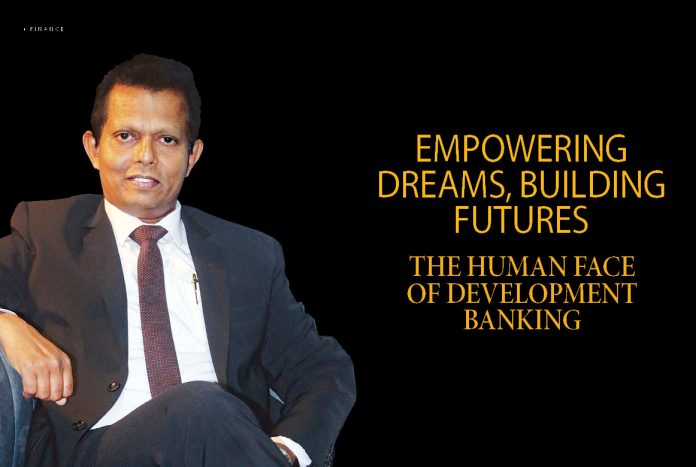
An Interview with Mr. R. M. N. Jeewantha, Deputy General Manager – Development Banking & Branch Credit Operations (Range 2), Bank of Ceylon.
The Bank of Ceylon (BOC) has long stood as a pillar of national development, serving every segment of society through its wide network and strong focus on inclusive banking. We sat down with the Deputy General Manager – Development Banking & Branch Credit Operations (Range 2), who oversees five provinces, to discuss how the Bank continues to drive SME growth, empower women and youth entrepreneurs, and transform lives through financial and non-financial support.
Q. You oversee Development Banking and Branch Credit Operations across five provinces—a vast and diverse area. Could you start by giving us an overview of your division’s mandate and how it contributes to the Bank of Ceylon’s national development goals?
Certainly. The Development Banking and Branch Credit Operations Range 2 Division comes under my purview, with the Branch Credit Operations Range 2 being responsible for managing the Bank’s loan portfolio across five provinces. Meanwhile, the Development Banking Unit is tasked with implementing various development loan schemes through our network of 661 branches across all 11 provinces islandwide, covering a diverse range of economic and social contexts. Our primary mandate is to facilitate access to finance for individuals, entrepreneurs, and SMEs, thereby fostering inclusive economic growth and regional development.
We play a pivotal role in supporting the Bank of Ceylon’s broader national development goals by promoting financial inclusion, empowering the SME sector, and channeling credit into key growth areas such as agriculture, industry, and services. Through our branch network, we ensure that financial services are accessible even in remote areas, enabling businesses to expand and communities to thrive.
In essence, our division acts as a bridge between the Bank’s strategic objectives and the grassroots economic activities that power the nation’s development. By aligning our operations with the country’s policy priorities, we help translate the Bank’s vision of being the nation’s bank into tangible outcomes across the regions we serve.
Q. SMEs form the backbone of Sri Lanka’s economy. How is the Bank of Ceylon supporting their growth through development banking, especially in the regions you oversee?
Indeed, SMEs are the lifeblood of the Sri Lankan economy. They account for the majority of businesses, provide substantial employment, and play a pivotal role in regional development. Recognising this, the Bank of Ceylon has made SME empowerment a top strategic priority.
We have introduced a range of SME-focused credit schemes offering concessionary interest rates, flexible repayment structures, and easy access to capital for expansion, modernisation, and diversification. Our development banking teams work closely with entrepreneurs to understand their business models and identify tailor-made financial solutions that fit their needs.
BOC Energizer
The BOC Energizer scheme is a flagship initiative targeting rural entrepreneurs, women-led businesses, and youth-owned enterprises. It provides substantial financial support to both established and emerging ventures.
• Existing SMEs and MSMEs are eligible to receive loans of up to LKR 50 million to scale operations or invest in expansion.
• Startups and new ventures can access financing of up to LKR 2 million, with attractive interest rates and supportive terms aimed at encouraging entrepreneurship in underserved regions.
Re-Energizer Loan Scheme
Under the Re-Energizer Scheme, credit facilities of up to Rs. 25 million can be considered to meet both investment and working capital requirements. A repayment period of up to 10 years is available, with a special focus on MSMEs engaged in manufacturing, construction, export-oriented activities, tourism, apparel, fisheries, animal husbandry, agriculture, and agro-based industries.
SMILE – III Loan Scheme
The ‘SMILE – III’ Scheme is specifically designed to provide financial assistance for the purchase of machinery by micro and small entrepreneurs in the manufacturing sector. This includes industries such as food processing, textiles and garments, agro-industries, fisheries, animal husbandry, and horticulture. The scheme offers a maximum loan amount of Rs. 25 million with a repayment period of up to 10 years.
National Credit Guarantee Loan Scheme
The Bank of Ceylon, in collaboration with the National Credit Guarantee Institute, implemented the National Credit Guarantee Scheme with the objective of overcoming the critical barrier of insufficient collateral that often restricts small and medium-sized enterprises from accessing essential financing. Under the scheme, the Bank is able to extend credit facilities for both investment and working capital purposes based on customers’ project proposals, without the need for collateral.
Under the scheme, loans of up to Rs. 25 million are available for investment purposes, with a repayment period of five years including a one-year grace period. Similarly, working capital facilities of up to Rs. 25 million are offered with a repayment tenure of up to three years.
By providing partial guarantees, the NCGS reduces lenders’ exposure to risk, encouraging them to approve loans based on business viability rather than traditional collateral. This initiative offers a crucial opportunity for entrepreneurs with viable ideas who lack tangible assets.
Among the 13 participating institutions under the NCGI, the Bank of Ceylon plays a pivotal role in promoting the loan scheme across the country.
In line with the recent budget proposals for 2026, the Government has planned to further strengthen and continue the National Credit Guarantee Initiative. As the premier State bank, the Bank of Ceylon is fully committed to supporting this initiative by continuing the National Credit Guarantee Scheme and placing greater emphasis on cash-flow–based lending.
Non- Financial Support provided by Bank of Ceylon
In its continued commitment to national economic development, the Bank of Ceylon (BOC) has taken a leading role in supporting the SME sector — not only through financial assistance but also by offering a wide range of non-financial services aimed at empowering entrepreneurs and strengthening the foundation of small and medium enterprises across the country.
BOC’s SME Circle initiative provides a dedicated advisory platform where entrepreneurs can access professional guidance on business planning, market expansion, and operational challenges. This service also facilitates crucial linkages between SMEs and government or private sector institutions, enhancing access to resources and support systems beyond banking.
The Export Circle of Bank of Ceylon is a specialised unit dedicated to supporting and facilitating the export activities of Sri Lankan businesses. It plays a crucial role in promoting international trade by providing tailored financial solutions and advisory services to exporters, helping them navigate the complexities of global markets.
As part of its ongoing commitment to strengthening the SME sector, the Bank of Ceylon is conducting “SME Clinics” at provincial level to address the specific challenges faced by entrepreneurs. These clinics offer personalised, one-on-one advisory support, enabling SME owners to receive targeted solutions tailored to their unique business needs.
In partnership with key external institutions such as the Export Development Board (EDB), Industrial Development Board (IDB), National Enterprise Development Authority (NEDA), Small Business Development Division (SED), and the Industrial Technology Institute (ITI), the Bank ensures a comprehensive service offering that goes beyond traditional banking.
During this year alone, the Bank successfully conducted around 10 SME Clinics, extending services to over 1,000 SME entrepreneurs across the country. This initiative reflects BOC’s broader mission to promote inclusive economic development by empowering local enterprises with the tools, knowledge, and support they need to thrive.
Q. Micro and consumer lending are critical to promoting inclusive finance. How do you ensure access to credit across your provinces while maintaining responsible and sustainable lending practices?
Inclusive finance is a cornerstone of our operations. Our goal is to ensure that every individual—regardless of location or income level—has access to affordable and responsible credit facilities. However, accessibility alone is not enough; lending must be sustainable and beneficial to both the borrower and the economy.
The Bank of Ceylon (BOC) has taken a leading role in promoting financial inclusion across Sri Lanka, implementing several innovative measures to bring informal and underserved communities into the formal financial system. Recognising that access to finance is a key driver of economic empowerment and poverty reduction, the Bank has introduced a series of targeted initiatives aimed at improving accessibility, trust, and financial literacy among rural populations.
One of BOC’s flagship community development projects, BOC Gammana, integrates financial inclusion with rural development by transforming underprivileged villages into model communities. Through this programme, the Bank has upgraded local infrastructure—introducing smart classrooms, libraries, and clean drinking water systems—while simultaneously promoting savings habits and delivering financial literacy training. By combining tangible community benefits with financial education, BOC effectively bridges the gap between social development and banking participation.
The BOC Mithuru Programme represents another cornerstone of the Bank’s inclusive finance strategy. Designed as a community-based microfinance initiative, it targets low-income individuals, particularly women, through the formation of self-help savings groups. These groups, guided by BOC field officers, foster collective saving, credit discipline, and entrepreneurship. Participants gain access to small-scale loans for income-generating activities such as food processing, livestock farming, and tailoring. To date, more than 12,000 families have benefitted from this initiative, which has established over 2,750 Mithuru groups across Sri Lanka.
To address the lack of banking infrastructure in remote areas, BOC has also introduced BOC Connect, an agency banking service launched in collaboration with Sri Lanka Post. This service extends core banking facilities—such as deposits, withdrawals, fund transfers, and bill payments—through authorized post offices and designated centers, allowing customers to conduct financial transactions conveniently within their communities. Complementing this effort is Branch on Wheel, a mobile banking service that physically delivers banking services to remote areas using mobile units equipped with modern banking technology.
These initiatives, supported by leadership under Mr. Y.A. Jayathilaka, Chief Executive Officer of BOC, have collectively advanced the Bank’s mission to strengthen financial inclusion and support national development. They demonstrate BOC’s commitment not only to expanding access to finance but also to fostering economic participation and resilience in marginalized communities.
In conclusion, the Bank of Ceylon’s multi-dimensional approach—blending community development, technology-driven access, and tailored financial services—has made significant progress in bringing informal communities into the formal financial system. Strengthening these efforts through greater digital inclusion, strategic partnerships, and policy alignment will further enhance Sri Lanka’s journey towards an inclusive, equitable financial landscape.
Q. One of your key responsibilities includes driving entrepreneurship among women and youth. How does the Bank of Ceylon encourage and empower women entrepreneurs at the grassroots level?
Empowering women is not only a social priority but an economic imperative. At the Bank of Ceylon, we recognise that women entrepreneurs play a critical role in community development and household resilience. However, many face barriers such as limited access to capital, lack of financial literacy, and restricted market exposure.
To address these challenges, we have introduced specialised loan schemes for women-led enterprises with flexible conditions that take into account their specific needs.
The “Ran Liya” Loan Scheme:
The “BOC Ranliya” Loan Scheme is specifically tailored for women entrepreneurs, offering flexible financing solutions of up to Rs. 100 million to support both investment and working capital needs.
Loans for investment purposes carry a repayment period of up to five years, while working capital facilities are offered with a repayment period of up to 03 years. This scheme not only promotes female participation in the economy but also helps bridge the gender gap in access to finance.
The “Siri Liya Saviya” credit scheme
To promote women’s economic empowerment and enhance their participation in entrepreneurial activities, credit facilities may be extended to women entrepreneurs for income-generating projects. Under this initiative, eligible women can access loans of up to Rs. 2 million, with a repayment period of up to eight years and a grace period of two years.
SME Trade Fair
Recognising the importance of providing non-financial services to women entrepreneurs, the Bank of Ceylon, in commemoration of International SME Day on June 27th, successfully organised a three-day SME Trade Fair free of charge at the historic Dutch Hospital premises. The event was designed to support small and medium enterprises (SMEs) financed by the Bank by offering women entrepreneurs valuable opportunities to showcase and market their products, enhance business visibility, and expand their customer base.
Q. The programme to develop 10,000 youth entrepreneurs is an inspiring initiative. Could you tell us more about how this programme is structured and the kind of financial and non-financial support provided?
The “ BOC Youth “ is one of our flagship initiatives aimed at nurturing the next generation of Sri Lankan entrepreneurs. The vision is to identify young individuals with innovative ideas and the drive to create self-employment or small business ventures—and then provide them with the right mix of financial and non-financial support to succeed.
BOC launched the “ BOC Youth Loan Scheme”, whose supported more than 18,000 young entrepreneurs with loans up to Rs. 500,000 across multiple sectors including manufacturing, agriculture, IT, tourism and services.
In its continued commitment to driving national economic development, the Bank of Ceylon (BOC) has taken a pioneering role in supporting young entrepreneurs — not only by providing financial assistance but also by delivering a wide range of non-financial services designed to empower and guide them towards sustainable success.
As part of this initiative, youth entrepreneurs who have obtained credit facilities are categorised into 12 dedicated WhatsApp groups. Through these groups, BOC offers ongoing mentorship, business guidance, and access to valuable resources, thereby extending its support beyond traditional banking services.
Q. What tangible results or success stories have you seen so far from these youth and women entrepreneurship initiatives?
The impact has been both tangible and inspiring. Across the provinces, we are witnessing young entrepreneurs who started with modest beginnings now managing successful and sustainable businesses. Many have gone on to employ others in their communities, contributing to local job creation and income generation.
For instance, several youth-led agricultural enterprises have adopted advanced technologies such as drip irrigation, hydroponics, and greenhouse cultivation after receiving our guidance and financial support. These ventures are now thriving examples of innovation-driven rural development.
Similarly, numerous women-led enterprises have transitioned from informal, home-based operations to structured businesses with established brands and market presence. These stories of empowerment reflect the essence of our mission—to create meaningful opportunities that uplift individuals, strengthen communities, and build a more inclusive and resilient economy for Sri Lanka.
Q. Looking ahead, what are your priorities for development banking and retail credit in the coming years?
Our vision is to deepen our reach and enhance efficiency through technology and innovation. We are working on expanding digital lending platforms that can process credit faster and more transparently, especially for rural clients.
As agriculture continues to serve as the backbone of Sri Lanka’s rural economy, the Bank of Ceylon (BOC) has initiated plans to establish a dedicated Agri-Finance Unit to provide focused financial support to farmers and agri-based industries. Through targetted development lending, the Bank finances key sectors such as paddy cultivation, fisheries, dairy farming, and home gardening. By strengthening these vital areas, BOC not only contributes to national food security but also enhances income generation and livelihood opportunities for thousands of rural households.
The Bank of Ceylon (BOC) has recently launched the “BIZplus” Credit Card, specially designed for SME customers as a new initiative to strengthen and support their business operations. This innovative product aims to provide greater financial flexibility, improve cash flow management, and empower entrepreneurs to meet their short-term business needs efficiently.
Another focus is on strengthening partnerships—with government agencies, donor institutions, and private sector entities—to widen access to capital and knowledge. Sustainability is a major theme for us going forward. We want to support environmentally responsible projects, promote renewable energy adoption, and encourage green financing among SMEs. The ultimate goal is to make development banking a driving force for inclusive, sustainable national prosperity.
Q. Finally, on a personal note, what motivates you to lead such impactful initiatives, and what message would you like to share with Sri Lanka’s aspiring entrepreneurs?
On a personal note, I am motivated by the opportunity to create meaningful impact through banking. Enabling individuals and businesses to grow, generate employment, and contribute to national development gives me immense satisfaction. Each success story reminds me that our efforts extend far beyond financial transactions — they help transform lives and strengthen communities across the country.
My message to Sri Lanka’s aspiring entrepreneurs is simple: believe in yourself, stay focused, and keep moving forward even when challenges arise. With hard work and the right guidance, success will follow. The Bank of Ceylon will continue to stand by you, providing the support you need to grow and make a positive impact on our nation.
Finally, I would like to extend my sincere gratitude to Mr. Kavinda De Zoysa, the Chairman of Bank of Ceylon, and the Board of Directors, as well as the General Manager and Corporate Management of the Bank, for their exceptional leadership, guidance, and unwavering support. I also wish to acknowledge and thank my dedicated team in the ‘Consumer and Development Banking and Branch Credit Operations Range 2 Division’ for their valuable contributions in ensuring the seamless delivery of services to the SME sector.
