
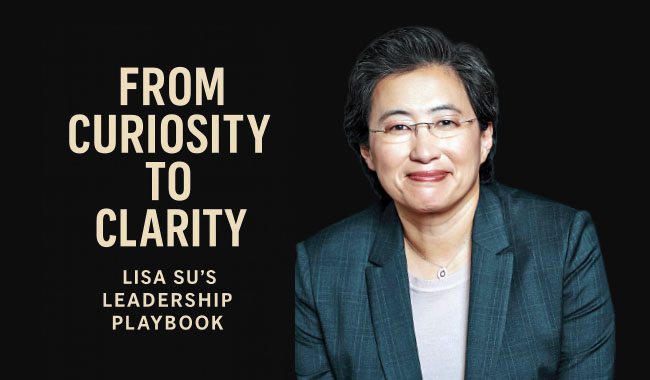
Lisa Su, the chair and chief executive officer of Advanced Micro Devices (AMD), is widely hailed as the “queen of chips”.
She has transformed AMD from a struggling underdog into one of the most formidable technology companies in the world, powering everything from smartphones to supercomputers and driving the artificial intelligence revolution. Her story is one of curiosity, resilience, bold strategy and a distinctive leadership style that has inspired a generation of leaders.
A Journey of Curiosity and Persistence
Born in 1969 in Taiwan and raised in New York, Su was encouraged by her parents to excel academically. From an early age she displayed a natural curiosity. She recalls dismantling her brother’s remote-controlled cars, determined to understand why they stopped working. This instinct for tinkering set her on the path to engineering.
Su went on to study electrical engineering at the Massachusetts Institute of Technology (MIT), where she earned her bachelor’s, master’s and doctoral degrees. Her PhD work in silicon-on-insulator technology placed her at the cutting edge of semiconductor design. Speaking later about those years, she remarked: “The ability to learn at each step was what really helped me in my career.”
After completing her studies, Su joined Texas Instruments, followed by IBM where she spent over a decade. At IBM, she contributed to innovations such as copper interconnects, which significantly boosted chip performance. A turning point came when she was appointed technical assistant to Lou Gerstner, IBM’s chief executive. It was here that she gained a rare view of leadership at the highest level, an experience she describes as one of the most formative of her career.
Climbing the Ladder in Semiconductors
Su later became chief technology officer and senior vice-president at Freescale Semiconductor. But her career-defining move came in 2012 when she joined AMD. Many at the time questioned the wisdom of this choice, as AMD was seen as perpetually overshadowed by Intel and struggling with erratic execution. Yet Su saw potential.
In October 2014, she was appointed CEO at a time when AMD’s shares hovered around three dollars and bankruptcy loomed. For many, the company was a fading name. For Su, it was a challenge worth embracing. “It was never a doubt that this was my dream job,” she later reflected.
The AMD Turnaround
Su’s approach was both bold and disciplined. She resisted the temptation to chase the booming smartphone market and instead placed a decisive bet on high-performance computing. She believed AMD’s greatest strength lay in designing the most powerful chips for personal computers, gaming, data centres and emerging AI applications.
This meant rebuilding AMD’s product architecture from the ground up. The breakthrough came with the Zen processors, designed with a modular “chiplet” structure that gave AMD a technological and cost advantage. The results were transformative. By 2021, AMD’s market capitalisation had surged past Intel’s, an achievement few would have imagined just years earlier.
Su’s success is not measured only in financial terms but also in strategic foresight. She understood that semiconductors were becoming central not only to consumer devices but also to national security, global supply chains and artificial intelligence. “In technology it is about making the right bets. The decisions we make today show results three to five years later,” she explained.
A Distinctive Leadership Style
Su’s leadership style is grounded in curiosity, integrity and the pursuit of hard problems. She challenges her teams with ambitious goals, such as demanding chips that were 40 per cent faster than previous generations, but she also gives them the time and trust to achieve them. “What leaders do is bring teams together to do something that nobody thought was possible,” she told Stanford Graduate School of Business.
She places strong emphasis on learning cultures, encouraging her teams to see setbacks as opportunities for growth. At AMD, she cultivated an ethos of collaboration and resilience. By communicating clearly and repeatedly, she ensured that every employee, from engineers to field advisers, understood the company’s direction.
Another hallmark of her leadership is her willingness to bet on overlooked talent. She credits her own rise to mentors who gave her unexpected opportunities, and she now extends that philosophy to others. “Our job as leaders is to give people opportunities. You cannot guarantee success, but you can help identify potential,” she says.
Navigating a Changing World
As semiconductors have become entangled with geopolitics, Su has demonstrated pragmatic clarity. She acknowledges that technology leadership today is as much about policy and supply chain resilience as it is about design. While AMD is a global company, she insists on compliance with US regulations and views industry participation in policy dialogue as vital.
She has also advanced AMD’s strategy in artificial intelligence, positioning the company as a key competitor to Nvidia. AMD’s commitment to open software ecosystems reflects Su’s belief in flexibility and customer choice, even though it requires more effort in interoperability.
For Su, the rise of AI is not merely a business opportunity but a chance to tackle society’s hardest problems. She envisions AI applications in healthcare, drug discovery and climate change, where accelerated computing could shorten research cycles from years to months.⸻
Dreaming Big
Despite her achievements, Su remains forward-looking. She urges young leaders to embrace uncertainty and seize opportunities. “Dream big. This is the time to have a bold, audacious dream and follow it,” she told Stanford students.
From a curious child dismantling toy cars to the queen of chips at AMD, Lisa Su exemplifies the power of persistence, clear vision and transformative leadership. Her story is not only about turning a company around but about showing what is possible when leaders dare to bet on the future.
References
Business Insider, 2025. Lisa Su on AMD’s strategy and the “what do you want to be when you grow up” question. Business Insider, 13 March. Available at: https://www.businessinsider.com/amd-ceo-career-question-lisa-su-what-do-you-want-2025-3
Chazan, G., 2025. Lisa Su, the queen of chips taking aim at Nvidia’s $4trn powerhouse. The Sunday Times, 23 August. Available at: https://www.thetimes.co.uk/article/lisa-su-amd-nvidia-intel-artificial-intelligence-nflrv5vlp
Chief Executive, 2024. CEO Of The Year: A Conversation With AMD’s Revolutionary Lisa Su. Chief Executive, 23 October. Available at: https://chiefexecutive.net/ceo-of-the-year-a-conversation-with-amds-revolutionary-lisa-su
Stanford Graduate School of Business, 2025. “Dream Big”: Lisa Su talks chips, curiosity, and chance. Stanford Graduate School of Business Insights, 4 June. Available at: https://www.gsb.stanford.edu/insights/dream-big-lisa-su-talks-chips-curiosity-chance
Time, 2024. CEO of the Year 2024: Lisa Su. Time, 10 December. Available at: https://time.com/7200909/ceo-of-the-year-2024-lisa-su
Wikipedia, 2025. Lisa Su. Wikipedia. Available at: https://en.wikipedia.org/wiki/Lisa_Su
