
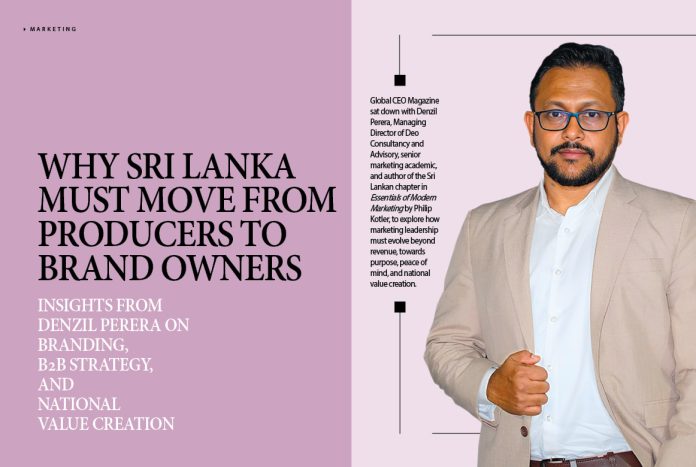
Global CEO Magazine sat down with Denzil Perera, Managing Director of Deo Consultancy and Advisory, senior marketing academic, and author of the Sri Lankan chapter in Essentials of Modern Marketing by Philip Kotler, to explore how marketing leadership must evolve beyond revenue, towards purpose, peace of mind, and national value creation.
Q: You recently met Professor Philip Kotler, widely regarded as the father of modern marketing. How did that interaction change your view of marketing leadership?
As marketers, we have traditionally been driven by numbers revenue, market share, volume, and profitability. Brand equity, ultimately, has been measured through financial outcomes. While we often speak about sustainability, much of it has remained superficial.
What struck me in my discussion with Professor Kotler was his evolving thinking. He is now proposing a six Ps framework, extending beyond the traditional models he himself created. One of those Ps is peace. When he spoke about peace, he referred to organisational peace and peace among nations. I challenged him further and proposed peace of mind for individuals.
Peace of mind matters when consumers buy products that truly deliver what they promise, and when societies move beyond endless consumption. Sri Lanka has practised mindfulness for over 2,500 years. We had it freely, yet never valued it. Today, Western universities teach mindfulness academically. This conversation reinforced my belief that Sri Lanka has something original to contribute to global marketing thought.
Q: Did this conversation challenge any long held assumptions you had as a marketer and educator?
Yes, very much so. While writing the Sri Lankan chapter for Essentials of Modern Marketing, I reflected deeply on what truly makes a good marketer. One insight that emerged from my professional practice was the need to extend the classic STP framework.
In theory, we segment, target, and position. In practice, I realised there must be a fourth element profiling. Every segment ultimately consists of unique individuals. To communicate effectively, marketers develop a representative consumer profile that guides advertising, research, digital strategy, and media planning. I termed this STPP.
Professor Kotler found this practical addition compelling and later acknowledged it positively. That validation reaffirmed the importance of grounded, experience based marketing frameworks emerging from markets like Sri Lanka.
Q: How has this influenced your role as a leader and educator in marketing?
I recognised a significant gap. Sri Lanka produces capable professionals, largely due to multinational exposure. However, the transfer of knowledge often stops at operational execution. We rarely develop global brand thinkers.
We import theories from the West but apply them in a very different socio economic context. That requires adaptive skills. More importantly, Sri Lanka must move from being a producer to a brand owner. Countries become wealthy by owning brands, not merely manufacturing products.
Take Coca Cola and Elephant House, both founded in the late nineteenth century. Product quality alone did not determine their global positions branding did. That realisation has shaped my commitment to developing brand thinking as a national capability.
Q: You have spoken strongly about B2B marketing being the next frontier. Why has it remained under-represented in Sri Lanka?
B2C dominates attention because it targets mass audiences. B2B, by contrast, often involves a small number of clients sometimes fewer than twenty. As a result, companies under-estimate the need for branding.
Yet B2B organisations are the backbone of our economy, particularly exporters. Companies like Brandix operate entirely in B2B, contributing immensely to national income while remaining invisible to the public.
For SMEs, I believe the journey should begin with B2B. It stabilises cash flow, improves processes, and builds operational discipline. Once that foundation is strong, B2C branding becomes far more sustainable.
Q: How can Sri Lankan companies reposition themselves for regional and global B2B value chains?
Sri Lanka is a small economy by scale, but our opportunities lie beyond borders. When companies restrict their vision to domestic markets, they remain trapped in intense competition. The moment they step outside, blue ocean opportunities emerge.
I have seen this first-hand through regional brand expansions in Bangladesh, Africa, and beyond. Sri Lanka has natural resources, creative capital, and cultural depth that global markets value. Branding is the bridge that allows us to monetise these strengths internationally.
Q: What kind of collaboration is needed to strengthen Sri Lanka’s national marketing ecosystem?
What we lack is coordination. Many institutions train entrepreneurs, but entrepreneurs do not need motivation, they need facilitation.
We need regional centres that provide packaging, labelling, logistics, digital marketing, and export support. An apex national body must align universities, professional institutes like SLIM, industry, and government with a clear objective measurable brand outcomes.
Training without monetisation leads nowhere. What gets measured gets done.
Q: You often speak about mind to mind marketing. What does this mean for the future of marketing?
Human to human marketing emphasises empathy. Mind to mind marketing goes deeper. It addresses why people consume excessively to seek happiness.
True sustainable consumption requires reducing consumption, which is uncomfortable for marketers and boards. The alternative is offering peace of mind as value.
Countries like Bhutan are already monetising mindfulness. Sri Lanka has a far deeper heritage. We must brand it, package it, and invite the world to experience it authentically.
Q: How can Sri Lanka contribute original marketing thought to the global discourse?
We already have. Sri Lanka was the first country to declare National Marketing Day on Professor Kotler’s birthday. That single act sparked global replication.
Thought leadership begins with simple, authentic ideas. Sri Lanka should position itself as the global centre of Theravada philosophy and mindfulness. This must transcend politics and become national policy.
The world is searching for meaning beyond religion. Sri Lanka can offer philosophy, balance, and peace.
Q: Finally, what responsibility do senior marketing leaders carry today?
We must create platforms, not hierarchies. Young professionals today are informed, confident, and globally aware. Respect is non -negotiable.
Four generations now work together. My generation serves as the bridge. We understand both pre digital and digital worlds. Our role is to enable harmony, not authority.
If we combine generational strengths, respect individuality, and focus on shared purpose, Sri Lanka can build brands, values, and mindsets that endure.
