
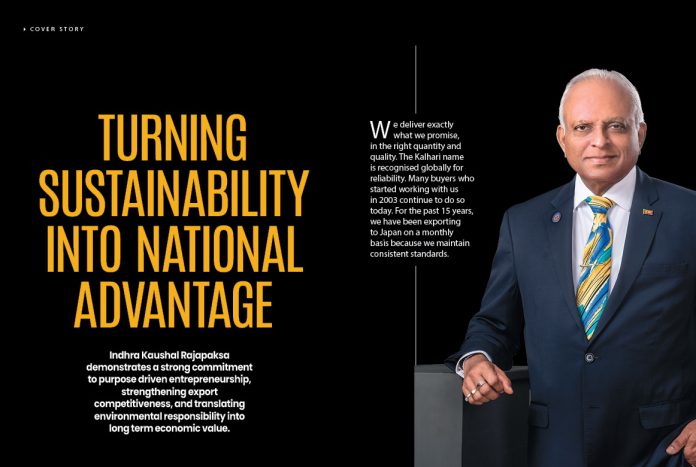
Indhra Kaushal Rajapaksa demonstrates a strong commitment to purpose driven entrepreneurship, strengthening export competitiveness, and translating environmental responsibility into long term economic value.
In an era where sustainability has become a corporate imperative, few leaders can claim to have embraced it long before it entered boardroom vocabulary. Indhra Kaushal Rajapaksa stands firmly among that rare group. As Chairman of the Kalhari Group of Companies, Group Managing Director of Sea Leisure Yachting Group including Sail Lanka Charter, President of the National Chamber of Exporters, and Chairman of the Chamber of Marine Industries, his leadership influence extends well beyond the boundaries of a single enterprise.
Rajapaksa also plays a significant strategic advisory role at the national level. He serves on the Boat and Shipbuilding Advisory Committee of the Ministry of Industries and actively contributes to regional development as Chairman of the Northern Investment Summit. These engagements reflect his deep involvement in shaping policy dialogue, promoting investment, and driving sectoral development across Sri Lanka’s emerging and future facing industries.
Founded in 2003 with a clear purpose of recycling industrial and post consumer waste, the Kalhari Group has evolved into Sri Lanka’s leading recycling enterprise. Its operations are largely focused on tyre industry waste recycling and export driven manufacturing.
What began as a single initiative has grown into a diversified group built on discipline, innovation, ethical leadership, and long term thinking, demonstrating how sustainability can be embedded at the core of a viable business model.
Beyond commercial success, Rajapaksa’s leadership philosophy is rooted in institution building, people development, and national responsibility.
At a time when Sri Lanka is seeking sustainable growth, industrial resilience, and renewed global credibility, his work offers a compelling example of how purpose-driven entrepreneurship can transform environmental responsibility into economic opportunity and lasting national impact
In this exclusive cover story, Global CEO Magazine explores the journey, values, and vision of a leader whose influence continues to shape Sri Lanka’s sustainability agenda, export strategy, and marine industry landscape.
In addition to his professional responsibilities, Mr Rajapaksa continues to play an active role across a wide spectrum of institutional and industry bodies.
He currently serves as a Director of the Indira Cancer Trust, Chairman of the Industrial Relations Committee of the Institute of Environmental Professionals, Vice President of the Confederation of Small and Medium Industries, and a General Assembly Member of the SAARC Chamber of Commerce and Industry.
He is also a member of the Executive Committee of both the China Business Council and the Singapore Business Council, and the Immediate Past President of the Sri Lanka Pakistan Business Council.
His longstanding commitment to leadership and service is further reflected in his previous contributions as Past President of the Chartered Management Institute and the Plastics and Rubber Institute, as well as his role as Past Council Chairman of Lions District 306.
Sustainability Before It Became Mainstream
■ As we mentioned in our introduction, you embraced sustainability long before it became a mainstream business focus in Sri Lanka. What inspired you to enter this field?
This journey began in 2003. At that time, I observed PET bottles used for drinking water and aerated beverages being discarded everywhere across cities and towns. That made me think about how these discarded materials could be put to productive use and transformed into a sustainable industry.
After conducting research, I started this project with just three people who left my former footwear industry to join me. From the very beginning, sustainability was not a side initiative for the Kalhari Group. It has always been at the core of our business model.
We began with PET bottle recycling and gradually expanded into e-waste, other plastic waste streams, rubber recycling, tyre waste recycling, and steel dust recycling.
Through tyre waste recycling and steel dust recycling, we have addressed serious environmental challenges while also contributing US dollar earnings to the country.
Leadership Principles at Kalhari Group
■ You lead a business that balances profitability with environmental responsibility. What leadership principles guide you?
We operate as a professional organisation with a strong focus on quality. Even though we export waste-derived products, quality is non-negotiable.
We deliver exactly what we promise, in the right quantity and quality. The Kalhari name is recognised globally for reliability. Many buyers who started working with us in 2003 continue to do so today. For the past 15 years, we have been exporting to Japan on a monthly basis because we maintain consistent standards.
Equally important is empowering our people. We operate four factories, and our staff are fully entrusted with operational responsibility. We maintain close dialogue between management and employees, and ensure a harmonious working environment. Our people are truly the driving force behind the company.
Sustainability and Export Competitiveness
■ As President of the National Chamber of Exporters, how important is sustainability in strengthening Sri Lanka’s export competitiveness?
In collaboration with the Export Development Board, the National Chamber of Exporters has been working closely to support exporters while also developing aspiring exporters.
We actively engage with regional producers across the North, South, and other areas, creating platforms for suppliers to interact with exporters, understand quality standards, packaging requirements, and global market expectations.
This continuous dialogue has been a game changer for aspiring exporters, helping them transition into established exporters. As the voice of exporters, our role is to nurture and develop this ecosystem.
Northern Investment Summit
■ As Chairman of the Northern Investment Summit, you have been focusing on investment in the Northern Province. Could you tell us more about this initiative?
The Northern Investment Summit was initiated by The Management Club (TMC), which is now over 23 years old and was founded by its Emeritus President, Mr Fayaz Saleem. The club brings together professionals in management and leadership and provide opportunity for knowledge sharing and networking.
During my presidency, we established The Management Club chapter in Jaffna, led by a dynamic member of university of Jaffna. The request from the region was clear: to support the accelerated economic development of the Northern Province through professional engagement.
The Northern Investment Summit, scheduled for 21 and 22 January, focuses on four key sectors: agriculture and fisheries, education and IT, tourism, and energy. The Governor of the Northern Province, together with all five District Secretaries, is extending full cooperation to drive the initiative to create investment ready opportunities.
KPMG, as our knowledge partner, is consolidating these opportunities into structured investment propositions. We are encouraging diaspora investors, as well as leading Sri Lankan industrialists, to participate and collaborate in developing the Northern economy.
Boat and Shipbuilding Industry
■ You have also taken a strong interest in boat and yacht building. Could you share your role in this sector?
I serve as Chairman of the Boat and Shipbuilding Advisory Committee under the Ministry of Industries and as Chairman of the Chamber of Marine Industries. I am also Group Managing Director of Sea Leisure Yachting Group including Sail Lanka Charter.
Our group operates four factories in the South and one in the North, all staffed by Sri Lankan youth. Recently, a team from Jaffna successfully built a 60-passenger motorboat, which is a significant achievement.
Sri Lanka has 63 boat manufacturing companies, but only around 10 currently export. We are working to encourage more manufacturers to enter export markets and to promote boating as a lifestyle locally, thereby expanding domestic demand.
Sri Lankan-built boats are of exceptional quality and comparable to global standards. We will be hosting the ninth Sri Lanka Boat Show at Port City on 30 and 31 January and 1 February, providing an opportunity to showcase local capabilities.
Legacy and Advice to Young Entrepreneurs
■ Finally, what legacy do you hope to leave through the Kalhari Group and your wider initiatives, and what advice would you give to young entrepreneurs?
My key message is simple: waste is not waste, waste is wealth. If waste is properly segregated, it has value. Never dispose of waste irresponsibly, as environmental damage ultimately affects us all.
We must follow the principles of reuse, recycle, and reduse. Reduce plastic use wherever possible, reuse what you can, and recycle responsibly.
To young entrepreneurs, I would say this: nothing is impossible if you have the will. Be your own master, make informed decisions, act at the right time, and avoid unnecessary delays. Do what needs to be done today, today.
At the same time, I respectfully request the younger generation to come forward and contribute their expertise and knowledge towards the development of our motherland.
