
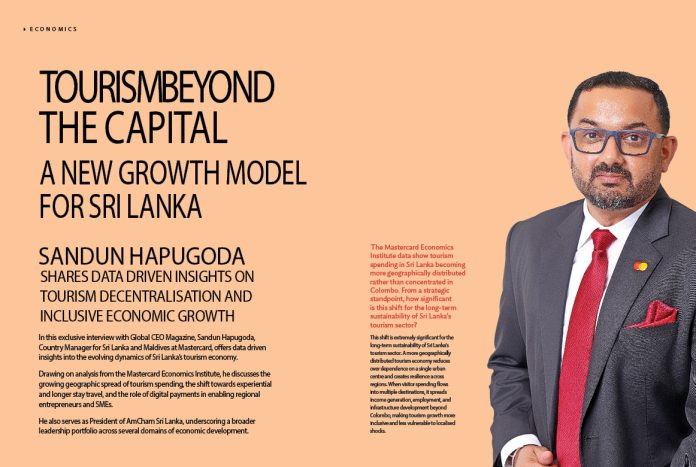
Sandun Hapugoda shares data driven insights on tourism decentralisation and inclusive economic growth
In this exclusive interview with Global CEO Magazine, Sandun Hapugoda, Country Manager for Sri Lanka and Maldives at Mastercard, offers data driven insights into the evolving dynamics of Sri Lanka’s tourism economy.
Drawing on analysis from the Mastercard Economics Institute, he discusses the growing geographic spread of tourism spending, the shift towards experiential and longer stay travel, and the role of digital payments in enabling regional entrepreneurs and SMEs.
He also serves as President of AmCham Sri Lanka, underscoring a broader leadership portfolio across several domains of economic development.
The Mastercard Economics Institute data show tourism spending in Sri Lanka becoming more geographically distributed rather than concentrated in Colombo. From a strategic standpoint, how significant is this shift for the long-term sustainability of Sri Lanka’s tourism sector?
This shift is extremely significant for the long-term sustainability of Sri Lanka’s tourism sector. A more geographically distributed tourism economy reduces over dependence on a single urban centre and creates resilience across regions. When visitor spending flows into multiple destinations, it spreads income generation, employment, and infrastructure development beyond Colombo, making tourism growth more inclusive and less vulnerable to localised shocks.
Strategically, this diversification strengthens Sri Lanka’s tourism value proposition by offering a broader range of experiences while ensuring that economic benefits reach communities across the country, supporting balanced and sustainable growth.
Emerging destinations such as Ella and the Southern Belt locations including Ahangama and Weligama are seeing strong growth in transaction share. What changing traveller behaviours and preferences are driving this move towards experiential travel and longer stays?
Today’s travellers are increasingly seeking authentic, experience-led journeys rather than short, city centric visits. Destinations like Ella, Ahangama, and Weligama align well with this shift, offering nature, wellness, surf culture, and community based experiences.
We also see a rise in longer stays, driven by flexible work arrangements and lifestyle-oriented travel, where visitors spend weeks rather than days in a destination. These travellers value local food, boutique accommodation, and immersive experiences, which naturally directs spending towards smaller towns and coastal or hill-country regions rather than traditional urban hubs alone.
Traditional centres like Kandy and Galle continue to contribute meaningfully despite modest declines in share. How should policymakers and tourism stakeholders balance strengthening established destinations while nurturing newer tourism hubs?
This should not be viewed as a trade-off, but rather as a portfolio strategy. Established destinations such as Kandy and Galle remain anchors of Sri Lanka’s cultural and heritage tourism offering and require continued investment in preservation, infrastructure, and visitor experience upgrades. At the same time, newer destinations need targeted support in areas such as connectivity, digital acceptance, skills development, and destination marketing. Policymakers should focus on integrated tourism planning that links established hubs with emerging locations, encouraging multi-stop itineraries that distribute visitor flows while maintaining the strength and relevance of Sri Lanka’s iconic destinations.
Your insights suggest that tourism growth is becoming more inclusive and locally impactful. How can digital payments and data-driven insights further support regional entrepreneurs, SMEs, and communities that are now benefitting from inbound tourism flows?
Digital payments play a critical role in enabling small businesses to participate fully in the tourism economy. When regional entrepreneurs accept digital payments, they gain access to international customers, improve cash-flow management, and build transaction histories that can support access to formal financing. In parallel, anonymised and aggregated data insights from institutions like the Mastercard Economics Institute help policymakers and industry stakeholders understand travel patterns, seasonality, and spending behaviour. These insights allow smarter decisions around infrastructure, skills training, and SME support, ensuring tourism growth translates into tangible, long-term economic opportunities at the community level.
With GDP growth projected to moderate in 2026, yet tourism receipts and private consumption remaining strong, what role do you see tourism playing in sustaining Sri Lanka’s broader economic resilience over the next few years?
Tourism will continue to be a critical pillar of Sri Lanka’s economic resilience. As a major source of foreign exchange, employment, and SME activity, tourism supports both external stability and domestic consumption. What is particularly encouraging is the shift towards higher-value, longer-stay travel and broader geographic distribution of spending, which strengthens multiplier effects across the economy. Over the next few years, tourism can act as a stabilising force by supporting regional development, sustaining private consumption, and reinforcing confidence among investors and entrepreneurs, provided the sector continues to evolve in a sustainable, inclusive, and digitally enabled manner.
