
Founded in 2016, NSBM Green University is Sri Lanka’s premier self-financed higher education institution. With a student body of over 12,000 and more than 20,000 graduates to date, it offers undergraduate and postgraduate programmes in Business, Computing, Engineering, and Science, with international collaborations in the UK, Australia, and the USA.
Recognised with multiple Gold Awards at the SLEOTY 2025, NSBM mirrors global success stories such as NTU Singapore by blending national service with international relevance. A pioneer in green, sustainable campus design, NSBM continues to shape future-ready graduates while expanding through Phase Two of its master plan.
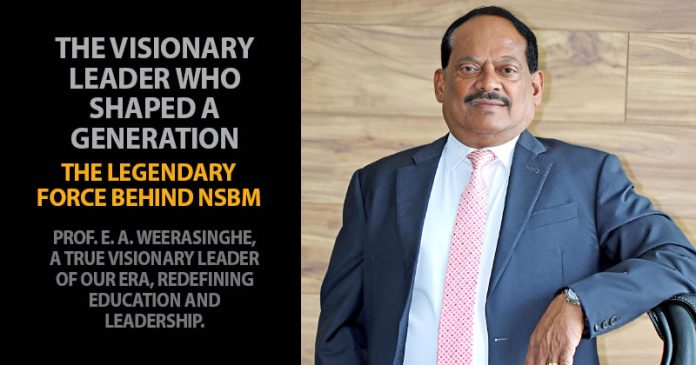
There are seasons in a nation’s life when a single vision bends the course of history, when one person dares to turn a dream into a structure of stone, glass, and living spirit. Prof. E. A. Weerasinghe, Founding Vice Chancellor of NSBM Green University, is such a figure. He is not merely an administrator or an academic, but a builder of institutions and a weaver of futures. His recent recognition as the Most Visionary Leader at the Sri Lankan Entrepreneur of the Year Awards 2025, alongside two Gold Awards for NSBM itself, marks not only a personal honour but a national affirmation.
Around the world, there have been such moments when one leader’s determination reshaped a nation’s intellectual landscape: Wilhelm von Humboldt’s vision that gave birth to the modern research university in Berlin, Jawaharlal Nehru’s resolve to establish the Indian Institutes of Technology, or John Harvard’s modest bequest that became the seed of one of the world’s foremost centres of learning. Each began with uncertainty, doubt, and resistance, yet became a legacy of knowledge. In the same spirit, Prof. Weerasinghe’s NSBM Green University now stands as Sri Lanka’s answer to this lineage of pioneers—a bridge of learning built with foresight, persistence, and an unshaken faith in the transformative power of education.
From the outset, his belief was that a university should not be defined merely by classrooms and certificates, but by the intellectual community it nurtures. This conviction carried him through his years at the National Institute of Business Management, where he transformed a struggling body into a dynamic, profitable institution. Yet his heart was set on building something larger—a university that would keep talent within Sri Lanka while also projecting it outward to the world.
The founding of NSBM Green University in 2016 was thus a national turning point. Like Nanyang Technological University (NTU) in Singapore, which within just three decades rose from its beginnings as a young institution to being consistently ranked among the world’s top twenty universities, NSBM became Sri Lanka’s first self-financed, purpose-built green campus, showing that higher education could expand without overburdening the State. What once was a paddy field is today a thriving institution of over 12,000 students, a symbol that education itself can be cultivated from unpromising soil when tended with vision.
NSBM’s mission is both local and global. Its academic portfolio spans Business, Computing, Engineering, and Science, with undergraduate degrees delivered either independently or in partnership with universities in the United Kingdom, Australia, and the United States. At the postgraduate level, NSBM programmes cultivate leadership, research, and innovation, preparing graduates not only to serve employers but to reshape industries.
The numbers speak of trust and success: over 20,000 graduates produced, 3,500 new enrolments annually, and high employability rates that place NSBM alumni in both local companies and global firms. The philosophy is clear—students are not treated as customers but as the very centre of the university’s purpose. Modern facilities, vibrant student life, and investment in research ensure that every learner emerges future-ready, grounded in ethics, and able to contribute meaningfully to the nation and beyond.
Like many global institutions of influence, NSBM is not standing still. Phase Two of its development, already under way, echoes the long-term master plans of universities such as NTU and Hong Kong University of Science and Technology. Built on a 50-acre site leased from the Urban Development Authority, Phase Two is funded entirely from internally generated surpluses, a model of self-reliance rarely seen in the region. Planned expansions include new faculties in Science, Law, and Social Sciences, as well as sustainable features—a rainwater harvesting pond, outdoor terraces, a jogging path, and a butterfly garden. These are not ornaments, but reflections of the belief that education must connect with environment and wellbeing, just as Stanford University embeds sustainability and community life into its campus design.
Recognition has followed this achievement. At the SLEOTY Awards 2025, NSBM won the Gold Award in the National Extra-Large Category and the Gold Award in the Western Province Extra-Large Category. Prof. Weerasinghe himself received the Most Visionary Leader Award, while the JaGAAS Lifetime Award affirmed his decades of service to Sri Lankan education. Yet for him, these honours are less important than the sight of parents who no longer need to mortgage their homes to send children abroad, and of students who carry both skills and confidence into their professions
.
His leadership has always been pragmatic as well as visionary. He has emphasised financial discipline, ensuring that NSBM’s rise has been powered not by grants or concessions but by loans responsibly managed and faithfully repaid. It is a model akin to the bold financing that underpinned many private universities in East Asia, proving that sustainability can coexist with ambition.
Looking forward, NSBM aims to be recognised as the best performing graduate school in Sri Lanka and to gain wider international recognition. This is not a boast but a roadmap. With expanding faculties, a stronger research culture, and continuous investment in academic quality, NSBM is positioning itself among the universities of Asia that aspire to global relevance. Like NTU in Singapore, which began with a national mission and grew into a global player, NSBM too is on a trajectory that blends service to the nation with international aspiration.
The story of Prof. E. A. Weerasinghe is therefore not only a tale of one man’s leadership but of a national awakening in higher education. A field that once held cattle now holds the hopes of a generation. In its green corridors, young Sri Lankans walk with confidence that they need not look abroad to find world-class learning. The bridge of dreams has been built, and through it the children of tomorrow will cross into new seas of opportunity.
Q: Visionary leadership is at the core of this award. How do you define visionary leadership in today’s rapidly changing world?
A: In my opinion, visionary leadership is about much more than predicting the future. It is about having the courage to see possibilities where others see limitations and then mobilising people, systems, and resources to turn those possibilities into enduring realities.
In Sri Lanka, one of the longstanding challenges has been the under-capacity of the higher education system. Each year, thousands of talented students complete their Advanced Level examinations but are unable to secure a place in the State university system. As someone who has lived through the transformative power of education in my own life, I could not accept the status quo. Visionary leadership, in my experience, meant asking: What if we could expand opportunities for the country’s youth? What if we could create a model that is self-sustaining, globally relevant, and designed for the future world of work, all without placing an additional burden on the government?
That line of questioning gave birth to NSBM Green University. Establishing NSBM was a monumental challenge. It required convincing multiple stakeholders, securing a loan of LKR 8.6 billion from BOC without burdening the government, and leading a young and relatively untested team. At the time, many doubted that this self-sustaining university model could succeed in Sri Lanka. But I used that scepticism to prove what is possible.
We launched the NSBM City Campus in Nugegoda even while the Green University complex was under construction in Homagama. This was a calculated step to prove the model’s viability and to build early credibility with students, parents, and policymakers. By the time the Green University opened its doors, we already had over 3,000 students enrolled.
Equally, visionary leadership requires anticipating global trends. From the beginning, I knew that Sri Lanka’s youth had to be prepared not only for local opportunities but also for the international stage. That is why we invested in cutting-edge infrastructure, forged partnerships with leading foreign universities, and embedded technology and sustainability into NSBM. The “green” concept was not just branding. It was about preparing students to live and work responsibly in a world where climate change, resource management, and sustainable innovation are defining issues.
In essence, visionary leadership is about holding a long-term perspective, making courageous decisions beyond challenges, inspiring teams and stakeholders to work towards a shared dream, and finally making a transformative impact. For me, visionary leadership meant transforming a longstanding educational gap into a once-in-a-century institution that now serves as a model for the region.
Q: Can you describe your vision for NSBM Green University and how it is shaping higher education in Sri Lanka?
A: From the very beginning, my vision for NSBM Green University has been to establish an institution that is not only Sri Lanka’s best-performing university but also one that stands proudly among globally recognised centres of higher education. When I envisioned NSBM, I was not simply thinking of just another university; I was imagining a national asset that could address systemic challenges while simultaneously positioning Sri Lanka as an educational hub in Asia.
At the heart of this vision is sustainability. I wanted NSBM to prove that higher education could thrive under a self-sustaining model. This was why NSBM was established without any burden on the taxpayers’ money. At the same time, this financial independence allows for reinvesting revenues into infrastructure, faculty development, research, and student services, without being slowed down by budgetary constraints.
The second pillar of my vision is global relevance. In today’s interconnected world, students must be prepared to navigate global markets, multicultural workplaces, and industries driven by rapid technological change. To ensure this, NSBM keeps on building strategic alliances with the world’s top universities. Currently, we hold academic partnerships with the University of Plymouth in the UK, Victoria University in Australia, and, more recently, American University in the USA and Southern Cross University in Australia. These collaborations mean that a Sri Lankan student studying at NSBM has access to curricula, quality standards, and learning experiences equal to those abroad, without the heavy financial or emotional burden of migration.
At the same time, NSBM is deeply rooted in national priorities. By offering industry-relevant degrees in fields such as Business, Computing, Engineering, Science, Law, and Design, we are addressing Sri Lanka’s human resource needs. Our graduates are trained not only with theoretical knowledge but also with practical skills, employability competencies, and a mindset of responsibility towards society and the environment. This balance between global standards and local responsibility is, in my view, what makes NSBM’s role unique.
Another dimension of my vision is holistic education. A university must shape not just employable graduates but responsible citizens. We believe in 360-degree student development. That is why our campus is built as a “university town,” complete with facilities and opportunities that nurture well-rounded individuals who can contribute meaningfully to their workplaces, communities, and the nation at large.
Ultimately, my vision is for NSBM to become a benchmark in higher education: a financially independent, globally respected, environmentally sustainable, and nationally transformative university. Already, NSBM has produced over 20,000 graduates who are contributing across the world. In the years ahead, I see NSBM shaping higher education in Sri Lanka not only by filling existing gaps but by redefining what is possible for an international-level university in this country.
Q: What initiatives at NSBM best reflect your forward-thinking leadership style?
A: Forward-thinking leadership, in my view, is about introducing initiatives that may seem ambitious today but will prove essential tomorrow. At NSBM, several initiatives embody this principle.
The first is our self-sustaining financial model. From inception, NSBM was designed to operate without dependence on government funding. We secured financing for the construction of this massive campus through an LKR 8.6 billion loan and structured the institution to generate its own revenues in the long-run. This was a bold step because many doubted whether such a model could survive in Sri Lanka. Today, not only has it survived, but it has thrived, proving the power of quality and innovation.
Second, I placed great emphasis on building a young, dynamic team. When NSBM began, many of our staff were in the early stages of their careers. We created an environment where young leaders could grow, experiment, and take responsibility. This infusion of youthful energy has been a major factor in NSBM’s culture of innovation and adaptability.
Another initiative is our phased, continuous development approach. Without falling into static patterns after initial success, at NSBM we deliberately built the campus and its programmes in phases, ensuring that each stage of growth was informed by experience and aligned with future demands and new opportunities. From the City Campus in Nugegoda to Phase I and now Phase II at Pitipana, the journey has been one of constant evolution. Phase III, in the Health Science sector, is already in the pipeline.
Equally important is our commitment to producing globally competitive graduates. Through regular curriculum reviews, we ensure that our programmes reflect the skills demanded by employers today and tomorrow. Initiatives such as project-based learning, entrepreneurship incubation, and international pathways further strengthen this vision.
Finally, NSBM’s green campus concept is perhaps the clearest reflection of forward-thinking leadership. Long before sustainability became a mainstream agenda, we designed NSBM as an environmentally responsible university town—with solar power, rainwater harvesting, waste-to-resource systems, and extensive greenery. This has made NSBM a national model for integrating education with sustainable living.
Together, these initiatives show how NSBM is built on innovation, adaptability, and a commitment to long-term impact, for the benefit of Sri Lanka and its future generations.
Q: How do you balance academic excellence with preparing students for real-world challenges?
A: I firmly believe that a university must do more than award degrees, but prepare graduates to succeed in real-world environments where adaptability, creativity, and resilience matter as much as knowledge. At NSBM, we achieve this balance through a carefully structured academic model and close industry collaboration.
Our degree programmes are designed with a 2+2 structure. The first two years with full-time study build strong theoretical foundations and academic discipline, while the final two years adopt a more flexible structure for students to combine part-time study with internships, industrial training, or entrepreneurial projects. This model ensures that by the time they graduate, students are not only academically qualified but also practically experienced.
Another important mechanism is the Company-Academic Round Table (CART), where industry experts and academics jointly review curricula. This ensures our programmes are continuously updated to reflect market needs, emerging technologies, and global best practices.
We also integrate practical learning opportunities throughout our courses that push students to apply theory to real-world problems and to develop skills such as teamwork, communication, and problem-solving. Partnerships with over 200 companies create internship pipelines, guest lectures, and collaborative projects, bridging the gap between the classroom and workplace.
At the same time, we place strong emphasis on soft skills and holistic development. Leadership programmes, entrepreneurship circles, cultural societies, and wellness services are all integral to NSBM life.
Research also plays a critical role in this balance. By involving undergraduates in research symposiums, innovation projects, and international conferences, we expose them to knowledge creation and critical inquiry.
Ultimately, balancing academic excellence with real-world readiness requires an ongoing dialogue amongst university, industry, and society. This approach is why our graduates are not only employed quickly but also recognised globally for their adaptability and impact.
Q: What role do you see education playing in building a knowledge-driven and globally competitive Sri Lanka?
A: Education, in my view, is the single most powerful instrument for national transformation. Sri Lanka has always taken pride in its high literacy rate, but literacy alone does not make a nation globally competitive. What we need today is a knowledge-driven society and an entrepreneurship-driven economy, where graduates are not only job seekers but job creators.
This is where higher education institutions have a crucial role to play. By creating NSBM Green University as a self-financing, globally aligned institution, I wanted to demonstrate how education could simultaneously expand access, save foreign exchange, and enhance national competitiveness. Every student who stays in Sri Lanka to pursue a world-class degree at NSBM saves the country millions in lost currency outflows. Equally, this model for foreign students to study at NSBM contributes to inflows, helping to position Sri Lanka as an educational hub in the region.
Beyond the economic benefits, if Sri Lanka is to become globally competitive, we must make education and graduate development our strongest comparative advantage. Rather than relying only on technical knowledge, graduates must possess critical thinking, digital literacy, cross-cultural understanding, and resilience. In doing so, we are cultivating a workforce capable of thriving not only in Sri Lanka but in the global job market.
I see NSBM’s role as central to this mission. By producing globally relevant graduates, by saving and earning foreign exchange, and by demonstrating a sustainable model of higher education, we are not only contributing to individual success stories but also to the broader vision of a knowledge-driven, competitive Sri Lanka.
Q: What does receiving the “Most Visionary Leader Award” mean to you personally and professionally?
A: This award holds profound meaning for me because it represents both a personal journey and a professional mission that has defined much of my life. I was born in Galle and schooled at Vidyaloka Vidyalaya before entering the University of Sri Jayewardenepura for my undergraduate studies. It was through Sri Lanka’s system of free education that I was able to pursue my higher studies, eventually securing scholarships for my Master’s and Doctoral studies in Japan. I owe much of what I have achieved to that foundation.
Because of this, I always felt a deep sense of responsibility to give back to my country. I had opportunities to remain abroad, but I chose to return. I wanted to contribute something meaningful and lasting to Sri Lanka that could benefit generations to come. That desire led me to establish NSBM Green University.
Creating a university from scratch is not something that happens often; in fact, it is perhaps a once-in-a-century task. It required not only vision but also resilience, as we had to overcome countless financial, institutional, and social hurdles. But today, it is deeply fulfilling to see NSBM standing tall as a nationally and internationally recognised university, built on a sustainable model that does not burden taxpayers.
On a personal level, this award affirms that the struggles, sacrifices, and difficult decisions were worthwhile. It is also a reminder of my humble beginnings and of the power of education to transform lives. Professionally, it validates the exemplary model we have created at NSBM.
More importantly, this award is not just about me. It is about the collective effort of my team, the trust of stakeholders, and the determination of students and parents who keep on believing in this vision. It is also about the country that gave me the opportunity to study for free and inspired me to give something back.
Therefore, I take this recognition to strengthen my commitment to continue building NSBM into a global benchmark, and through it, to contribute to building a knowledge-driven and globally competitive Sri Lanka.
