
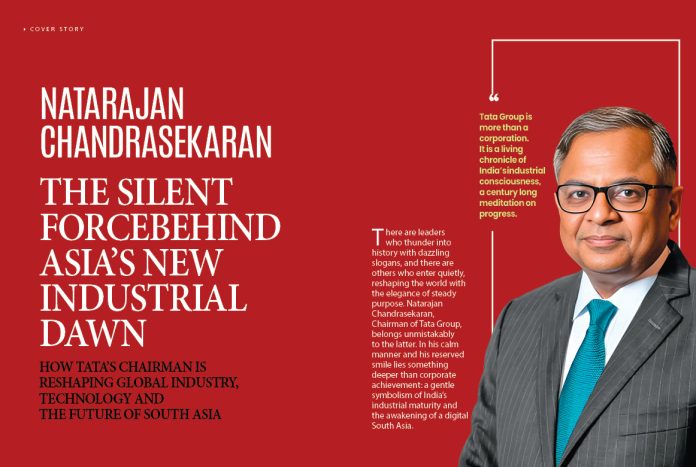
There are leaders who thunder into history with dazzling slogans, and there are others who enter quietly, reshaping the world with the elegance of steady purpose. Natarajan Chandrasekaran, Chairman of Tata Group, belongs unmistakably to the latter. In his calm manner and his reserved smile lies something deeper than corporate achievement: a gentle symbolism of India’s industrial maturity and the awakening of a digital South Asia.
Born in the town of Mohanur in Tamil Nadu, Chandrasekaran’s ascent was neither inherited nor engineered by fortune. It was composed like a long patient raga, each note drawn from learning, discipline and perseverance. When he first walked into Tata Consultancy Services as a young technologist, he could hardly have imagined that the soft glow of computer screens would one day illuminate a global transformation. Yet every step of his journey now appears like a beautifully arranged prelude to the leadership he would later assume.
A transformation written in silence
Tata Group is more than a corporation. It is a living chronicle of India’s industrial consciousness, a century-long meditation on progress. Its interests sweep across steel, aviation, consumer markets, automobiles and technology. To guide such an immense enterprise requires not only intellect, but subtle sensibility. And that is precisely where Chandrasekaran’s uniqueness rests.
He did not storm the gates of transformation. Rather, he opened them slowly, inviting an old institution to converse with an emerging world. Under his guidance, digital transformation became not a project to be completed, but a philosophy to be lived. He allowed technology to breathe into heritage, turning Tata from a traditional industrial giant into an elegant global technological force.
Across continents and industries, Tata Consultancy Services extended under his watch like a network of new possibilities, aiding governments, financial institutions and healthcare systems to design futures they had not yet imagined. Behind that quiet approach lay a conviction that technology is not merely a tool of commerce, but the nervous system of the civilisation that is arriving.
South Asia’s subtle compass
Across South Asia, the Tata presence moves like a quiet river beneath the landscape of enterprise. Chandrasekaran sees the region not as a division of markets, but as a shared geography of progress. Under his leadership, borders form less of a line and more of a bridge.
For Sri Lanka, this holds particular resonance. As the island seeks a larger space within regional economic frameworks, it encounters in Tata a philosophy that mirrors its aspirations: disciplined management, technological capability, and industrial ambition. Chandrasekaran’s leadership becomes therefore not only an Indian story, but a South Asian one. It is a reminder that strength in the region grows not through isolation, but through collaboration.
Building the digital highways of tomorrow
Once it was physical roads that shaped civilisations. Today invisible currents of data redefine destiny. Few leaders in Asia comprehend this transition as intimately as Chandrasekaran. During his TCS years, he helped transform India into one of the world’s most respected digital service nations. He encouraged a culture of future readiness long before the world began speaking of digital revolutions.
Artificial intelligence, quantum computing, data sciences and cybersecurity are not distant concepts in his vocabulary. They are threads of a future fabric being woven patiently. For Sri Lankan thinkers observing regional possibilities, Chandrasekaran’s journey suggests a profound lesson: that developing nations need not follow old models of industrial evolution. They may leap, rather than climb, by embracing knowledge-centred industries.
Wisdom for Sri Lankan boardrooms
In boardrooms across Colombo, his leadership is increasingly studied not as a biography, but as a paradigm. The rise of modern India was not powered merely by resources, but by knowledge and skill. Chandrasekaran’s emphasis on talent, innovation and patient strategic investment echoes deeply with the dilemmas that Sri Lankan corporate leaders face today.
He offers an example of how nations can reinvent futures not by imitating global powers, but by discovering new languages of progress from within their own soil.
An industrial poet of the present century
There is poetry in Chandrasekaran’s leadership. He leads without spectacle, persuades without noise, and transforms without turbulence. One senses in him both the serenity of older Indian wisdom and the restless curiosity of a digital age. He stands as part of a new generation of Asian leaders who believe that tomorrow’s world will not be written only in Silicon Valley, but also in Chennai, Bengaluru, Colombo and Singapore.
And as Sri Lanka looks towards its own moment of reinvention, Chandrasekaran’s example arrives as a gentle companion. His story suggests that real transformation rarely announces itself with grandeur. It grows quietly, almost invisibly at first, until one day it becomes the horizon itself.
References
Britannica. (n.d.). Natarajan Chandrasekaran. Retrieved from https://www.britannica.com/money/
Natarajan-Chandrasekaran
Tata Consultancy Services. (n.d.). N. Chandrasekaran – Leadership biography. Retrieved from https://www.tcs.com/who-we-are/leadership/n-chandrasekaran
Tata Power. (n.d.). Mr. Natarajan Chandrasekaran – Leadership profile. Retrieved from https://www.tatapower.com/our-legacy/our-leadership/mr-natarajan-chandrasekaran
SiliconIndia. (2024, December 28).
Tata Group’s global transformation under Chandrasekaran’s leadership. Retrieved from https://www.siliconindia.com/news/usindians/www.siliconindia.com/news/usindians/tata-groups-global-transformation-under-chandrasekarans-leadership-nid-233610-cid-49.html
Financial Express. (2017, February 21). From Trichy to Tata Sons: A brief profile of the new boss at Tata Sons. Retrieved from https://www.financialexpress.com/business/industry-from-trichy-to-tata-sons-a-brief-profile-of-the-new-boss-at-tata-sons-560262/
Jagran Josh. (2024, October 14). Who is Natarajan Chandrasekaran? Chairman of the Tata Group. Retrieved from https://www.jagranjosh.com/general-knowledge/who-is-natarajan-chandrasekaran-chairman-of-the-tata-group-1728855959-1
