
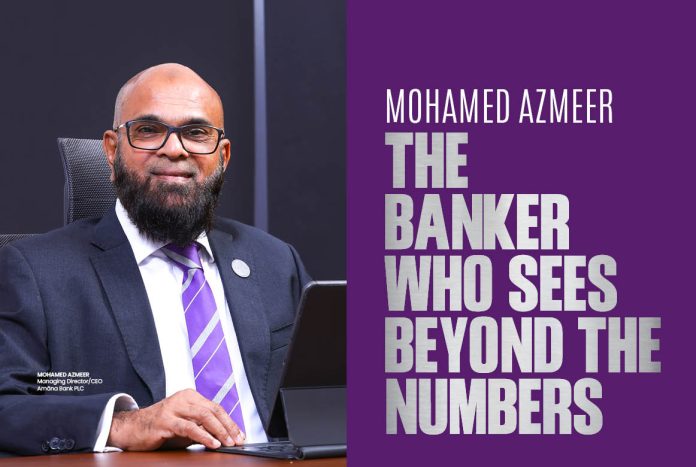
Some careers are built by climbing a familiar ladder. Others are shaped by repeatedly stepping into unfamiliar territory — new markets, different banking philosophies, emerging institutions and risks that refuse to behave according to textbook assumptions.
For Mohamed Azmeer, banking has been that kind of journey.
Across more than four decades, he has experienced the industry from several vantage points: conventional banking and Islamic banking, business and risk, established financial institutions and start-ups, Sri Lanka and some of the world’s more dynamic banking markets. That breadth of experience has given him something more enduring than a collection of senior titles: an understanding of how financial institutions behave when ambition encounters uncertainty.
His foundations were laid at Commercial Bank of Ceylon, but it was beyond Sri Lanka that his perspective widened considerably. At Citibank in the United Arab Emirates, Azmeer gained exposure to both the business and risk dimensions of banking, eventually serving as Vice President – Risk for the UAE and Oman. Along the way, assignments in the United Kingdom, India and Kenya introduced him to the different rhythms of markets and the particular challenges that emerge when banking crosses borders.
Those experiences matter when viewed through the lens of leadership. Growth can be intoxicating; risk is often its necessary counterweight. A banker who has spent meaningful time on both sides of that equation develops an instinct for the distance between opportunity and overreach.
Azmeer’s career also brought him close to the uncertainty of building something from the ground up. He was a founder member of the former Dubai Bank, established at the direction of the Dubai Government. It was another dimension of banking altogether — not simply operating within an institution, but experiencing the demands surrounding the creation of one.
Yet perhaps the more defining turn in his professional journey came through Islamic banking.
For Azmeer, the attraction was connected to a desire to see what was then a relatively nascent, people-friendly and development-focused banking concept accepted by a wider audience. His subsequent experience took him to senior positions at Al Rajhi Bank in Saudi Arabia, the largest Islamic bank in the world, where Azmeer was the only non-Saudi national to head one of three regions of the Bank. He later joined Sharjah Islamic Bank, a pioneering institution that had converted its operations from conventional to Islamic banking, where he served as Executive Vice President.
It was therefore not simply another career move. It represented exposure to a different philosophy of finance — one that would later become central to his leadership journey in Sri Lanka.
A Different Proposition
When Azmeer assumed the leadership of Amãna Bank in June 2014, he was not arriving as an outsider. Having joined the Bank in 2012 as the Chief Operating Officer, he had already overseen the Bank’s Consumer, SME, Corporate and Treasury business functions. He understood its machinery from within.
More importantly, he understood the proposition the institution was attempting to establish.
Amãna Bank had commenced operations in 2011 with a distinctive model. Fifteen years later, that proposition has developed into an institution serving more than 500,000 customers through over 80 customer locations, with total assets exceeding LKR 200 billion. For Azmeer, however, the significance of the journey lies not merely in scale but in the growing acceptance of what the Bank describes as a development-focused, people-friendly approach to banking.
The distinction is important
At the heart of the model is asset-backed financing connected to the real economy — businesses, industries, employment and livelihoods. Alongside it sits another principle: banking relationships should be grounded in transparency, fairness and responsibility.
That philosophy becomes more tangible when viewed through the Bank’s focus on small and medium-sized enterprises, as well as the unbanked and under-banked segments. Amãna Bank has worked with entrepreneurs across sectors ranging from agriculture, food production and healthcare to manufacturing, renewable energy, vehicle imports and export-oriented businesses. The objective, as Azmeer describes it, extends beyond providing finance towards understanding businesses and accompanying them through different stages of growth.
It reflects a broader view of what a bank can be.
Resilience When It Matters
That view was tested during Sri Lanka’s recent economic turbulence. Having experienced two major crises earlier in his career — first as a Business Manager during the Gulf War in the 1990s, and later as Head of Risk during the 2008 Global Financial Crisis and its impact on the UAE — Azmeer gained valuable perspective and resilience, which would later help him navigate Amãna Bank through the multiple crises Sri Lanka went through.
Amãna Bank’s asset-backed model, with its focus on the real sector and absence of exposure to interest-bearing instruments, provided a degree of insulation from some of the risks confronting the wider banking system. During difficult periods, the Bank continued financing supply chains connected to essentials including food, fuel, pharmaceuticals and medical supplies, while supporting SME and retail customers through challenging circumstances.
Periods of stability reveal much about an institution’s capacity to grow. Crises reveal something different: its character.
For Azmeer, the experience reinforced the relationship between financial discipline and responsibility. The strongest balance sheet is not simply one that survives pressure; it is one that retains the capacity to serve when that service matters most.
The same thinking is visible in the Bank’s approach to financial inclusion. Over the past five years, Amãna Bank has conducted more than 350 financial literacy programmes reaching over 25,000 people, including SMEs, traders, women entrepreneurs, professionals and students. Its women-focused banking initiatives have included dedicated Ladies Banking Units, savings products and financing programmes, while one initiative financed Sri Lanka’s first fully women-operated solar power plant.
It was this same philosophy of going beyond numbers that gave rise to OrphanCare, the Bank’s flagship community outreach initiative, through which accounts are established for orphaned children on a zero-discrimination basis, guided by Article 2 of the United Nations Convention on the Rights of the Child, reflecting the belief that saving orphans from a second abandonment is not merely an act of charity, but a responsibility.
These are different activities, but they converge around a common idea: finance acquires greater meaning when access to it expands opportunity.
The Discipline of Perspective
Azmeer’s professional contribution has also extended beyond the boundaries of a single institution. He has served on the boards of the Sri Lanka Banks’ Association (Guarantee) Ltd. and LankaClear, Sri Lanka’s national payment and clearing association, and as Chairman of the Financial Ombudsman Sri Lanka (Guarantee) Ltd. He holds a Master’s Degree in Business Administration from the University of Leicester in the United Kingdom.
Yet the more compelling thread running through his career is not geography, designation or institutional prestige.
It is perspective
Azmeer has seen banking through the eyes of the commercial banker pursuing opportunity, the risk professional examining what might go wrong, the institution-builder confronting the uncertainty of a start-up and the Islamic banker seeking to broaden acceptance of an alternative approach to finance.
Those perspectives do not always sit comfortably together. Perhaps that is precisely their value.
Today, as Sri Lanka moves from economic recovery towards the possibility of renewed growth, Azmeer sees opportunities across SME banking, digital banking, sustainable finance, trade finance and wealth management. Technology and accessibility will inevitably reshape how customers interact with banks. Yet for Amãna Bank, the challenge will also be to preserve the principles that distinguish its model while embracing that change.
It is an interesting tension: how does an institution become more digital without becoming less human? How does it pursue growth without allowing growth itself to become the purpose?
After more than four decades in banking, Azmeer’s career offers no simplistic answer. Instead, it suggests that enduring leadership in finance rests on judgement — knowing when to advance, when to exercise restraint and, above all, remembering whom the financial system ultimately exists to serve.
Because banking, at its most consequential, is never merely about how money moves.
It is about what that movement makes possible
To explore the thinking behind that philosophy, Global CEO Magazine sat down with Mohamed Azmeer, Managing Director/CEO of Amãna Bank, for an exclusive conversation on the Bank’s 15-year journey, its distinctive approach to banking, the lessons of Sri Lanka’s economic challenges and the opportunities that lie ahead.

Q: Amãna Bank is celebrating its 15th anniversary this year. Looking back, what does this milestone represent to you?
Our journey is a testament to the strength of a vision that many believed was ambitious when Amãna Bank commenced operations in 2011 as the flag-bearer of a unique model of banking. Our vision was to demonstrate the positive impact that our unique, development-focused, people-friendly approach to banking could bring to the economy as a whole by enabling growth and enriching lives.
The progress we have achieved, where today we serve over 500,000 customers through a network of more than 80 customer locations, surpassing LKR 200 billion in total assets as one of the fastest banks in Sri Lanka to reach this milestone, despite the country’s recurring economic shocks, validates our success in pursuing this vision.
More importantly, we have continued to earn the trust of all stakeholders, demonstrating the growing acceptance of the value-driven banking model.
Q: Amãna Bank has consistently described itself as a Development-focused, People-friendly Bank. What does this philosophy mean in practice?
Development-focused, People-friendly Banking is much more than a tagline — it is the philosophy that guides every decision we make. Our model of banking is centred on asset-backed financing that directly supports the real sector of the economy, strengthening industries, creating employment and improving livelihoods, thereby contributing meaningfully to economic development.
People-Friendly means placing customer well-being at the centre of banking through ethical practices, transparency, fairness and long-term relationships. Further, with the strong belief that one should not gain at the expense of another and that being responsible and ethical is as important as making profits and gains, Amãna Bank does not benefit from the hardship or misery of our customers. These values influence everything from product design and financing decisions to customer service and community initiatives.
Q: Your customer growth has been remarkable over the past fifteen years. What has driven this acceptance?
The greatest endorsement of our banking model has come from the trust and confidence built with our customers. Today, our customer-base exceeds half a million, representing people from every ethnic, religious and social background across Sri Lanka. Customers increasingly appreciate transparency and ethical banking principles. This, combined with consistent service excellence and genuine care, especially during difficult times, has enabled Amãna Bank to become one of the country’s fastest-growing banks.
Q: Amãna Bank has consistently outperformed the industry in key business indicators. What were the key drivers?
Yes, both deposits and financing portfolios have grown significantly above industry averages, reflecting strong customer confidence and prudent balance sheet management. Equally important is the quality of that growth. We have maintained one of the industry’s strongest CASA ratios while also recording one of the lowest non-performing advance ratios.
This demonstrates that growth and portfolio quality can co-exist and deliver results within a framework strengthened by prudent risk management and governance.
The key drivers enabling all of the above are our people and the value-driven, customer-centric culture. Amãna Bank is blessed with purpose-driven people guided by a strong and experienced Board and Sharia Supervisory Council, which place great emphasis on governance and compliance.
Q: The Bank has maintained a consistent profitability trajectory while rewarding shareholders. How significant is this achievement?
Sustained profitability is essential because it enables us to continue investing in customers, technology, people and communities. We are honoured to have maintained a strong profitability trajectory in line with our strategic plan while declaring dividends consistently over the last eight years. Our financial performance reflects disciplined governance, prudent capital management and the resilience and stability of our business model. Creating long-term shareholder value while delivering broader economic and social value has always been central to our strategy.
Q: IsDB Group has remained your strategic shareholder despite Sri Lanka not being a member country of the Islamic Development Bank. How important has this partnership been?
The Islamic Development Bank (IsDB) has been a strategic shareholder of the Bank since its inception despite Sri Lanka not being a member country, making an exceptional investment. Having recognised the growth the Bank has achieved, they continued to invest in the Bank through its private sector arm, the Islamic Corporation for the Development of the Private Sector, or more commonly known as ICD. As you know, IsDB is a supranational AAA-rated multilateral development financial institution with a membership of 57 countries. The IsDB Group brings immense value to the Bank through its global expertise and best governance practices.
Today, Amãna Bank has become an internationally recognised success story of Islamic banking operating successfully in a country with a Muslim minority, becoming a case study for IsDB to promote Islamic Banking across other countries. Our recent recognition as the Most Impactful ICD Investee Company, competing against multiple global investee companies from 57 member countries, is a reflection of the value this partnership has created.
Q: How is Amãna Bank enabling businesses, particularly SMEs, which are your core focus area?
SMEs remain the backbone of Sri Lanka’s economy, accounting for over 75% of all active businesses, generating approximately 45% of total employment and contributing over 50% to the national GDP. At Amãna Bank, supporting this sector has always been a strategic priority because we believe that when businesses grow, communities prosper and the nation progresses.
Our unique banking model, with its focus on development, has found strong resonance among SMEs by offering financing solutions that are transparent, ethical and tailored to the real needs of businesses.
Over the years, we have partnered with entrepreneurs across a wide spectrum of industries, including retail, trade, rice and flour milling, tea and other agricultural produce, poultry, food imports, renewable energy, healthcare, manufacturing, vehicle imports and export-oriented businesses. Many of these sectors are critical to food security, industrial development, foreign exchange generation and national resilience.
Beyond providing finance, we strive to be partners in our customers’ growth journeys by understanding their businesses and supporting them through the stages of their development. This approach has enabled us to build enduring relationships while contributing meaningfully to financial inclusion, sustainable economic growth and the development of Sri Lanka’s productive sectors.
Q: Amãna Bank has become known for supporting women’s empowerment. Could you elaborate?
Women’s economic participation is fundamental to inclusive development. We have developed dedicated banking propositions including exclusive Ladies Banking Units, women-focused savings products and financing programmes tailored for female entrepreneurs. One project we are particularly proud of is financing Sri Lanka’s first fully women-operated solar power plant — an initiative that combined renewable energy with women’s empowerment.
Q: Sri Lanka experienced many challenging crises in recent history. How did Amãna Bank navigate that period?
Yes, unfortunately our country went through recurring shocks impeding our economic progress. However, our banking model demonstrated remarkable resilience during these crises. Since our operations are asset-backed, focused on the real sector of the economy and not exposed to interest-bearing instruments, we were naturally insulated from several risks that affected the broader banking sector.
This enabled us to maintain stronger liquidity and continue supporting the economy when it mattered most. We played a significant role in financing supply chains related to food, fuel, pharmaceuticals and medical supplies during the critical time. Meanwhile, we also stood by SMEs and retail customers through difficult circumstances, staying true to our model and showcasing the genuine care we express.
Q: Financial inclusion is often described as a catalyst for sustainable economic growth. How is Amãna Bank advancing this agenda in Sri Lanka?
Financial inclusion has always been at the heart of Amãna Bank’s Development-Focused, People-friendly approach to banking. We are committed to making financial services more accessible amongst the unbanked and under-banked, with an emphasis on financial literacy and the inherent financial discipline inbuilt in our model.
Over the last five years, we have carried out over 350 financial literacy programmes, reaching out to an audience in excess of 25,000, including SMEs, traders, women entrepreneurs, professionals and school and university students.
Further, our award-winning Gold Certificate Financing solution and Small Asset Financing solution have enabled us to reach a wider segment of society that previously had limited access to formal financial services.
Q: Many organisations speak about purpose beyond profits, but Amãna Bank has translated that philosophy into meaningful action through OrphanCare. What inspired this initiative, and what impact has it created over the years?
OrphanCare is an initiative that best represents our purpose beyond banking. Inspired by the UN Sustainable Development Goal No. 10, Reduced Inequalities, and guided by Article 2 of the UN Convention on the Rights of the Child, ensuring no form of discrimination, OrphanCare supports orphaned children across Sri Lanka in building financial independence as they transition out of institutional care, thereby addressing what we describe as a “second abandonment.”
Today, the initiative supports over 3,200 children across more than 90 orphanages and is growing. In fact, last year, OrphanCare unveiled its inaugural Impact Report, highlighting the transformative difference it has made in the lives of orphaned children across Sri Lanka. The Impact Report quantifies OrphanCare’s significant reach and meaningful impact. The report features numerous compelling impact stories, illustrating how OrphanCare’s funding and support have empowered orphans to overcome immense challenges, pursue higher education, initiate small businesses and build brighter futures.
Q: Amãna Bank has received many global and local accolades. What stands out most?
Having been recognised as the ‘Best Up-and-Coming Islamic Bank’ by Global Finance Magazine USA during our formative years, Amãna Bank has continued to earn prestigious local and international accolades that reflect our strength, leadership and sustained progress. Recent recognitions include a ranking among the World’s Top 50 Strongest Islamic Banks by The Asian Banker; ‘Most Impactful ICD Investee Company’ among 30 investee companies globally at the IsDB Private Sector Forum Awards; ‘Best Bank in Sri Lanka’ for two consecutive years at the Indian Chamber of Commerce Emerging Asia Banking Awards, adjudicated by PwC; and South Asia’s ‘Islamic Bank of the Decade’ at the Islamic Finance Forum of South Asia Awards.
Q: How is Amãna Bank expanding customer reach and convenience?
Our customer reach and convenience strategy seamlessly combines physical and digital channels, with the expansion of our physical footprint increasingly driven by Self Banking Centres (SBC) — a digitally-enabled hybrid channel that delivers more accessible, efficient and cost-effective banking solutions to a wider audience, especially in under-served areas.
The fact that the SBC network exceeds the branch footprint firmly establishes SBCs as Amãna Bank’s primary channel for customer outreach. Complementing this expansion of our physical reach, digitalisation remains a central pillar of the Bank’s strategic agenda.
As customer expectations continue to evolve, we have accelerated our digital transformation journey with a strong focus on convenience, accessibility and customer experience. Our growing suite of digital solutions — including Online Banking, Online Account Opening, the Online Financing Portal, WhatsApp Banking, AmanaConnect and the recently-launched Digital Hub — is bringing banking closer to our customers while laying a strong foundation for future growth.
Q: Looking ahead, where do you see the greatest opportunities for Amãna Bank?
Sri Lanka’s economic recovery and subsequent growth phases present significant opportunities. We see continued growth potential across SME banking, digital banking, sustainable finance, trade finance and wealth management. We will continue investing in technology, expanding customer accessibility and introducing innovative financial solutions while preserving the unique values that differentiate our institution.
Furthermore, as Islamic banking continues to gain momentum globally, Amãna Bank will seek to leverage its expertise and proven business model to explore broader opportunities for collaboration, knowledge-sharing and value-creation in the region.
Q: Finally, what message would you like to leave with stakeholders as Amãna Bank celebrates fifteen years?
As we celebrate this important milestone, we extend our heartfelt thanks to all our stakeholders who have played an invaluable role in our journey of growth. We are deeply grateful to our customers for their enduring trust; our shareholders for their continued confidence; our employees for their dedication and commitment; our regulators for their guidance; our Board of Directors and Sharia Supervisory Council for their wisdom and stewardship; our OrphanCare Trustees for advancing our social mission; and our suppliers and partners for their steadfast support.
With the trust and confidence we have built over the years, we believe our most exciting chapters are still ahead as we continue our mission of Enabling Growth and Enriching Lives.
