
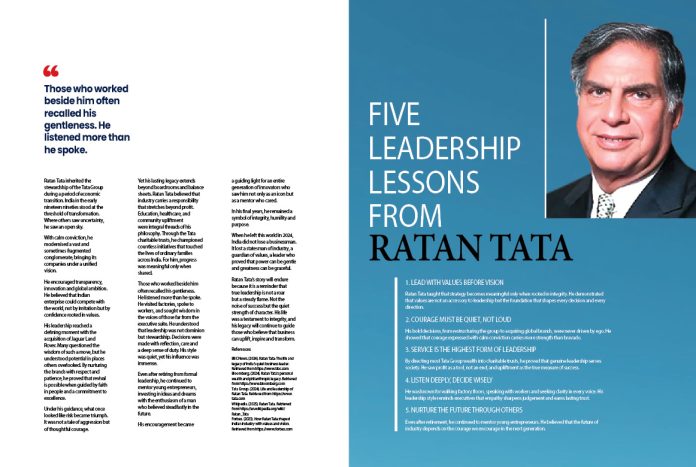
Some leaders leave behind monuments of steel and glass. Others leave behind something far greater, something that lives in the conscience of a nation and in the quiet admiration of millions. Ratan Tata was such a leader.
His life was not defined by spectacle but by dignity.
His success was not measured only in the vastness of the empire he guided, but in the gentleness with which he carried his responsibility.
Born on a December morning in 1937 in Bombay, he entered the world surrounded by heritage, yet forged a legacy shaped as much by compassion as by ambition.
When he passed away on 9 October 2024 in Mumbai at the age of eighty six, India mourned not merely an industrial titan but a moral voice in business.
His personal wealth at the time of his death was estimated at less than one billion United States dollars, a modest sum when compared with the scale of the Tata Group he led. This was by design. Most of the wealth of Tata Sons belonged to the Tata charitable trusts, not to him. He lived with quiet restraint, proving that true leadership is measured not by accumulation but by service to a larger purpose.
Ratan Tata inherited the stewardship of the Tata Group during a period of economic transition. India in the early nineteen nineties stood at the threshold of transformation. Where others saw uncertainty, he saw an open sky.
With calm conviction, he modernised a vast and sometimes fragmented conglomerate, bringing its companies under a unified vision.
He encouraged transparency, innovation and global ambition. He believed that Indian enterprise could compete with the world, not by imitation but by confidence rooted in values.
His leadership reached a defining moment with the acquisition of Jaguar Land Rover. Many questioned the wisdom of such a move, but he understood potential in places others overlooked. By nurturing the brands with respect and patience, he proved that revival is possible when guided by faith in people and a commitment to excellence.
Under his guidance, what once looked like risk became triumph. It was not a tale of aggression but of thoughtful courage.
Yet his lasting legacy extends beyond boardrooms and balance sheets. Ratan Tata believed that industry carries a responsibility that stretches beyond profit. Education, healthcare, and community upliftment were integral threads of his philosophy. Through the Tata charitable trusts, he championed countless initiatives that touched the lives of ordinary families across India. For him, progress was meaningful only when shared.
Those who worked beside him often recalled his gentleness. He listened more than he spoke. He visited factories, spoke to workers, and sought wisdom in the voices of those far from the executive suite. He understood that leadership was not dominion but stewardship. Decisions were made with reflection, care and a deep sense of duty. His style was quiet, yet his influence was immense.
Even after retiring from formal leadership, he continued to mentor young entrepreneurs, investing in ideas and dreams with the enthusiasm of a man who believed steadfastly in the future.
His encouragement became a guiding light for an entire generation of innovators who saw him not only as an icon but as a mentor who cared.
In his final years, he remained a symbol of integrity, humility and purpose.
When he left this world in 2024, India did not lose a businessman. It lost a statesman of industry, a guardian of values, a leader who proved that power can be gentle and greatness can be graceful.
Ratan Tata’s story will endure because it is a reminder that true leadership is not a roar but a steady flame. Not the noise of success but the quiet strength of character. His life was a testament to integrity, and his legacy will continue to guide those who believe that business can uplift, inspire and transform.
References
BBC News. (2024). Ratan Tata: The life and legacy of India’s quiet business leader. Retrieved from https://www.bbc.com
Bloomberg. (2024). Ratan Tata’s personal wealth and philanthropic legacy. Retrieved from https://www.bloomberg.com
Tata Group. (2024). Life and leadership of Ratan Tata. Retrieved from https://www.tata.com
Wikipedia. (2025). Ratan Tata. Retrieved from https://en.wikipedia.org/wiki/Ratan_Tata
Forbes. (2023). How Ratan Tata shaped Indian industry with values and vision. Retrieved from https://www.forbes.com
