
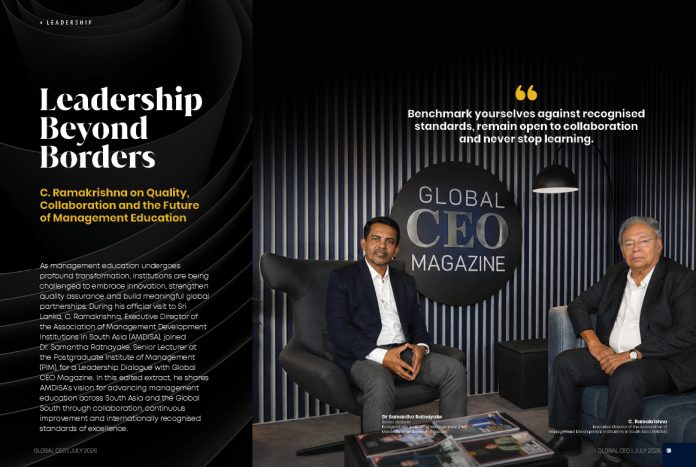
As management education undergoes profound transformation, institutions are being challenged to embrace innovation, strengthen quality assurance and build meaningful global partnerships. During his official visit to Sri Lanka, C. Ramakrishna, Executive Director of the Association of Management Development Institutions in South Asia (AMDISA), joined Dr. Samantha Ratnayake, Senior Lecturer at the Postgraduate Institute of Management (PIM), for a Leadership Dialogue with Global CEO Magazine. In this edited extract, he shares AMDISA’s vision for advancing management education across South Asia and the Global South through collaboration, continuous improvement and internationally recognised standards of excellence.
Dr Samantha Ratnayake:
For readers who may not be familiar with AMDISA, could you begin by explaining its mission and the role it plays across South Asia?
C. Ramakrishna:
AMDISA was established in 1989 with a clear purpose: to strengthen management education and management development across South Asia by fostering collaboration among institutions. Today, it has grown into a well established regional organisation with more than 340 institutional members representing India, Bangladesh, Pakistan, Nepal, Bhutan, Sri Lanka and the Maldives.
Our membership is institutional rather than individual, enabling business schools and management development institutions to learn from one another, share best practices and build meaningful partnerships. Over the years, AMDISA has become a recognised regional platform that brings global management knowledge into the South Asian context while helping institutions remain relevant in an increasingly competitive and interconnected world.
The organisation also reflects the diversity of the region. Its presidency rotates among member countries, and the governing board includes representatives from across South Asia, ensuring that regional perspectives remain central to its work.
S.R.:
Having spent nearly two decades with AMDISA, how have you seen management education evolve across the region?
C.R.:
It has been an extraordinary journey. Like any institution that has existed for several decades, AMDISA has experienced periods of growth, disruption and renewal. The COVID pandemic interrupted many of our long term plans and fundamentally changed the way institutions interact. Traditional
face-to-face engagements gave way to virtual platforms almost overnight.
Rather than viewing this as a setback, we embraced the opportunity to evolve. Today, management education operates within a hybrid environment where digital engagement complements physical interaction. Virtual platforms have made collaboration more frequent and accessible, while in person engagements continue to play an important role despite higher costs and increasing geopolitical uncertainties.
The lesson has been clear. Institutions must remain adaptable. The pace of change is accelerating, and management education must evolve continuously to meet the expectations of learners, organisations and society.
S.R.:
AMDISA is now extending its engagement beyond South Asia. What is driving this strategic direction?
C.R.:
While South Asia remains our primary focus, the Board recognised that the changing global landscape presents new opportunities for collaboration across what is commonly described as the Global South.
Many developing economies face similar challenges and opportunities in management education. We believe there is tremendous value in sharing experiences, research and best practices across these regions.
AMDISA has therefore established collaborative relationships with several international organisations, including the Chartered Association of Business Schools in the United Kingdom, the African Association of Business Schools, CLADEA representing Latin America, the Russian Association of Business Education, ANZAM in Australia and New Zealand, and the Canadian Association of Business Schools.
These partnerships are not merely symbolic. They focus on mutual learning, quality enhancement, accreditation, research collaboration and institutional development. We believe that meaningful international partnerships will help strengthen management education throughout the Global South while allowing institutions to benefit from diverse perspectives and shared experiences.
S.R.:
One of AMDISA’s most recognised initiatives is the South Asian Quality Assurance System, or SAQS. Why has quality assurance become so important?
C.R.:
Quality assurance lies at the heart of institutional excellence. SAQS was originally conceived through a European Union supported initiative and has evolved into South Asia’s own internationally recognised quality assurance framework for management education.
Since its inception, SAQS has completed more than ninety accreditation cycles across the region. We are particularly pleased that Sri Lanka’s Postgraduate Institute of Management has successfully achieved SAQS accreditation, demonstrating its commitment to internationally benchmarked standards.
However, accreditation should never be viewed as the final destination. It is part of an ongoing journey of continuous improvement. Institutions are expected to evaluate themselves critically, identify opportunities for development and continually enhance their academic quality, governance, research, industry engagement and international outlook.
Our objective is simple: to help institutions progress from good to better, and ultimately to excellence.
S.R.:
What advice would you offer institutions considering SAQS accreditation?
C.R.:
The first point I would emphasise is that we do not approach institutions as salespeople. Our purpose is not to promote accreditation as a commercial product but to create awareness of a credible quality assurance framework that institutions may choose if it aligns with their aspirations.
One significant advantage is that institutions applying for SAQS automatically become AMDISA members, making the process straightforward while providing immediate access to the broader regional network.
Equally important is the support institutions receive throughout the accreditation journey. Once an institution is deemed eligible, it is assigned an experienced mentor who guides the preparation of the self assessment report and helps interpret the standards. This mentoring process is one of SAQS’ distinctive strengths.
The evaluation itself is conducted by an international peer review team representing both regional and international perspectives. Their recommendations do not end with the accreditation decision. Institutions continue working towards agreed quality improvements, ensuring that accreditation becomes part of an ongoing culture of excellence rather than a one-time achievement.
S.R.:
Looking ahead, how do you see the future of management education, particularly in light of rapid technological advances and artificial intelligence?
C.R.:
The environment in which we operate has become exceptionally dynamic. Artificial intelligence, digital technologies and constant disruption are reshaping not only business but also the way management education is delivered.
Long-term planning has become increasingly difficult because change is occurring at unprecedented speed. Even five-year strategic plans now require continual review and adjustment.
Our responsibility as an organisation is to remain relevant. That means continuously reviewing our practices, strengthening international partnerships, embracing innovation and encouraging institutions to adapt while maintaining the highest standards of quality.
There will undoubtedly be challenges ahead, but challenges also create opportunities for those willing to evolve. We believe management institutions must cultivate adaptability, resilience and a mindset of continuous learning if they are to prepare the next generation of leaders successfully.
S.R.:
Finally, what message would you like to leave with management educators and institutions across Sri Lanka?
C.R.:
Sri Lanka has outstanding management institutions with significant potential to strengthen their international standing. My message is simple. Embrace quality assurance as a continuous journey rather than a destination. Benchmark yourselves against recognised standards, remain open to collaboration and never stop learning.
Management education today is about preparing leaders who can navigate complexity, uncertainty and rapid change. Institutions that cultivate a culture of continuous improvement will be best positioned to serve their students, their stakeholders and society.
I am grateful to the Postgraduate Institute of Management for facilitating my visit and to Global CEO Magazine for providing this opportunity to share AMDISA’s vision with a wider audience.
I hope more institutions across Sri Lanka will engage with the regional and international opportunities available to them as they continue their own journeys towards excellence.
