
In life insurance, leadership is ultimately defined by the ability to build trust today while preparing customers and organisations for an uncertain tomorrow.
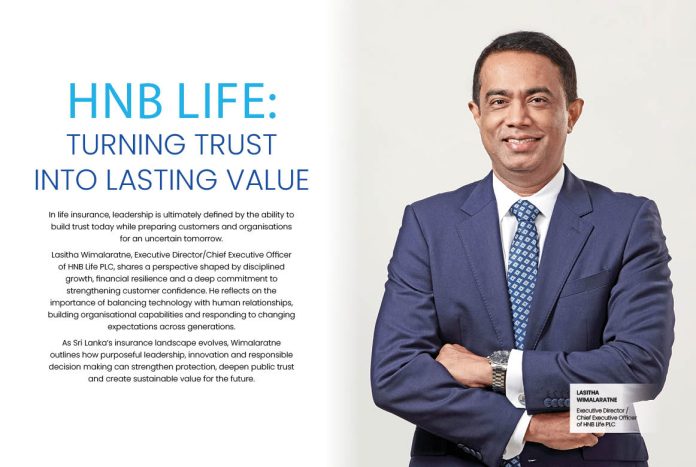
Lasitha Wimalaratne, Executive Director/Chief Executive Officer of HNB Life PLC, shares a perspective shaped by disciplined growth, financial resilience and a deep commitment to strengthening customer confidence. He reflects on the importance of balancing technology with human relationships, building organisational capabilities and responding to changing expectations across generations.
As Sri Lanka’s insurance landscape evolves, Wimalaratne outlines how purposeful leadership, innovation and responsible decision making can strengthen protection, deepen public trust and create sustainable value for the future.
With a career span of over 28 years, Lasitha Wimalaratne has established a strong leadership presence within Sri Lanka’s insurance sector, His expertise spans the full insurance value chain, complemented by strategic leadership across multinational and local insurers. He currently serves as President of the Insurance Association of Sri Lanka (IASL). His leadership credentials include President of SLII, Founder Secretary General of ACIP Sri Lanka, and Board Director of Biodiversity Sri Lanka.
Q: Life insurance has traditionally been associated with providing financial protection when something goes wrong. Today, however, customers increasingly expect insurers to play a broader role in their financial wellbeing. As HNB Life enters a new chapter in its 25-year journey, how do you believe the role of a life insurer should evolve from simply providing protection to enabling people to live with greater financial confidence and pursue their aspirations?
Protection will always be at the heart of life insurance. It is the promise that, when life takes an unexpected turn, a family’s future does not have to be derailed. However, a modern life insurer must be present not only at a moment of loss, but throughout a customer’s financial journey.
People want to educate their children, own a home, build a business, prepare for retirement and improve the quality of life of those they love. An insurer should help customers prepare both for what could go wrong and for what they want to achieve. This requires us to begin with the person rather than the product, understanding their stage of life, responsibilities, aspirations and the risks that may prevent them from reaching their goals.
This thinking is central to HNB Life’s evolution. As we mark 25 years, our transformation represents more than a change of name or identity. It reflects a sharper focus on life insurance and a renewed commitment to helping Sri Lankans build financially secure futures.
Ultimately, insurance is not simply the sum assured in a policy. Its value is the freedom that comes from knowing that the people and ambitions that matter most have a stronger foundation. That is the role we want HNB Life to play: protecting lives, enabling progress and giving people confidence to move forward.
Q: Despite the importance of insurance, a considerable section of Sri Lanka’s population remains inadequately protected or outside the formal insurance system altogether. What do you see as the principal barriers to greater life insurance penetration in Sri Lanka, and what must insurers do differently to make protection more relevant, accessible and affordable to a wider cross-section of society?
The protection gap reflects interconnected barriers, including limited awareness, pressure on household incomes, product complexity, uneven access and the belief that insurance should be considered only later in life or when one earns more. We must change that perception. Insurance is not a luxury. The absence of protection can be most damaging to households least able to absorb the financial shock of illness, loss of income or the death of a breadwinner. Protection is therefore fundamental to financial resilience.
The industry must listen more carefully to the communities it wants to serve. Products should reflect how people actually earn, save and manage money. This may require simpler benefits, flexible payment arrangements, affordable cover and solutions suitable for irregular or seasonal incomes.
Accessibility must go beyond product design. Customers should be able to obtain advice and protection through professional Life Planners, banks, digital platforms, workplaces, community networks and well-structured partnerships.
Education also requires continuous engagement in language people understand, supported by schools, workplaces, community organisations, financial institutions, regulators and the media. We must remove friction across the full experience, from recognising the need and choosing cover to making payments, receiving service and submitting a claim. When insurance becomes easier to understand, access and maintain, more Sri Lankans can enter the formal protection system.
Q: Insurance ultimately depends on trust, particularly because customers are making long-term commitments based on promises that may only be fulfilled many years later. At a time when consumers are becoming more informed and demanding greater transparency and value, how can the industry strengthen public confidence, and what role should customer experience, responsible advice and simpler products play in that process?
Trust is the true currency of insurance. A customer may pay premiums for many years before calling upon the promise made by an insurer. That places an extraordinary responsibility on every insurer, adviser and employee who serves the policyholder.
Trust cannot be created through advertising alone. It is built through repeated experiences: whether a product is explained honestly, whether the customer understands what is covered, whether support is available when needed, and whether claims are handled with fairness, speed and empathy.
Responsible advice must be the first priority. Customers should be guided towards cover that suits their needs and remains affordable over the long term. Benefits, exclusions, commitments and potential outcomes should be explained clearly, without hiding important details behind technical language.
Simplicity is equally important. Insurance is technical, but the customer experience need not feel complicated. Products should have clear propositions, documents should be understandable, and policyholders should know what they are paying for and what they can reasonably expect.
Technology can improve responsiveness, but trust ultimately depends on organisational behaviour. Insurers must be financially sound, well governed and accountable. From an Industry perspective, confidence is a collective responsibility because one poor experience can influence perceptions of the entire industry. Ethical practice, professional development and sound standards are essential to protecting the credibility of our shared promise.
Q: Digitalisation, artificial intelligence and data analytics are transforming how insurers understand risk, develop products and interact with customers. Yet life insurance remains an intensely personal business involving families, health, financial security and the future. How do you see technology reshaping life insurance while ensuring that the human relationship and sense of care at the heart of the industry are not lost?
Technology will transform almost every part of life insurance, but it should not change the reason our industry exists: to help people protect those they love and prepare for the future. Technology must strengthen that purpose, not distance us from it.
Used responsibly, data and artificial intelligence can help insurers understand customers more accurately, recognise emerging needs, improve risk assessment and design more relevant solutions. They can reduce repetitive administration, identify service issues earlier and support faster, more consistent decisions.
Its value, however, should not be measured only by the amount of human contact removed. It should also be measured by the time and insight it gives our people to care for customers. A Life Planner supported by better information can have a more meaningful conversation. A service employee freed from routine processing can concentrate on a complex concern. A claims team equipped with efficient tools can respond more quickly to a family at a difficult time.
There will always be moments when a screen is not enough. Health, bereavement, family responsibilities and long-term financial choices require judgement, sensitivity and reassurance. Customers should be able to move naturally between digital convenience and human assistance without repeatedly explaining their situation.
Responsible use is essential. Data privacy, cybersecurity, fair decision-making and clear accountability must be protected. The future is a thoughtful combination of intelligent technology and genuine human care, delivering greater ease, speed, relevance and confidence while ensuring that a caring person is available when needed.
Q: Your career spans almost 30 years across multinational and local insurers, while your current role as President of the Insurance Association of Sri Lanka gives you a broader view of the industry beyond HNB Life. Looking towards the next decade, what changes do you believe will define Sri Lanka’s life insurance sector, and how are you positioning HNB Life to become a future-ready insurer capable of protecting what matters most while helping customers build better futures?
Over the next decade, Sri Lanka’s life insurance sector will be shaped by greater financial inclusion, more personalised protection, deeper use of technology and data, higher expectations of trust and transparency, and wider recognition of insurance as a contributor to national economic resilience.
Customers will expect solutions relevant to their stage of life rather than standard products based on broad categories. Products must become clearer and more flexible, while advice becomes more needs-based, professional and accountable.
The sector must also serve a broader spectrum of society. Sustainable growth cannot come only from competing for customers who already understand and can readily afford insurance. The next phase must include first-time policyholders, younger people, informal-sector workers, small enterprises and historically underserved communities. This will require closer collaboration among insurers, regulators, government, banks, technology providers, educational institutions and other partners.
For HNB Life, becoming future-ready begins with clarity about the customer we exist to serve. Our evolution after 25 years provides a renewed platform for that ambition. We are strengthening experience across every touchpoint, equipping Life Planners to provide more meaningful advice, developing flexible solutions, expanding access through partnerships and using technology to make service simpler and more responsive.
Being future-ready is not simply about adopting technology or launching more products. It is about anticipating change while remaining true to purpose. It requires capable people, disciplined execution, strong governance, responsible innovation and continuous listening. The organisations that succeed will combine financial strength and modern capability with empathy and integrity. That is the future we are building at HNB Life: ready for change, anchored in care, protecting what matters most and helping people build better futures.
KEY TAKEAWAYS
1. Trust Remains the Foundation of Life Insurance
HNB Life views customer confidence, financial strength and responsible organisational behaviour as essential to building enduring relationships and delivering meaningful protection.
2. Technology Must Strengthen Human Relationships
Digitalisation can improve speed, convenience and personalisation, but HNB Life believes technology should empower advisers and complement, rather than replace, trusted human engagement.
3. Sustainable Growth Requires Long-Term Thinking
HNB Life’s approach combines disciplined growth, organisational capability and innovation with a long-term commitment to financial resilience and creating lasting value for customers and stakeholders.
