
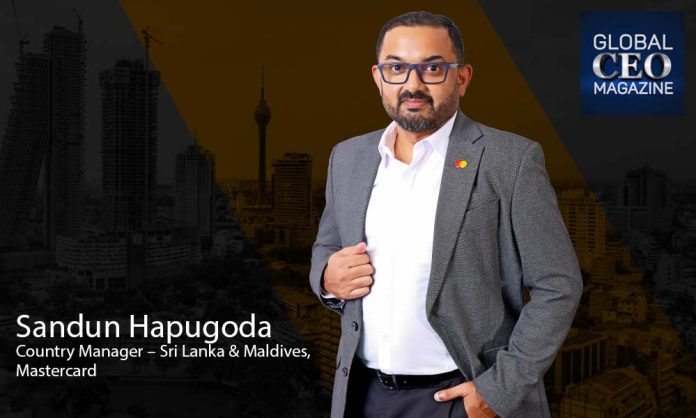
In a world increasingly governed by algorithms and ambition, there arise a few quiet architects who shape the future not with fanfare, but with foresight. Mr Sandun Hapugoda, Country Manager of Mastercard for Sri Lanka and the Maldives, is one such visionary—blending the discipline of banking with the poetry of digital transformation.
In this illuminating conversation with Global CEO Magazine, he traces a journey that began in the modest corridors of Sampath Bank and ascended to the helm of a global payments leader.
With grace and gravitas, Hapugoda unpacks the art of building ecosystems, the nuance of policy dialogue, and the delicate balance of purpose and performance.
From revolutionising transit in the Maldives to igniting fintech innovation in Sri Lanka, his narrative is both a masterclass in leadership and a meditation on impact. For those who seek inspiration in action, his words resonate like a well-composed symphony of strategy and soul.
Your professional journey has spanned over two decades across leading banks and global payment giants. Could you share with us how this journey began and what key decisions shaped your path to becoming Mastercard’s Country Manager for Sri Lanka and the Maldives?
My journey began in 2003 at the Card Centre of Sampath Bank, a place we used to internally refer to as “Mastercard” because it was the first bank to start the relationship with Mastercard in Sri Lanka back in 1989. That early exposure to the world of payments lit a spark that never went out. Over the years, I immersed myself in the evolving landscape of financial services—constantly learning, adapting, and building relationships across banks, regulators, and technology providers.
After Sampath Bank, I worked across three more banks—ICICI Bank, Amana Bank, and Hatton National Bank—taking on roles in IT Management, Information Security, Digital Banking, and Payments and Cash Management. These diverse experiences gave me a well-rounded perspective of the financial services sector, spanning both technology and business, and covering the full spectrum from retail to corporate banking. It helped me develop a strong appreciation for how technology, risk, and customer experience intersect to drive meaningful transformation in banking.
Mastercard formally opened its physical office in Sri Lanka in 2015, and I joined the organisation in 2017 as part of the founding team that helped shape and grow its local presence. One of the key turning points in my career was this move from the banking side to the network side. It gave me a broader, more ecosystem-wide view and an opportunity to contribute to country-level impact. Being appointed as the first Sri Lankan to lead Mastercard’s operations in Sri Lanka and the Maldives in 2021 was both a professional milestone and a deeply personal honour.
You’ve played a pivotal role in driving digital transformation and financial inclusion in both Sri Lanka and the Maldives. What would you consider your most significant achievement in this journey so far?
It’s difficult to pick just one, but supporting the Maldives in becoming the first nation-wide open-loop transit system in South Asia stands out as a landmark achievement. From buses to ferries and speedboats, it’s a truly multimodal, interoperable model—and Mastercard was proud to be a key partner in bringing that vision to life. It’s a great example of what’s possible when governments, technology, and purpose come together.
In Sri Lanka, one of the most significant milestones has been the recent landmark announcement of Mastercard’s strategic partnership with LankaPay. This collaboration between the national payment network and a global payments technology leader marks a powerful step forward in accelerating the country’s digital economy. By combining LankaPay’s national infrastructure with Mastercard’s global capabilities in security, innovation, and interoperability, we’re creating a platform to jointly drive inclusion, efficiency, and digital transformation—while fully aligning with Sri Lanka’s broader national agenda.
Our impact also goes beyond technology. During the prolonged crisis in Sri Lanka, we curated a tourism recovery campaign titled “Sri Lanka with Love”, in collaboration with the Ministry of Tourism. I personally visited all major banks in India to promote Sri Lanka and encourage inbound travel—at a time when the industry was struggling to find its footing. It was an initiative far beyond the traditional scope of our roles, but one that brought immense satisfaction, knowing we were doing our part to support national recovery and economic revival.
Beyond that, I’m proud of the work we’ve done to digitise SMEs, support fintech growth, and create enabling ecosystems for financial access. We actively engage with almost all fintechs and payment tech start-ups in the market—from the ideation stage right through to scale-up. It’s truly rewarding to be able to support their journey, watch them evolve into industry leaders, and know that we’ve contributed to building a more dynamic and inclusive digital economy.
Mastercard’s success in the Maldives is often attributed to a strong blend of global expertise and local customisation. What’s your leadership approach in balancing these forces while steering innovation in complex markets like these?
To succeed in complex markets, you need both deep listening and bold execution. My leadership approach is to blend Mastercard’s global best practices with a ground-level understanding of local culture, policy, and customer behaviour. That means investing time in local partnerships, respecting regulatory dynamics, and co-creating solutions that are locally relevant—rather than just lifting and shifting global models.
We don’t just show up with a toolkit—we work alongside governments, banks, and ecosystem players to build what works for their context. That’s where the real magic happens.
You’ve served on national-level committees on fintech, blockchain, and digital banking. How has this multi-stakeholder experience influenced your thinking and leadership when navigating policy and market-driven challenges?
Serving on those committees has been incredibly enriching. It’s given me a 360-degree view of how innovation, regulation, and infrastructure intersect. When you’re at the table with central banks, tech start-ups, established banks, and policymakers, you start to understand the nuances of alignment—and misalignment—that can make or break progress.
It’s also made me a better leader. You learn to think beyond commercial outcomes and consider systemic impact. It has helped me frame Mastercard’s work not just as product deployment, but as nation-building—whether it’s in financial inclusion, cyber security, or policy formation and re-formation.
As someone who has led cross-functional teams through rapid digital changes, how do you cultivate a culture of agility, trust, and performance within your organisation?
For me, it starts with empowerment and clarity. People need to understand why their work matters and be trusted with the how. At Mastercard, we foster a culture of ownership—where every team member, regardless of role, sees the direct link between their contribution and the broader mission of advancing economies and empowering lives.
Equally important is how we work. Our philosophy of “doing well by doing good” is deeply embedded in our leadership culture. That means we’re not just focused on commercial success, but on delivering impact ethically and responsibly. We place a strong emphasis on integrity, compliance, and doing business the right way—no matter how complex or competitive the environment is.
Agility comes from trust and psychological safety. I try to create a space where people feel confident to test ideas, learn fast, and adapt without fear of failure. When people are aligned with purpose, supported by leadership, and grounded in strong values, performance becomes a natural outcome.
Many young professionals aspire to lead at the intersection of technology and finance. What advice would you offer them—especially those looking to build impactful careers in digital payments and fintech?
My advice is to develop a strong foundation in both technology and business. It’s that unique blend—bringing deep technical know-how together with sound business acumen—that becomes a powerful driver for innovation and sustainable growth. In a space like digital payments and fintech, understanding how things work under the hood while also seeing the bigger commercial picture can set you apart and enable you to create real impact.
Equally important is the ability to build genuine relationships. Go beyond transactional interactions. When you cultivate relationships rooted in trust and shared purpose, you not only grow the business, but you also unlock opportunities to collaborate and do more for society. Some of the most meaningful progress we’ve made has come from these kinds of partnerships—where values align just as strongly as objectives.
And finally, stay curious. This industry moves fast, so be a constant learner, stay close to the problem, and always keep the user in mind. That mindset will take you far.
Looking ahead, what’s your vision for Mastercard in Sri Lanka and the Maldives over the next five years, particularly in advancing digital economies and expanding financial inclusion?
Our vision is clear: to be a key enabler of inclusive digital economies in both Sri Lanka and the Maldives. That means expanding access—through affordable acceptance solutions, inclusive card programmes, and innovative partnerships across sectors. We’re also focused on supporting government digital transformation agendas, especially in areas like transit, tourism, SME development, and cyber security.
In the next five years, I see Mastercard not just as a payments company, but as a strategic partner to these nations in their journey towards a resilient, connected, and inclusive future.
How would you describe your leadership style, and how has it evolved throughout your career in the financial and digital sectors?
My leadership journey started long before my corporate career—when I had the honour of serving as the Head Prefect of D.S. Senanayake College. That experience at a young age taught me the fundamentals of responsibility, discipline, and leading by example along with the motto of my alma mater, “Country Before Self”. It gave me early exposure to the power of influence, empathy, and earning the trust of people from all walks of life.
Professionally, I would describe my leadership style as purpose-driven and people-focused. In the early stages of my career, I was very execution-oriented—focused on precision, delivery, and tangible results. But as I grew into more senior roles, I learned that real leadership is about enabling others to succeed, building trust, and aligning teams around a common vision.
Over time, I’ve become more collaborative, empathetic, and deeply invested in developing others. I believe in open communication, empowering teams, and maintaining strong ethical foundations. One principle I strongly believe in is: if you take care of your people, they will take care of your business. In a region as diverse and dynamic as South Asia, listening and adaptability are critical. I’ve learned to lead with purpose while remaining grounded—and to always remember that fame and recognition are tied to the titles we temporarily carry. That perspective keeps me humble and focused on what truly matters.
Balancing a demanding leadership role with personal responsibilities can be challenging. What strategies do you follow to maintain work-life balance while staying productive and focused?
Balance is never perfect, but I try to be intentional about how I manage my time and energy. One strategy I follow is being fully present in whatever role I’m playing—whether I’m leading a business discussion or spending time with my family. That mental presence makes a real difference.
I also believe in setting boundaries and building strong support systems—both at home and at work. I’m fortunate to have a great team at Mastercard and a deeply supportive family who understand the demands of my role. I recharge by spending time with my daughters, disconnecting from screens when I can, and reflecting on the bigger picture. For me, productivity isn’t about being busy all the time—it’s about staying aligned with what truly matters, both personally and professionally.
