
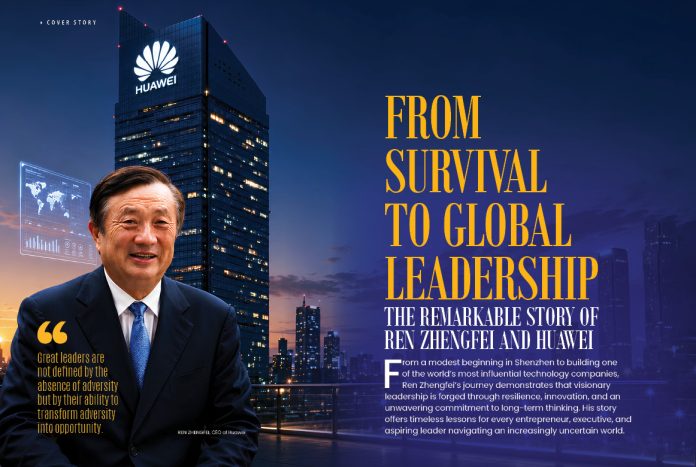
From a modest beginning in Shenzhen to building one of the world’s most influential technology companies, Ren Zhengfei’s journey demonstrates that visionary leadership is forged through resilience, innovation, and an unwavering commitment to long-term thinking. His story offers timeless lessons for every entrepreneur, executive, and aspiring leader navigating an increasingly uncertain world.
Some companies are built to chase markets. Others are built to change them. Huawei belongs firmly to the second category, and at the heart of its remarkable story stands its founder, Ren Zhengfei. His journey is not merely one of commercial success. It is a story of resilience, conviction, and the belief that every setback carries the seed of a greater opportunity.
Born in 1944 in Guizhou Province, China, Ren grew up in a modest household where both his parents were schoolteachers. Resources were scarce, yet education was abundant. Those early years instilled in him a lifelong respect for knowledge, discipline, and perseverance. After studying civil engineering, he served in China’s Engineering Corps before entering the business world in the early years of China’s economic reforms.
In 1987, with capital of approximately 21,000 yuan, equivalent to roughly US$3,000 at the time, Ren founded Huawei in Shenzhen. The company began as a small distributor of telecommunications equipment. Few could have imagined that this modest venture would one day become one of the world’s largest technology companies.
Huawei’s growth did not happen overnight. Like a tree strengthening its roots before reaching towards the sky, the company spent years investing in engineering talent, research, and customer relationships. Instead of relying on imported technologies, Huawei steadily developed its own expertise in telecommunications infrastructure. This relentless commitment to research became the company’s defining characteristic.
As mobile communications expanded across the globe, Huawei emerged as a formidable competitor. It supplied network equipment to telecommunications operators, entered the consumer electronics market, and eventually became one of the world’s leading smartphone manufacturers. By the late 2010s, Huawei had become synonymous with technological innovation, particularly in 5G communications, cloud computing, artificial intelligence, and enterprise solutions.
Then came the storm
Beginning in 2019, the United States imposed a series of trade restrictions that dramatically altered Huawei’s operating environment. The company lost access to many American technologies, including advanced semiconductors, software, and key components that had underpinned much of the global electronics industry. Many observers predicted that Huawei’s best days were behind it.
History, however, often favours those who refuse to surrender
Rather than retreat, Huawei chose reinvention. The company accelerated investment in research and development, strengthened its semiconductor design capabilities through HiSilicon, expanded its cloud computing and enterprise businesses, and intensified work on HarmonyOS, its own operating system. What appeared to many as a crippling setback became a catalyst for greater technological independence.
Ren Zhengfei consistently urged his employees to adopt what he called a “survival mindset”. He reminded them that success today guarantees nothing tomorrow, and that complacency is often the greatest threat to any organisation. His philosophy is simple yet profound: companies should never become prisoners of past achievements. Every day should be approached as though survival depends upon continuous improvement.
That philosophy has shaped Huawei’s culture. The company invests heavily in research, employing hundreds of thousands of people worldwide and dedicating a significant proportion of its annual revenue to innovation. Today, Huawei operates across more than 170 countries and regions, serving billions of people through its telecommunications networks, cloud services, digital power technologies, enterprise solutions, and consumer products.
The financial recovery has been equally remarkable. After years of navigating sanctions and geopolitical uncertainty, Huawei reported annual revenue exceeding 860 billion yuan in 2024, demonstrating that resilience, innovation, and long-term thinking can overcome even the most formidable obstacles.
Yet Huawei’s story extends beyond balance sheets and market share. It illustrates a broader lesson about leadership. Great leaders do not simply manage prosperity. They navigate uncertainty. They inspire confidence when circumstances appear bleak, and they encourage innovation precisely when resources become constrained.
Ren Zhengfei has never portrayed himself as an infallible visionary. Instead, he often speaks about humility, learning, and remaining alert to change. His leadership reminds us that sustainable success is rarely built upon comfort. It is forged through discipline, continuous learning, and the courage to confront difficult realities.
The Huawei journey also reflects a timeless business truth. Competition may sharpen an organisation, but adversity reveals its true character. When external support disappears, innovation becomes more than a competitive advantage. It becomes a necessity.
Today, Huawei continues to occupy a unique position in the global technology landscape. Admired by many for its engineering capabilities and questioned by others because of geopolitical concerns, the company remains one of the most influential technology enterprises of the modern era. Whatever one’s perspective, few would dispute that Ren Zhengfei transformed a modest start up into a global technology powerhouse through determination, strategic patience, and an unwavering belief in the power of innovation.
His story reminds entrepreneurs everywhere that the size of one’s beginnings rarely determines the scale of one’s destination. Vision, resilience, and the courage to keep moving forward often matter far more.
5 Leadership Lessons from Ren Zhengfei
1. Turn Adversity into Opportunity
The toughest challenges often create the greatest opportunities for innovation. Rather than allowing sanctions and restrictions to define Huawei’s future, Ren Zhengfei used them as a catalyst to accelerate research, strengthen self-reliance, and build new technological capabilities.
2. Invest in Innovation Before You Need It
Ren believed that research and development should never be viewed as an expense but as an investment in the future. Huawei’s sustained commitment to innovation over several decades enabled the company to remain competitive even during periods of intense external pressure.
3. Stay Humble, Even at the Top
Despite leading one of the world’s largest technology companies, Ren has consistently encouraged a “survival mindset”. He reminds leaders that past success offers no guarantee of future success, and that humility is essential for continuous learning and improvement.
4. Build Long-Term Value,
Not Short-Term Success
Ren Zhengfei focused on creating lasting capabilities rather than chasing quick profits. By investing patiently in people, technology, and customer relationships, Huawei established strong foundations that enabled it to weather global disruptions and emerge stronger.
5. Leadership Means Inspiring Confidence During Uncertainty
True leadership is tested when circumstances become difficult. Ren’s calm determination, clear vision, and ability to unite thousands of employees around a common purpose helped Huawei remain focused, resilient, and innovative even in its mos challenging years.
