
By Dr Eranga Jayasekara
Success stories are cherished in each and every economy. We value resilience, growth and innovation. However, there is a more muted and overlooked reality behind every successful business – Failure. Business close, strategies fail and dreams are dashed due to these failures. This reality has been more apparent in Sri Lanka recently than it has ever been. Nevertheless, failure is more than just an end. It’s a signal. A lesson. A moment of change.
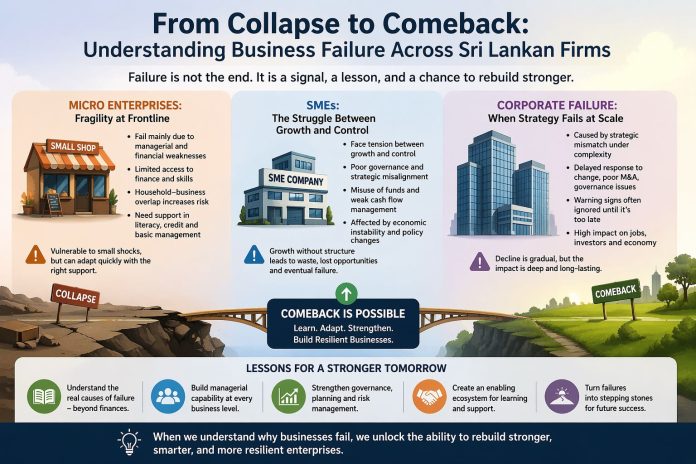
Drawing from the experience in corporate and academic fields and comprehensive research from global, Asian and Sri Lankan research on business failure this article aims to shift the narrative – from fear of failure to understanding it. Because when we understand why businesses fail, we unlock the ability to rebuild stronger, smarter, and more resilient enterprises.
Business Failure: A Multi-Dimensional Reality
Recent research highlights a crucial understanding: business failure cannot be attributed to a single cause; rather, it is a multi-dimensional and context-dependent phenomenon. Commonly, failures are simplistically linked to financial difficulties. While financial distress undoubtedly plays a significant role, evidence indicates a far more intricate reality. Business failure arises from the interplay of various factors, including managerial limitations, financial constraints, strategic weaknesses, and institutional challenges.
Moreover, these elements do not function independently; they interact and amplify over time. A minor managerial oversight can trigger financial strain, which may, in turn, limit strategic options and expose the business to external shocks. Thus, what starts as a trivial concern can ultimately escalate into a profound crisis.
This interconnectedness of failure is very pertinent in Sri Lankan firms, especially due to the current economic context. It serves as a reminder that controlling a system is more important for avoiding failure than solving a single problem.
Micro Enterprises: Fragility at Frontline
The basic foundation of Sri Lankan economy is micro enterprises. From small retail shops to home-based businesses, they provide livelihoods for thousands of families. Yet, they are also the most vulnerable to failure.
It is consistently evident that micro-enterprises fail primarily due to managerial and financial vulnerabilities. Most of the entrepreneurs are driven and passionate when they start their business, but they lack professional experience in financial management, planning, or strategic thinking. Rather than being analytical, decisions are made intuitively.
Limited access to formal financing exacerbates the challenges faced by micro businesses, which often depend on personal savings or informal lending. This reliance leaves them undercapitalized and vulnerable to even minor economic fluctuations.
In Sri Lanka, this situation is further complicated by the indistinct lines between household and business finances; personal financial difficulties can directly jeopardize a micro enterprise’s viability, hastening its potential failure. However, such fragility also presents opportunities. Not constrained by rigid bureaucratic systems, micro enterprises can adapt swiftly with appropriate support, including financial literacy, access to credit, and basic managerial training.
SMEs: The Struggle Between Growth and Control
Small and medium-sized enterprises are often described as the backbone of any economy. In Sri Lanka, they play a crucial role in employment generation and economic diversification. However, recent evidence shows that SMEs face a unique and often overlooked challenge, which is the tension between growth and control.
SMEs usually have some level of technical and operational ability, which is different from micro businesses. But research shows that their failures are often caused by poor governance and strategic misalignment. As companies get bigger, things get more complicated. Things that worked on a smaller scale might not work anymore. Yet, most of the SME owners still rely on traditional approaches, which waste time and money and miss opportunities.
The writer is a Senior Lecturer in the Department of Science for Technology, Faculty of Technology, University of Sri Jayewardenepura.
