
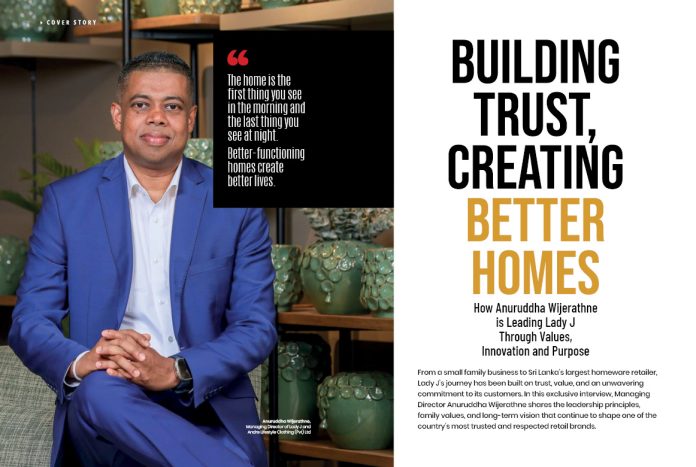
From a small family business to Sri Lanka’s largest homeware retailer, Lady J’s journey has been built on trust, value, and an unwavering commitment to its customers. In this exclusive interview, Managing Director Anuruddha Wijerathne shares the leadership principles, family values, and long-term vision that continue to shape one of the country’s most trusted and respected retail brands.
Whether we are furnishing a new home, searching for the perfect gift, or simply looking for quality products we can trust, retail brands often become part of our everyday lives.
The most successful brands do not merely sell products; they build meaningful connections with customers that endure across generations.
Few brands in Sri Lanka have achieved this connection quite like Lady J. Over the years, Lady J has become a trusted household name, earning the confidence and loyalty of customers across the country.
Nadee Balasuriya of Global CEO Magazine sat down with Mr. Anuruddha Wijerathne, Managing Director of Lady J and Andre Lifestyle Clothing (Pvt) Ltd., to discuss the story behind Lady J’s success, the leadership principles that have guided its growth, and the opportunities and challenges shaping the future of retail in Sri Lanka.
To begin, could you take us through the experiences that shaped who you are today?
I studied at Thurstan College . In 1998, I moved to Australia for higher studies and remained there until 2005. During that time, I completed my Bachelor’s Degree in Marketing and Human Resource Management at La Trobe University in Melbourne.
Those years were transformational for me, both personally and professionally. While studying at La Trobe University, I met my wife, Jayani, who was pursuing her Honours degree there at the time. She is the elder daughter of Lady J’s founders, Mr. J. G. Sumanapala and Mrs. Dharmalatha Akurugoda.
We returned to Sri Lanka in 2005 and got married. It was then that I gained my first experience at Lady J under the guidance of the founders. Later, we returned to Australia, where I completed my Master’s Degree in Politics and Policy at Deakin University in Melbourne.
I came back to Sri Lanka in 2011 and have been actively involved in the business ever since. Looking back, I have accumulated more than two decades of retail experience across Sri Lanka and Australia.
You also have a very personal connection with Lady J.
Absolutely. Lady J is named after my wife, Jayani. My father-in-law and mother-in-law started their business journey in the 1980s. They had two daughters, Jayani and Manjari, and eventually developed two parallel retail chains: Lady J and Manjari.
I married Jayani, and that is how I became connected to Lady J. Today, I have the privilege of leading the business and carrying forward the values established by its founders.
Retail is an extremely competitive sector. What principles have helped Lady J maintain customer trust?
Lady J’s journey began humbly in 1986, when my father-in-law and mother-in-law started a small family business in Galle Fort called Kotuwe Kade. Over the past four decades, that modest beginning evolved into one of Sri Lanka’s most trusted retail brands.
Our first Lady J store opened in Colombo in 2002, and in 2027 we will celebrate our 25th anniversary. Our second store was opened in Maharagama in 2018.
Between 2015 and 2017, I began thinking about how we could transition from organic growth to a more structured and strategic phase of development. From that thinking, we formalised a set of core values inspired by the principles that my in-laws had embedded in the business from the very beginning.
These values have guided Lady J’s evolution over the past 25 years, helping build a trusted brand that today stands as Sri Lanka’s largest homeware store.
Customer expectations continue to evolve. How is Lady J adapting?
Sri Lankan consumer behaviour is changing rapidly. Gen Z is already a significant part of the marketplace, and Generation Alpha will soon follow. At the same time, our ageing population continues to grow.
Balancing the expectations of these different demographics is both challenging and fascinating. At home, my wife and I are raising three children aged 18, 14 and 6, which gives me valuable insight into changing generational preferences.
Younger consumers often gravitate towards pastel colours, minimalist furniture, practical clothing and more functional living spaces. Apartment living is also growing significantly in Sri Lanka.
We continue to evolve by understanding these social, economic and technological shifts. However, our foundation remains unchanged: customer trust. We focus on fulfilling genuine needs rather than simply encouraging consumption.
How does Lady J embrace innovation?
Innovation is not limited to technology companies. In retail, innovation takes place every day through product development, sourcing, distribution, merchandising and customer experience.
We do not blindly follow trends. We carefully select products that align with Sri Lanka’s social, economic and cultural realities. A product may be attractive, but it must also suit local purchasing power and meet the needs of the broader market.
Our purpose is simple: we want to make every home a happier place every day.
We work hard to bring customers the right product, at the right price, with the right design, functionality and usability.
How did your global education influence your leadership?
When I moved to Australia at 19, I had to adapt to a completely different culture and environment. It taught me resilience, adaptability and the importance of understanding diverse communities, systems and perspectives.
My education was not only academic. While studying, I worked in several roles, beginning as a cleaner then in retail, and later at the Grand Hyatt and Park Hyatt hotels in Melbourne. I was also part of the opening team for the Park Hyatt hotel, gaining valuable front-office experience.
Those roles taught me how organisations function, how people are respected, how processes are managed and how technology supports business performance.
Perhaps most importantly, I learned the value of empathy within Australian workplace culture. Combined with the practical business wisdom I received from my father-in-law and mother-in-law in Sri Lanka, it created a powerful foundation for my leadership journey.
Sri Lanka faced the Easter Sunday attacks, COVID-19 and the economic crisis. How did Lady J navigate these challenges?
In business, you must always expect the unexpected. After opening our Maharagama store in 2018, we encountered the Easter Sunday attacks, followed by COVID-19 and later the economic crisis. Inflation, high interest rates, reduced purchasing power and foreign exchange shortages created what was effectively a perfect storm for retailers.
One of our key responses was localising the supply chain. During the crisis, we connected with approximately 400 micro and small suppliers across Sri Lanka. We collected products directly from their doorsteps and paid them promptly.
For example, we sold over 400,000 clay pots through a single store in 4 years and continue to sell between 4,000 and 5,000 live plants every month—categories that were not part of our original business model.
We also strengthened partnerships with local ceramic and plastic manufacturers. Today, approximately 90% of our clothing range is manufactured in Sri Lanka.
Another concept I introduced was Empower, Elevate, Achieve. First, you empower people. Then you educate, support and nurture them so they can grow. Achievement follows naturally.
My wife, Jayani, has always reminded me of the importance of looking after our people. That philosophy helped us navigate some of our most difficult periods.
What qualities do you look for in future leaders?
The first quality is empathy. You must understand how others feel and see the world through their perspective.
The second is a commitment to continuous learning. The third is adaptability, especially in an era shaped by artificial intelligence and rapid technological change.
Future leaders must also stay close to customers. They cannot rely solely on reports or spreadsheets. They must spend time on the ground, speak to customers and understand their real needs.
Empathy remains the most important quality because it connects every stakeholder—from customers and suppliers to employees, government, society and family.
How do you see retail evolving over the next five to ten years?
Retail will continue to evolve rapidly. Consumer decisions are increasingly influenced by social media, digital platforms and, in the future, artificial intelligence.
We can no longer focus solely on local demand. Demographic shifts, technology, omnichannel strategies, global developments and changing lifestyles will all influence retail.
I believe the homeware market will continue to grow, particularly in Colombo and suburban areas. People increasingly seek homes that provide comfort, calm and peace of mind. Consumers will place greater emphasis on value, quality, design, lifestyle impact and sustainability. These factors will shape the future of retail.
What challenges do you foresee?
Apart from demographic changes, Macroeconomic conditions will remain a major challenge. Interest rates, inflation, exchange rates, unemployment and foreign remittances all influence consumer spending patterns.
Global geopolitical developments, including events in the Middle East and South Asia, can also have significant effects on local markets.
The environment will remain challenging over the coming years. However, I view these as challenges to be managed rather than problems to be feared.
What can customers expect from Lady J in the future?
We will continue focusing on products and services that enhance everyday life at home.
The home is the first thing you see in the morning and the last thing you see at night. A well-functioning home contributes to a better life.
We want to help customers create homes that are calm, practical and peaceful. This is not about expensive products; it is about creating systems and environments that allow a home to function comfortably and efficiently. We will continue introducing products that combine value, quality, functionality and international design influences.
We may expand with additional stores in the future, but our journey will remain measured, sustainable and customer-focused rather than aggressively expansion-driven.
Finally, what are your thoughts on work-life balance?
The foundation of my success is my family, particularly my wife, Jayani.
She creates a peaceful home environment that allows me to work effectively, think clearly and maintain perspective.
I have learned a great deal simply by observing how she manages our home and raises our three children Anneli, Evan and Yaara. If my home is not functioning well, I cannot function well either.
Work-life balance begins at home. A peaceful home allows you to decompress, rest, recharge and manage stress more effectively.
That belief is closely connected to our business purpose. We want to create products and spaces that help people enjoy calmer, happier homes.
I encourage everyone, regardless of income, status or profession, to make their home a place of peace, harmony and growth. After all, it is where children learn, develop and quietly build their dreams.
That brings us to the end of this insightful conversation.
Today, Mr. Anuruddha Wijerathne reminded us that successful businesses are built on far more than products and profits. They are built on values, trust, empathy, resilience and the ability to evolve without losing sight of their core purpose.
Thank you for joining us and sharing your valuable experiences.
Thank you, Nadee. Thank you to Global CEO Magazine and everyone involved. It has been a pleasure speaking with you.
