
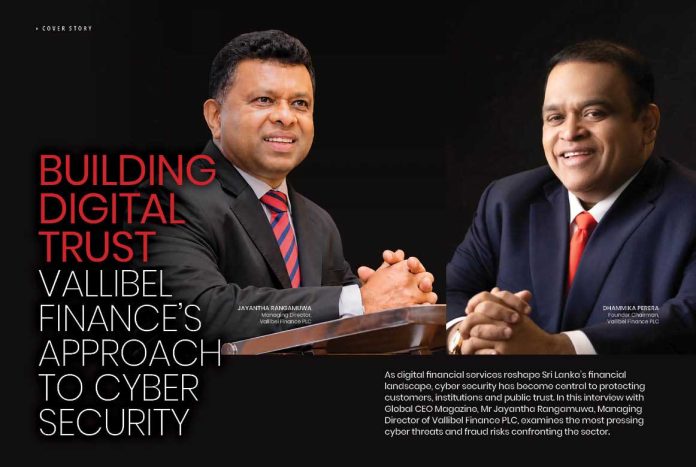
As digital financial services reshape Sri Lanka’s financial landscape, cyber security has become central to protecting customers, institutions and public trust. In this interview with Global CEO Magazine, Mr Jayantha Rangamuwa, Managing Director of Vallibel Finance PLC, examines the most pressing cyber threats and fraud risks confronting the sector.
Jayantha Rangamuwa is Managing Director of Vallibel Finance PLC. A Fellow of the Chartered Institute of Marketing, UK, and a Chartered Marketer, he brings extensive experience across Sri Lanka’s financial services sector. His career includes senior roles at Central Finance PLC and Mercantile Investments PLC before joining Vallibel Finance in 2007. He holds an MBA from the University of Southern Queensland/ICASL and a postgraduate Diploma in Financial Administration. A former Deputy Chairman of the Leasing Association of Sri Lanka, he also serves on the boards of Hunnas Falls PLC and Finance House Consortium.
He discusses Vallibel Finance’s approach to digital resilience, customer data protection, regulatory compliance and fraud prevention, while highlighting the growing influence of artificial intelligence on cybercrime. He also explains why customer awareness, strong governance and continuous investment in technology are essential to building confidence in an increasingly connected financial environment today.
As digital financial services continue to expand rapidly across Sri Lanka, what are the most significant cyber threats and fraud risks facing financial institutions and their customers today?
The growth of digital financial services has undoubtedly transformed the way customers interact with financial institutions. Today, people can access services, make payments and manage their finances with just a few clicks. However, this convenience has also created new opportunities for cybercriminals.
One of the biggest risks we see today is phishing and social engineering. Fraudsters are becoming increasingly creative in how they approach customers, often pretending to represent trusted organisations through emails, phone calls, SMS messages or social media platforms. Their goal is usually to obtain sensitive information, such as passwords, account details or one-time verification codes.
In addition, identity theft, unauthorised account access, malware attacks and online scams continue to pose significant challenges. As digital adoption increases, both financial institutions and customers must remain vigilant. Cyber security is no longer just a technology issue; it is a shared responsibility that requires awareness, good practices and continuous investment in security.
Could you outline your organisation’s cyber security strategy and the key initiatives that have been implemented to strengthen digital resilience and protect customers from emerging threats?
Our approach to cyber security is based on being proactive rather than reactive. We understand that cyber threats are constantly evolving, and therefore, our security measures must evolve as well.
We have implemented multiple layers of protection across our systems and digital platforms. These include continuous monitoring, secure infrastructure, regular system upgrades, vulnerability assessments and periodic security testing. We also place significant emphasis on employee awareness because people remain one of the strongest lines of defence against cyber threats.
Another important aspect is resilience. While prevention is critical, organisations must also be prepared to detect, respond to and recover from incidents quickly if they occur. We continuously review our processes and collaborate with technology partners and regulatory authorities to ensure that our security standards remain aligned with industry best practices.
What fraud prevention and cyber risk management frameworks has your organisation adopted to detect, prevent and respond to such threats?
Fraud prevention requires a balanced combination of technology, processes and people. We follow a risk-based approach that enables us to identify potential threats early and respond appropriately.
Our systems continuously monitor transactions and activities to identify unusual patterns or suspicious behaviour. We have implemented strong authentication controls, access management procedures and incident response mechanisms that help reduce risks and strengthen overall security.
In addition, cyber risks are regularly reviewed through our governance and risk management processes. This allows us to assess emerging threats, evaluate our controls and make necessary improvements. The objective is not only to prevent fraud but also to ensure that the organisation can respond effectively if an incident occurs.
What measures have you introduced to safeguard customer information, secure transactions and maintain confidence in your digital channels?
Customer trust is at the heart of everything we do. People expect their personal and financial information to be handled securely, and we take that responsibility very seriously.
To protect customer information, we have implemented secure authentication processes, encryption technologies, access controls and transaction monitoring systems. These measures help safeguard customer data and identify any suspicious activity at an early stage.
However, technology alone is not enough. We also focus on educating customers about safe digital practices and encouraging them to remain alert when using online services. When customers understand the risks and how to avoid them, the overall security environment becomes much stronger.
Artificial intelligence is transforming both cyber security and cybercrime. How is your organisation leveraging AI to strengthen security, and what new risks do AI-driven threats present to the financial sector?
Artificial intelligence is changing many aspects of business, and cyber security is no exception. On the positive side, AI enables organisations to analyse large amounts of data quickly and identify unusual activities that may indicate potential threats. This helps improve monitoring, threat detection and response times.
At the same time, cybercriminals are also using AI to make their attacks more sophisticated. Fraudulent messages can appear more convincing, impersonation attempts can become more realistic and scams can be executed on a much larger scale.
As an industry, we must recognise both sides of this development. While AI offers tremendous opportunities to strengthen security, it also requires organisations to continuously adapt and invest in new technologies and capabilities to stay ahead of emerging threats.
What initiatives has your organisation undertaken to educate customers about phishing, social engineering, online scams and other forms of digital fraud?
Customer awareness is one of the most effective defences against cybercrime. Even the most advanced security systems can be compromised if individuals unknowingly share sensitive information with fraudsters.
We regularly communicate with customers through digital channels, SMS notifications, social media platforms, our website and branch networks. These communications focus on helping customers recognise common scams, protect their passwords, verify suspicious requests and understand safe online practices.
Our objective is to empower customers with knowledge so that they can make informed decisions and confidently use digital financial services while protecting themselves from fraud.
How does your organisation ensure the protection of customer data while maintaining compliance with regulatory and industry requirements?
Data protection and regulatory compliance are fundamental responsibilities for any financial institution. We maintain comprehensive policies and procedures governing how customer information is collected, stored, accessed and used.
Regular reviews, audits, employee training programmes and security monitoring help ensure that customer data remains protected at all times. We also work closely with regulatory authorities to ensure that our practices remain aligned with applicable requirements and industry standards.
For us, compliance is not simply about meeting regulatory obligations. It is about maintaining customer confidence and demonstrating our commitment to responsible and ethical business practices.
What security innovations or technologies have you introduced to enhance the safety and convenience of digital financial services?
Customer expectations continue to evolve, and organisations must strike the right balance between convenience and security. Our focus has been on introducing technologies that improve the customer experience while maintaining strong security standards.
We have enhanced our digital platforms with secure authentication methods, stronger monitoring capabilities, improved infrastructure and automated processes that help deliver faster and more efficient services. These improvements allow customers to enjoy greater convenience without compromising the safety of their information and transactions.
As technology continues to evolve, we will continue to explore innovative solutions that strengthen both the customer experience and cyber security.
How does your organisation approach compliance, risk management and governance in an increasingly complex threat environment?
Cyber security today extends beyond the IT department. It is a business-wide responsibility that requires strong leadership, effective governance and a culture of risk awareness throughout the organisation.
We integrate cyber security into our overall risk management framework, ensuring that risks are regularly assessed, monitored and addressed. Policies, internal controls, audits and management oversight all play important roles in maintaining a strong governance structure.
Most importantly, cyber security is discussed at the highest levels of the organisation because protecting customers and maintaining operational resilience are strategic priorities for the business.

Looking ahead, what do you see as the biggest challenges and opportunities in combating cybercrime, and what advice would you offer to customers and business leaders?
The biggest challenge is that cyber threats continue to evolve at a very rapid pace. As technology advances and digital adoption increases, criminals are constantly developing new methods to exploit vulnerabilities.
At the same time, there are tremendous opportunities. Advances in artificial intelligence, automation, data analytics and cyber security technologies are enabling organisations to detect and respond to threats more effectively than ever before.
My advice to customers is simple: stay alert, protect your personal information, verify requests before responding and never share sensitive details with unknown parties. A few moments of caution can prevent significant financial loss.
For business leaders, cyber security should be viewed as a long-term investment rather than a cost. Organisations that prioritise security, invest in technology, strengthen governance and continuously educate their people will be better positioned to build trust and succeed in an increasingly digital future.
