
By Dr Eranga Jayasekara
Walk into any modern Sri Lankan organisation today and you will witness something remarkable. At one table sits a seasoned professional who built a career through resilience and loyalty. Across from them, a dynamic mid-career expert balancing ambition with purpose. Nearby, a young employee—digitally fluent, bold, and impatient to make an impact. Presently, three distinct generations—Generation X, Millennials, and Generation Z—collaborate within these organisations. Each generation contributes unique values, expectations, and behaviours shaped by differing socio-economic backgrounds. This diversity presents considerable opportunities; yet, it also introduces challenges that many organisations find difficult to address.
Understanding generational behaviour has transitioned from a supplementary consideration to a strategic necessity. Organisations that effectively navigate these differences are well positioned to foster innovation, resilience, and sustained competitive advantage. Conversely, those that do not may face internal conflict, diminished productivity, and the loss of talent.
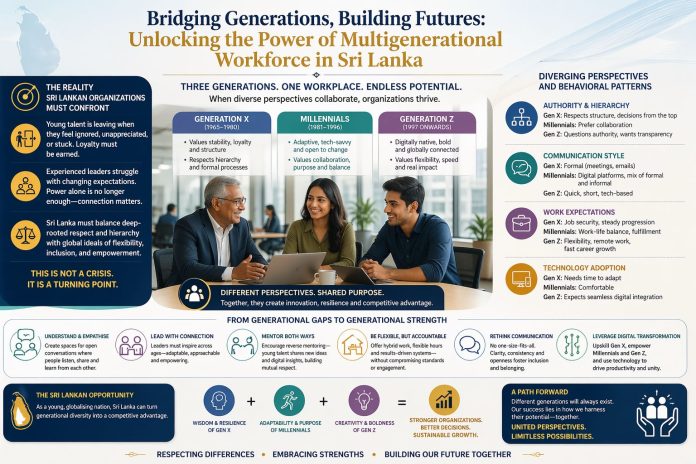
Diverging Perspectives and Behavioural Patterns
Generation X (born approximately 1965–1980) represents senior leadership and middle management in many Sri Lankan organisations. Millennials (born approximately 1981–1996) form the backbone of the workforce. Having grown up during Sri Lanka’s economic liberalisation and technological expansion, they are more adaptable, tech-savvy, and open to change. Generation Z (born approximately 1997 onwards) represents the newest entrants to the workforce, shaped by digital immersion, social media, and global connectivity.
The interaction of these three generations creates both synergy and friction within organisations.
One of the most prominent differences lies in attitudes towards authority and hierarchy. Generation X workers typically respect formal structures and believe decisions should come from the top. Millennials prefer collaborative environments, while Generation Z questions authority and expects openness and approachability from leaders.
Communication styles also differ. Generation X tends to rely on formal methods such as meetings and emails. Millennials use a mix of formal and informal digital platforms. Generation Z prefers quick, concise, and technology-driven communication, even at the expense of depth and formality.
Work expectations vary notably. Generation X emphasises job security and steady career progression. Millennials prioritise work–life balance and personal fulfilment. Generation Z values flexibility, remote work opportunities, and rapid career advancement. These differing priorities can lead to misunderstandings regarding commitment and performance standards.
In terms of technology adoption, Generation X may require time to adapt, Millennials are generally comfortable, and Generation Z expects seamless digital integration. Organisations that fail to keep pace with digital transformation may struggle to engage younger employees.
The Reality Sri Lankan Organisations Must Confront
Across sectors in Sri Lanka, several patterns are becoming increasingly evident.
Many organisations struggle to retain young talent. Millennials and Generation Z are willing to leave environments where they feel ignored, undervalued, or constrained. Loyalty is no longer automatic; it must be earned. At the same time, experienced leaders often find it challenging to respond to evolving expectations. Leadership styles that once proved effective are now being questioned. Authority alone is no longer sufficient—connection is essential.
Perhaps most importantly, Sri Lanka faces a cultural balancing act. It is a nation deeply rooted in respect and hierarchy, yet increasingly influenced by global ideals of flexibility, inclusion, and empowerment.
This is not a crisis. It is a turning point.
From Generational Gaps to Generational Strength
The way forward is not to manage generations, but to unite them.
The first step is understanding. As individuals begin to appreciate why others think and behave differently, frustration gives way to empathy. Organisations must create opportunities for meaningful dialogue—spaces where employees listen, share, and learn from one another.
Modern leaders must move beyond management and build genuine connections. The most effective leaders are adaptable, guiding teams without excessive control and inspiring individuals across all age groups. Mentorship plays a critical role, and it should extend beyond traditional top-down approaches. Reverse mentoring, where younger employees share insights on digital trends and innovation, can foster mutual respect.
Flexibility is no longer optional. Hybrid work models, flexible hours, and results-oriented performance systems can meet the expectations of Millennials and Generation Z without compromising organisational objectives. At the same time, organisations must ensure that flexibility does not lead to disengagement or reduced accountability.
Communication also requires rethinking. In today’s diverse workplace, there is no single correct approach. Clarity, consistency, and openness are essential. Organisations that embrace diverse communication styles create inclusive environments where everyone feels valued.
Digital transformation should not be seen as a generational divide, but as a unifying force. Training programmes can support Generation X, while empowering younger employees to contribute their digital expertise. Technology, when used effectively, enhances productivity, collaboration, and efficiency.
The Sri Lankan Opportunity
Sri Lanka occupies a unique position. As a relatively young nation demographically and increasingly globalised, it has the potential to leverage generational diversity as a competitive advantage.
In organisations where generational perspectives are effectively integrated, innovation, adaptability, and improved decision-making can flourish. The resilience and experience of Generation X, combined with the adaptability of Millennials and the creativity of Generation Z, create a powerful organisational dynamic. However, this requires a shift in mindset—from managing generations to empowering individuals.
A Path Forward
The future of work in Sri Lanka will not be defined by a single generation, but by the ability of organisations to harmonise diverse perspectives. Generational differences should not be viewed as obstacles, but as opportunities to grow, learn, and innovate.
Leaders who embrace this diversity will not only strengthen their organisations but also contribute to a more inclusive and progressive corporate landscape in Sri Lanka.
As we move forward, the question is not whether generational differences exist—they always will. The real question is whether we are ready to harness their potential.
The answer will define the success of Sri Lankan businesses in the years to come.
The writer is a Senior Lecturer in the Department of Science for Technology, Faculty of Technology, University of Sri Jayewardenepura.
