
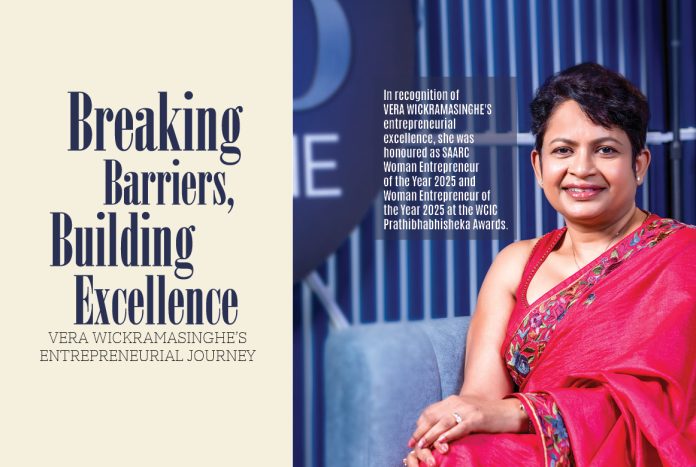
In recognition of Vera Wickramasinghe’s entrepreneurial excellence, she was honoured as SAARC Woman Entrepreneur of the Year 2025 and Woman Entrepreneur of the Year 2025 at the WCIC Prathibhabhisheka Awards.
Ms Vera Wickramasinghe is the Founder, Owner, and Managing Director of Worldlink Shipping Colombo (Pvt) Limited, a company she established in 1997 and has successfully led for nearly three decades. A respected entrepreneur in Sri Lanka’s logistics and freight forwarding sector, she has built Worldlink Shipping into a resilient and trusted enterprise through strategic foresight, operational discipline, and strong global partnerships.
Beyond logistics, Ms Wickramasinghe leads a diversified business portfolio, serving as Managing Director of Island Flavors N Blends (Pvt) Ltd and Pubs & Restaurants Colombo (Pvt) Ltd, while also contributing to industry leadership as Secretary of the Freight Forwarder Network (FFN), a network based in Netherlands. Her ability to balance multi-sector responsibilities reflects a leadership style grounded in accountability, adaptability, and long-term value creation.
In recognition of her entrepreneurial excellence, she was honoured as SAARC Woman Entrepreneur of the Year 2025 and Woman Entrepreneur of the Year 2025 at the WCIC Prathibhabhisheka Awards. Ms Wickramasinghe is widely regarded as an inspiring role model for women leaders and entrepreneurs in Sri Lanka.
What first sparked your journey into entrepreneurship, and when did you realise Worldlink Shipping could become a lasting enterprise?
At one point, I wanted to go a step further than my then career position as General Manager of a logistics company. However, I realised that it would not be possible to step up further at the age of 26, and that was the day I decided it was time to start my own business.
From the very beginning, I aimed for a lasting enterprise. I was driven by a passion for logistics and the challenge of building something meaningful from scratch. The logo was designed by a good friend based on my idea, and our credo and mission were worded by my father with my input. I truly meant what it said: “Unrelenting improvement in know -how, infrastructure, and relationships.”
Starting a logistics business nearly three decades ago in a male-dominated industry was bold. What was the toughest early challenge you had to overcome?
Despite limited resources, I chose to focus on one of the most complex and high-risk markets — the Russia and CIS region. While many saw it as too difficult, I saw opportunity. That mindset has shaped the journey of Worldlink ever since.
Serving the Russian region required close collaboration with logistics, customs clearance, and trucking companies in Russia, including gateway points such as Finland, Iran, China, and Europe. It was also challenging to face severe winters and language barriers when I first travelled to St Petersburg and Moscow.
The logistics and freight sector has changed dramatically. What single strategic decision helped Worldlink Shipping stay resilient and competitive?
Developing an ERP system that perfectly blended with our operations, while continuing to focus on high-risk markets.
You now lead businesses across logistics, hospitality, and networking. How do you stay focused while managing such diverse responsibilities?
The biggest challenge is being able to shift focus from one subject to another within a short period. This has been one of my characteristics since childhood. I have never performed well when given only one task for a long period, but I have always performed well when given multiple responsibilities together.
After almost thirty years in business, what leadership habit or principle has mattered most to your success?
Being able to listen, discuss, and take decisions as a team. It is my habit to seek opinions from others, even on small matters.
I also form my own opinion before discussions and enjoy debating. I believe this process leads to the best outcomes in any situation.
Building trust is critical in logistics. What leadership challenge tested your credibility the most, and how did you handle it?
Operational excellence, financial control, and financial stability build trust in logistics. I am regularly involved in these departments and have a clear understanding of daily operations.
During the recent national crisis, depreciation of the currency and scarcity of foreign exchange posed major challenges. The most important factor in maintaining credibility with foreign partners is timely payments.
From the beginning, we focused on the export industry with an understanding of earning foreign currency. This gave us leverage to negotiate with banks and enabled us to pay overseas partners mostly on time during one of the most difficult periods in Worldlink’s history.
Your recent SAARC and National awards have brought regional recognition. What responsibility comes with that visibility as a woman business leader?
For many years, we operated mainly as a deep-sea company. In recent years, I focused more on the SAARC region, which I saw as a high-volume but less profitable market.
Over the past two years, I have given greater attention to this region, and I believe this recognition supports our efforts further.
When you are awarded, you must maintain the required standards. This is more of a personal responsibility than an external expectation. I always strive to feel better than yesterday and to perform better, following an organic growth approach.
Talent and culture drive service businesses. What do you prioritise most when developing people and leadership within your organisations?
Talent is important for individuals, and culture is important for teams. At Worldlink, we recognise both and give equal importance to talent and organisational culture.
Looking ahead, what is your strategic vision for Worldlink Shipping and your wider business portfolio?
In the coming years, I aim for quantitative growth without losing the qualitative character of the company. This is one of the most challenging aspects of business.
As stated in our mission: Make the impossible possible.
Finally, what is the one leadership lesson you would share with Sri Lanka’s next generation of entrepreneurs, especially women?
If you decide to be an entrepreneur, you cannot think as a woman. You must think only as an entrepreneur.
There is no difference in responsibility whether you are a man or a woman. Take challenges, be knowledgeable, analyse your risks, and do it.
