
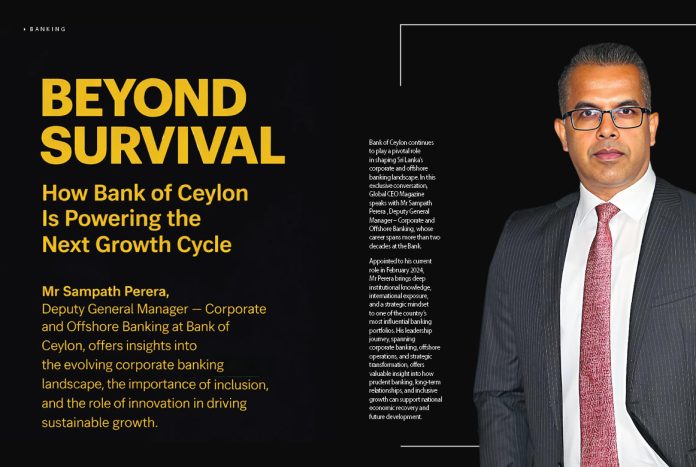
Mr Sampath Perera, Deputy General Manager – Corporate and Offshore Banking at Bank of Ceylon, offers insights into the evolving corporate banking landscape, the importance of inclusion, and the role of innovation in driving sustainable growth.
Bank of Ceylon continues to play a pivotal role in shaping Sri Lanka’s corporate and offshore banking landscape. In this exclusive conversation, Global CEO Magazine speaks with Mr Sampath Perera , Deputy General Manager – Corporate and Offshore Banking, whose career spans more than two decades at the Bank.
Appointed to his current role in February 2024, Mr Perera brings deep institutional knowledge, international exposure, and a strategic mindset to one of the country’s most influential banking portfolios. His leadership journey, spanning corporate banking, offshore operations, and strategic transformation, offers valuable insight into how prudent banking, long-term relationships, and inclusive growth can support national economic recovery and future development.
Q: How do you assess the current corporate and offshore banking landscape in Sri Lanka?
A: If I were to describe the current corporate and offshore banking landscape in Sri Lanka in one word, it would be competitive — highly competitive. In particular, pricing has become an intense battleground, with banks often engaging in what can be described as a price war.
However, it is important to recognise that pricing alone cannot sustain or retain quality business. Today’s corporate clients expect far more from their banking partners. Clients expect banks to demonstrate a deep understanding of their business models, align banking solutions with their operational and technological requirements, and deliver consistent, high quality service. We are firmly committed to fulfilling these expectations and meeting our clients’ needs with excellence.
More importantly, corporates seek trusted partners rather than transactional lenders. Banks that rely solely on pricing as a competitive tool risk overlooking this critical dimension. In doing so, they may fail to attract and retain high-quality clients and build long-term, value-driven relationships that endure beyond short-term pricing advantages.
Q: Bank of Ceylon serves corporates at various levels including private enterprises, government institutions, and State-Owned entities. How is the Bank structured to effectively serve such a diverse corporate landscape?
A: Bank of Ceylon’s Corporate and Offshore Banking Division is structured to address the needs of a highly diverse and broad-based corporate market. The division operates through eight Assistant General Manager divisions, all of which report directly to me. This structure enables specialisation rather than a one-size-fits-all approach.
Our Corporate Relations Division focuses on serving corporates at the upper end of the market and exporters, while the Metropolitan Branch caters specifically to SME and mid-corporate customers. The Offshore Banking Division focuses on overseas-incorporated companies and BOI-approved exporters, while the SOE Relations Division is dedicated entirely to government institutions and State-Owned Enterprises. We also operate the Pettah Business Centre, which serves the vibrant trading and commercial community that plays a critical role in fuelling the nation’s supply chain.
In addition, our Trade Services Division supports all corporate segments by facilitating import and export activities, while our newly established Project Finance Division, headed by an Assistant General Manager, focuses on financing emerging and nationally significant projects.
This specialised structure allows us to deliver tailored solutions through dedicated professionals with deep sector expertise, ensuring focused and effective banking support across all corporate segments.
Q: As Sri Lanka regains economic stability, how is the Bank supporting the next phase of growth?
A: Corporates are now moving beyond survival and looking towards growth. Our responsibility is to support these ambitions prudently. While cash flows are improving, deferred loan repayments are also becoming due. Our role is to structure facilities carefully, balancing working capital needs, debt servicing capacity, and sustainable expansion. We rely heavily on rigorous cash flow analysis and disciplined credit structuring to ensure growth does not lead to overextension.
Q: Banks are often criticised for favouring large corporates over SMEs. How does Bank of Ceylon address this balance?
A: Inclusivity is embedded in our business model, not merely a slogan. While we serve the country’s largest corporates, we also maintain one of the largest SME loan books in the industry, larger than the entire asset base of some private banks. Dedicated units serve SMEs, mid-corporates, and exporters. We recognise the SME sector as the backbone of employment, innovation, and GDP contribution, and we are deeply committed to supporting it.
Q: Following your appointment in 2024, what strategic priorities became most critical?
A: The challenge was twofold. On one hand, we needed to safeguard asset quality during a period of repayment pressures. On the other, we had to drive measured balance sheet growth as economic activity revived. My focus has been on maintaining this balance through disciplined risk management, careful credit expansion, and supporting viable businesses without compromising financial stability.
Q: Looking ahead, what is your medium-term vision for the Corporate and Offshore Banking Division?
A: Our ambition is to lead, not merely to grow. We aim to become the most technologically advanced corporate banker in Sri Lanka. A key priority is integrating entire corporate value chains into the banking ecosystem, enabling better credit decisions, efficiency, and inclusion. Through digital integration and prudent banking, we want to contribute meaningfully to national priorities such as economic growth, digital inclusion, and long-term financial resilience.
