
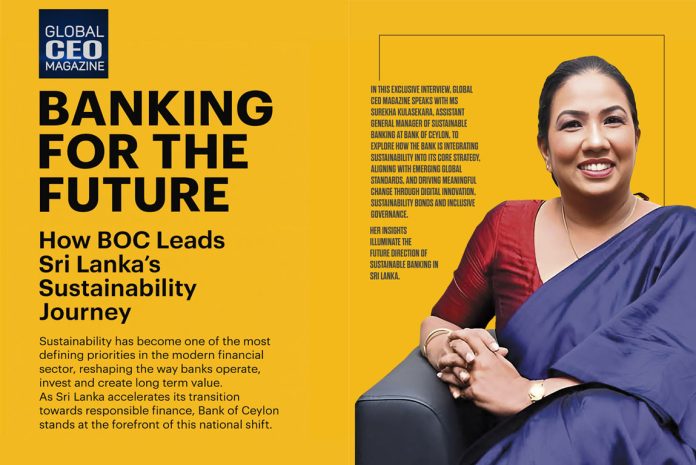
Sustainability has become one of the most defining priorities in the modern financial sector, reshaping the way banks operate, invest and create long term value.
As Sri Lanka accelerates its transition towards responsible finance, Bank of Ceylon stands at the forefront of this national shift.
In this exclusive interview, Global CEO Magazine speaks with Ms Surekha Kulasekara, Assistant General Manager of Sustainable Banking at Bank of Ceylon, to explore how the bank is integrating sustainability into its core strategy, aligning with emerging global standards, and driving meaningful change through digital innovation, sustainability bonds and inclusive governance.
Her insights illuminate the future direction of sustainable banking in Sri Lanka.
Q. Sustainability has become a central pillar in modern banking. How does Bank of Ceylon integrate sustainability strategy with its overall business strategy, and what opportunities or challenges have you encountered in this process?
A: Sustainability is no longer a separate initiative. It has become a business imperative both locally and globally. At Bank of Ceylon, we integrate environmental, social and governance principles into our operations, our bank wide risk management framework, and our financial products. This integration must become part of our corporate culture.
A key requirement is that every stakeholder should understand the sustainability strategy, their role within it, and their responsibility to deliver the expected outcomes.
The main challenge was securing strong leadership commitment at the outset. Fortunately, we received full support from our Board of Directors, especially through the Integrated Risk Management Committee, which oversees the bank’s sustainability direction. We also have a Sustainability Committees headed by our General Manager and a Sustainability Sub Committee led by our Chief Financial Officer. These sub committees are responsible for environmental and social due diligence for credit approvals received from our branch network.
We have finalised material matters for the bank through extensive stakeholder engagement involving the Government, corporate and retail customers, employees, donor agencies and funding partners. Based on this engagement, we have identified ten key material matters including economic performance, digital transformation, customer experience, employment relations and responsible investment.
A recent achievement is the introduction of the biodegradable debit card, which reflects our commitment to reducing plastic waste which has been a hazard to the planet. We are also in the process of issuing a sustainability bond comprising green and social bonds. This is a milestone in our sustainability journey.
Q. Banks are now required to comply with new international sustainability disclosure standards such as IFRS S1 and S2. How is Bank of Ceylon preparing for these requirements, and why are they important?
A: The International Financial Reporting System Foundation has introduced IFRS S1 and S2 to strengthen transparency, consistency and comparability across businesses and industries. These standards address sustainability risks and opportunities, allowing investors to make informed decisions based on a complete understanding of a company’s performance, cash flow trends and future prospects.
For banks, these standards are essential because they broaden our risk lens. Traditionally we assessed majorly credit risk, default risk and interest rate risk likewise. Now we must also assess climate related and sustainability risks and understand how these risks affect our business model and long-term resilience.
Recognising the strategic importance of these standards, Bank of Ceylon decided to adopt IFRS S1 and S2 early, commencing this year. We have conducted extensive training for staff in risk management, finance, sustainability and business divisions. We have also held sessions at Board level to ensure full commitment and understanding.
The bank has updated its internal policies and is working actively on integrating these disclosure standards into our reporting and strategic planning.
Q. Bank of Ceylon recently launched its Sustainable Finance Framework and announced its intention to issue sustainability bonds. Could you explain how the framework operates and what types of projects these funds will support?
A: We are very proud to have announced our sustainability bond initiative, which is grounded in our Sustainable Finance Framework. This framework, developed with support from the Asian Development Bank and the Colombo Stock Exchange, sets out the governance structure for raising and utilising funds under the sustainability bond.
Unlike conventional loans, all lending under this bond requires special screening to ensure the funds are used for projects with positive environmental or social impact. The most important requirement is impact reporting. We must publicly report the environmental and social outcomes delivered through these financed projects.
For example, if we finance solar projects, we must report the energy generated. For social financing, we must report the livelihoods supported or the number of jobs created. The framework also requires audit assurance to ensure that Bank of Ceylon aligns with the International Capital Market Association principles.
The framework clearly outlines the responsibilities of each division involved in screening, allocation of funds and impact reporting. It sets high standards of transparency and governance.
Q. Green bonds and sustainability linked products are gaining global momentum. How do you see these developments influencing Sri Lanka and the local banking sector?
A: Sri Lanka is becoming increasingly active in the green bond and social bond space. Some financial institutions have already issued such instruments, and the South Asian region as a whole has shown strong progress.
There is also clear regulatory encouragement. The Central Bank of Sri Lanka issued Direction No. 05 in year 2022 outlining sustainable finance expectations, followed by the Sustainable Finance Framework and the Green Finance Taxonomy. The Colombo Stock Exchange has also introduced frameworks for trading new sustainable products.
Investor demand is rising in both local and global sector, especially we observe younger generations who care deeply about the planet and the social responsibility of the organisations they choose to support and work for.
In this environment, sustainable investments are not just an option but a strategic requirement. Strong sustainability governance safeguards the long-term financial strength of banks and supports the country’s sustainable economic development.
Q. Sustainability at Bank of Ceylon also extends to governance and workplace inclusion. How does the bank promote gender equality and employee empowerment?
A: At Bank of Ceylon, we provide equal opportunity to all employees. Gender has never been a factor in recruitment, promotion or training. We evaluate candidates solely based on academic qualifications, suitability for the role, experience and capacity to take on higher responsibilities.
Training opportunities are provided based on the requirements of the individual to perform their duties effectively. Our approach to inclusion ensures that every employee can progress based on merit and capability.
Q. Technology plays a major role in sustainable finance. How is Bank of Ceylon leveraging digital infrastructure, and what plans do you have for future technologies such as artificial intelligence?
A: Digitalisation and transformation are among our highest priorities. Bank of Ceylon has invested significantly in digital infrastructure, which supports sustainability by reducing material consumption and improving efficiency.
We offer a wide range of online services including account opening, loan applications, credit card requests and investment products. E statements have replaced paper statements wherever possible.
Our agency banking model, BOC Connect, gives rural communities access to banking services through local shops, reducing the need to travel long distances. The branch on wheels initiative extends services to remote areas, promoting financial inclusion and bridging the rural urban divide.
In the future, we expect artificial intelligence to play an important role in improving customer experience, risk management and operational efficiency. We are preparing our systems and capabilities to integrate these technologies responsibly.
