
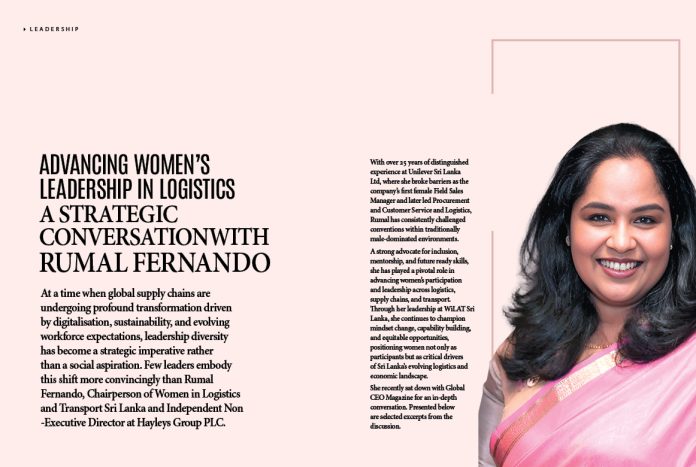
At a time when global supply chains are undergoing profound transformation driven by digitalisation, sustainability, and evolving workforce expectations, leadership diversity has become a strategic imperative rather than a social aspiration. Few leaders embody this shift more convincingly than Rumal Fernando, Chairperson of Women in Logistics and Transport Sri Lanka and Independent Non -Executive Director at Hayleys Group PLC.
With over 25 years of distinguished experience at Unilever Sri Lanka Ltd, where she broke barriers as the company’s first female Field Sales Manager and later led Procurement and Customer Service and Logistics, Rumal has consistently challenged conventions within traditionally male-dominated environments.
A strong advocate for inclusion, mentorship, and future ready skills, she has played a pivotal role in advancing women’s participation and leadership across logistics, supply chains, and transport. Through her leadership at WiLAT Sri Lanka, she continues to champion mindset change, capability building, and equitable opportunities, positioning women not only as participants but as critical drivers of Sri Lanka’s evolving logistics and economic landscape.
She recently sat down with Global CEO Magazine for an in-depth conversation. Presented below are selected excerpts from the discussion.
■ Women currently represent a small percentage of the transport and logistics workforce. As the new Chairperson of WiLAT Sri Lanka, what are your key priorities to accelerate women’s participation and leadership in this sector?
Female participation in Sri Lanka’s logistics and supply chain sector remains strikingly low at just 3.5%, despite the country’s high female literacy rate and equal access to education. While young women today enjoy greater freedom in career choice, logistics continues to be perceived as a male dominated field. This disparity highlights enduring structural and societal barriers, but also presents a powerful opportunity, both for women to enter a dynamic industry and for the sector to benefit from greater diversity and inclusion.
Women in Logistics and Transport (WiLAT) Sri Lanka was established over 12 years ago with the vision to create equal platforms for women and girls and to drive mindset change. Our work focuses on building confidence among schoolchildren, university students, and young professionals by showcasing the vital role logistics and supply chains play in connecting economies and communities, particularly during times of crisis. By engaging early, we aim to making young women future ready and empowering them to pursue careers that previous generations may not have considered possible.
WiLAT Sri Lanka operates through five key pillars: Leadership, Empowerment, Mentorship, Entrepreneurship, and Corporate Social Responsibility. A cornerstone of our efforts is the long-running mentoring programme, now in its 11th year, which connects students and young professionals with experienced female and male role models from the industry. These mentors provide guidance, share real world insights, and support mentees in navigating career pathways.
Our flagship mentoring initiative, “Ignite”, has grown steadily under successive leadership teams. As the sixth Chairperson, I am proud to highlight a major milestone achieved this year, a partnership with EFL Global. Through this collaboration, participants who successfully complete the programme are offered internships, bridging the gap between learning and employment while exposing them to both operational and emerging areas of logistics.
Leadership development is further strengthened through industry exposure. Members participate in visits to ports, terminals, warehouses, manufacturing facilities, aircraft, and vessels, enabling them to translate theory into practice. Many WiLAT members have gone on to pursue logistics careers after graduation, contributing to increased female participation in the sector.
WiLAT also emphasises member -led project execution, building skills such as accountability, stakeholder management, and execution excellence. In 2025, members successfully delivered high impact initiatives including the WiLAT Awards, a National Logistics Day community walk with over 550 participants, and the Ignite passing out ceremony of 70 plus mentees.
Collectively, these initiatives have empowered WiLAT Sri Lanka members locally and globally, enabling them to contribute meaningfully to the wider WiLAT network and advance the agenda of gender inclusion in logistics well beyond Sri Lanka.
■ With over 25 years of experience across logistics, procurement, and customer development, how do you see organisations benefitting from more women taking on critical roles within supply chains?
Many ask, why women? Is advocating for women in the workplace simply a passing trend? Drawing from my personal experience in traditionally male-dominated roles such as Sales, Procurement, and Logistics within a leading multinational FMCG company, I can confidently say that women’s presence transforms not only the role itself, but also the experience of teams, customers, suppliers, and stakeholders.
Women are often labelled as emotional, fragile, or unpredictable, yet reality tells a different story. Women are resilient, adaptable, and emotionally intelligent. They bring empathy to leadership, creativity to problem solving, and strong attention to detail. Women naturally adjust their leadership styles to suit different situations, communicate effectively, collaborate with ease, and place strong emphasis on well-being, both their own and that of their teams.
Within teams, women often read dynamics intuitively, recognise unspoken challenges, and foster trust. They also contribute valuable, experience driven perspectives to decision-making, including consumer insights that are frequently overlooked. Even everyday observations, such as purchasing behaviours and brand preferences, can shape stronger, more consumer centric strategies at the boardroom level.
As workplaces evolve with Gen Z and soon Gen Alpha entering the workforce, leadership must evolve as well. These generations value flexibility, purpose, wellbeing, and open dialogue over rigid hierarchies and traditional measures of presence. Leading such teams requires empathy, inclusivity, and the ability to understand diverse viewpoints, strengths that women leaders consistently demonstrate.
In conclusion, women in leadership are not a trend. They are a strategic advantage for organisations navigating the future of work.
■ From your time at Unilever leading logistics and customer service, what were the biggest barriers you observed for women entering or advancing in the supply chain field and how can WiLAT help break these barriers?
Reflecting on my 25-year career, I can say with gratitude that I was given timely opportunities to step into roles I aspired to be in. My early experience in Sales challenged long -standing norms, both for me and for customers accustomed to male sales representatives. It broadened my perspective and built the confidence to embrace unfamiliar challenges. I later moved into Procurement and Logistics, functions traditionally held by men at the time. By saying “yes” to opportunities beyond my comfort zone, I gained new skills, expanded my understanding of the business, and became a more well rounded professional. These experiences reinforced my belief that growth lies in embracing the unknown.
This journey shaped my passion for advancing inclusivity in logistics and supply chains. Drawing from lived experience at Unilever and now as an Independent Non-Executive Board Member at Hayleys Group PLC, I have seen the tangible value of diverse perspectives at both leadership and operational levels.
Despite progress, barriers remain for many. One of the most significant is mindset. Women often underestimate their capabilities and hesitate to raise their hands unless they meet every requirement. Confidence, guidance, and learning follow action, a principle central to the WiLAT Sri Lanka mentoring programme, which connects aspiring professionals with experienced industry leaders.
Equally important is support from families and workplaces. A lack of empathy, flexibility, and inclusive policies can force women to step away from promising careers. Through WiLAT’s networks, members share best practices on well-being and inclusivity to drive change within their organisations.
Another critical yet overlooked barrier is safe commuting. Harassment in public transport continues to push women out of education and employment. In response, this year, WiLAT Sri Lanka partnered with the Western Province Governor’s Office to launch an awareness campaign on social media, encouraging women to stand up for their rights and ensuring unsafe transport does not limit their futures.
■ Global supply chains are rapidly evolving with digitalisation, sustainability, and ESG priorities. How do you believe Sri Lankan women can become key drivers of this transformation, and what support systems are essential to empower them?
Sri Lankan women already play a strong role in education, finance, ICT, and public service, and with targeted support, they can further accelerate the country’s digital transformation. Expanding women’s participation in areas such as data analytics, Artificial Intelligence, cybersecurity, fintech, ecommerce, digital health, and digital public services is critical to building a future- ready economy.
Advancing sustainability and ESG outcomes requires preparing both women and men with future ready skills. Investment in digital and technical education must challenge the outdated perception of technology as a male domain. Education reforms should introduce advanced digital skills early, supported by free or subsidised programmes in coding, artificial intelligence, cloud computing, data science, and cybersecurity. Partnerships with global technology leaders, alongside stronger integration of ICT into vocational and university curricula, can significantly improve digital readiness.
Equally important is building ESG capabilities. Training women for green jobs can generate early interest and expertise. Collaborations between educational institutions and organisations with strong ESG practices can offer internships and hands on exposure, enabling young professionals to contribute meaningfully to sustainability agendas.
Beyond technical expertise, leadership oriented soft skills are essential. Project based learning, mentorship, and sponsorship can strengthen women’s leadership, communication, decision making, financial literacy, and entrepreneurial capabilities, supporting long-term career progression.
Inclusive workplaces are a key enabler of success. Fair hiring and promotion practices, flexible work models, childcare support, parental leave, safe commuting options, and zero tolerance for harassment help women enter, remain, and advance into leadership roles.
Increasing women’s representation in middle management, board positions, and national digital and ESG policy discussions will enhance visibility and inspiration. A focused national strategy, corporate incentives, university industry partnerships, and positive media narratives can collectively create lasting impact. Through these efforts, Sri Lanka can build a more inclusive, resilient, and future-ready economy.
