
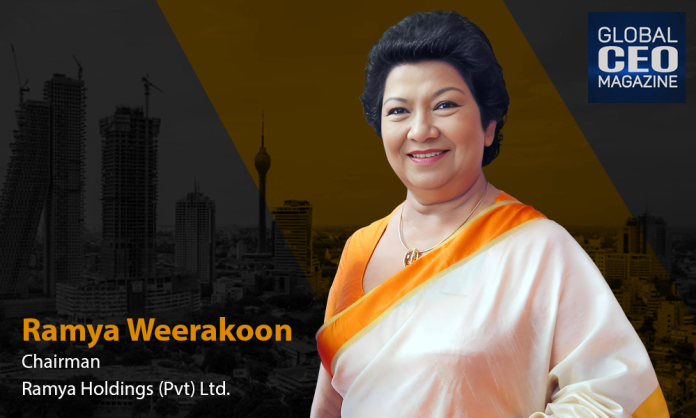
Ramya Weerakoon, the Chairman of Ramya Holdings (Pvt) Ltd., embodies the essence of resilience and entrepreneurial spirit.
From her humble beginnings to her current position as a prominent businesswoman, Ramya’s journey is a testament to her unwavering determination and adaptability.
Born into a life of academia and obedience, Ramya excelled as a studious girl, consistently earning the General Proficiency Prize throughout her school years.
However, her life took an unexpected turn when tragedy struck in 1971, leaving her widowed with a young daughter and another child on the way.
Facing societal challenges and the harsh realities of being a woman in a male-dominated world, Ramya embarked on a new path, driven by her passion for Batik manufacturing. With no prior experience in marketing or labour management, she learned the ropes through sheer determination and hands-on experience.
Starting with a workshop employing 54 individuals in various manufacturing processes, Ramya ventured into the local market before expanding into exports. Her entrepreneurial journey led her to international trade fairs in Europe, where she showcased Sri Lankan handicrafts and wooden products.
Over the years, her perseverance and strategic vision have propelled Ramya Holdings into a thriving enterprise, now employing around 5000 individuals across various sectors.
Ramya’s story is not just one of business success but also of resilience, adaptability, and unwavering determination in the face of adversity. Through her journey, she inspires others to pursue their dreams with passion and perseverance, regardless of the challenges they may encounter along the way.
Ramya recently engaged in a conversation with Global CEO Magazine, discussing various aspects of her life, including her setbacks and achievements.
Can you share with us your journey from your school days to your current position as a prominent businesswoman?
I was a very obedient, studious girl, achieving the General Proficiency Prize every year up to grade 9. After that, there were no prize-giving ceremonies in school.
My mother insisted on arranging my marriage after A/levels, and I was proposed to by Capt. Noel Weerakoon, to whom I got married in June 1967.
My life took a different path when he was killed in the April 1971 insurgency. I was left with a 2 ½-year-old daughter and was carrying our second child.
This marked the beginning of my journey to becoming who I am today. I encountered negativity from society, primarily due to being a woman.
I turned to Batik manufacturing, a hobby of mine while I was in Colombo where Noel was stationed. I had no prior knowledge of marketing or labour handling, which I learned through experience. I had a workshop with 54 employees involved in different manufacturing processes, supplying to the local market. In 1976, I ventured into exports by attending a Trade Fair in Frankfurt, Germany. Since then, I have annually participated in various Trade Fairs in Europe and expanded to exports of wooden handicrafts in 1978.
Eventually, I seized an opportunity to exhibit and sell my products along with Sri Lankan food festivals in five-star hotels in Europe, mainly in Switzerland.
In 1983, I closed down the Batik workshop in Kurunegala and moved to Kadawatha, where I currently reside. Both my daughters found admission to a leading school in Colombo.
In March 1988, I started a small garment factory with 35 machines and 54 employees. From then till now, I have grown to employ around 5000 employees within our Group.
What were some of the major challenges you faced along the way, and how did you overcome them?
Working with unreliable buying agents, I have faced order cancellations.
Another time, four forty-foot containers of fabric imported for jeans were found substandard. As a result, the order got cancelled, and the supplier from India did not accept the fabric for us to re-export. This was another blow I faced during the same period. All these affected the working capital of the company.
Obtaining quota requirements for garment exports issued by the Ministry of Textile Industry then was another challenge. I spent whole days in the Ministry, yet it was not approved for our orders in hand. I was compelled to buy quotas through brokers from other factories, resulting in losses for the company.
In 1992, the “200 garment factory programme” was initiated in villages. The quota was allocated to factories in rural areas. In 1993, I joined this initiative and bought land in Katupotha in the Kurunegala District, where a quota of 25000 dozen was allocated.
I found banks denying loans for the 200 garment factory programme after the death of President R Premadasa, who implemented it.
However, I faced this challenge and proceeded with the project, facing a financial crisis in 1994/95. Government officials’ red tape in obtaining project approvals was also a significant hurdle.
I overcame the situation when a Korean company joined in managing the factory. The bank withheld all facilities for both the factories in Kadawatha and Katupotha and restructured loan repayments for 10 years. With sheer determination and hard work, I managed to pay all due loans with interest within the stipulated period.
Could you highlight some of your key achievements throughout your career?
We have expanded our business under Ramya Holdings, Trendywear Pvt Ltd, with four factories in outstations manufacturing and exporting high-quality ladies’ wear. Ramya Horticulture Pvt Ltd is growing and exporting ornamental tropical foliage plants, with a tissue culture production facility in Walpita Divulapitiya. Aditi Infinity Pvt Ltd has retail garment outlets in many areas of the country. On The Plains, the Ambewela Boutique Hotel, strawberry and vegetable farm agricultural lands for coconut, paddy, and fruits in Kurunegala and Dambulla areas.
Today, I have a direct workforce of over 5,000 and own four garment factories in our island nation. We manufacture and export high-quality ladies’ wear to high-end markets in the USA, UK, and EU countries. Throughout this journey, I have received many accolades and awards.
How do you define success, and do you feel you’ve achieved your goals in life so far?
Every time I walk into my factories, the sight of so many women at work lifts my spirits. Approximately seventy-five per cent of my workforce are females, many from underprivileged family backgrounds. Providing them with stable jobs has afforded security to their families and allowed them to send their children regularly to school, which is immensely rewarding.
I am very confident in myself now. I have no fears. I set up a business from scratch when few people had confidence in me. Now, my only aspiration is to help others. When I meet families of my employees, they express their gratitude for how I have changed their lives. Many women have built houses with their income, and their children are receiving good education and are able to buy what they want. It warms my heart to hear their stories.
My enterprising spirit is far from quenched. My mind is still brimming with ideas, but now my objective is to provide employment to a larger number of people so they can fulfil their hopes and dreams. I want to contribute more to my country, as so many people have benefitted from my company through direct and indirect employment.
What is the best advice you’ve ever received in your professional journey, and how has it impacted your approach to leadership?
I am a self-made person. I have received advice from people who had factories on setting up a factory with required machinery and infrastructure. This gave me the know-how of starting the industry, which I improved through experience.
I always searched for higher goals through expansion and giving employment to many people and ensuring their livelihood. Developing a strong company culture with ethical practices, good governance, and environmental protection for a sustainable journey.
Diversification and expansion through global requirements and the approach of the correct product at the correct time in manufacturing are something I had as an aspiring leader. We have to be continually updated and improved to maintain sustainability in business.
Leadership development boosts employee engagement, increases the organisation’s ability to deal with gaps in the talent pipeline, and reduces the stress and costs associated with turnover.
Considering your experience, what advice would you offer to aspiring businesswomen who are just starting their careers?
I started my business from humble beginnings. Any person who is just starting a business should have a goal and work towards it through sheer determination and courage. No matter what obstacles and hindrances come their way, they should see them as opportunities for the success of the business.
Getting approvals for projects is a stumbling block. However officials played a negative approach, you should be able to drive your way through till you get it done.
The technical know-how and financial commitments are key things you should aspire to in setting up a business.
Human resource development and efficient management in a company help their business gain a competitive advantage.
Selecting a product for manufacturing should be another aspect of the business. It is always better to approach an export-oriented product since the Sri Lankan market is competitive and limited. Having knowledge of the global approach in this matter is very important.
In your opinion, what qualities make a great leader, and how do you embody these qualities in your own leadership style?
Qualities of a good leader include self-awareness, being constantly aware of how they are acting. Team members observe leaders in their non-verbal communication and actions. Employees look up to the leader for formal and informal guidance. The credibility and ability of the leader should be trusted by the team members. Relationship building with employees is a part of organisational improvement.
Motivation is a significant ability of a leader. A leader must be able to build morale and create a proper working environment for their subordinates. Vision and foresight in future planning, along with creativity and innovation, should be present in a leader.
Resilience in any difficult situation is crucial. A leader should be able to navigate the business under any circumstances.
Can you share your thoughts on the importance of fostering a positive attitude towards employees within an organisation?
Fostering positive attitudes towards employees will improve the performance of the organisation.
Being optimistic about situations and interactions with employees’ positive attitudes will make you more alert, less depressed, more productive, and able to solve problems and work well with others. Having a positive attitude in the workplace can be one of the key factors in getting your work done effectively and improving your overall work experience. Maintaining a positive attitude can make you more successful in both your personal and professional life.
Apply positively oriented human resource strength and psychological capacities that can be measured, developed, and effectively managed for performance improvement in the workplace.
How do you prioritise work-life balance, and what strategies do you use to maintain it in your busy schedule?
Maintaining a harmonious relationship between your work and personal life is crucial. It involves managing your time and energy to meet both professional and personal commitments while prioritising self-care and well-being. Plan ahead to combine work activities with leisure, social, and fitness activities. Set priorities and boundaries. The first step to achieving balance between personal and professional life is to identify what is most important. Practise time management and set your work accordingly. Allow employees to take leave from work for family issues. Support employees’ issues by the management so that employees can concentrate on their work.
It is important for employee-management relationships to understand work-life balance without hindering either.
What do you believe is the role of mentorship in career development, and have you had any influential mentors throughout your journey?
Mentorship plays a crucial role in career development. While most successful business people may not have had a mentor, following the guidance of a mentor can be helpful. Throughout my journey in business, I was not influenced by a mentor. However, I always had a vision for the correct path to moving forward and when to change and diversify. This has resulted in the success of my career in different aspects of business.
