
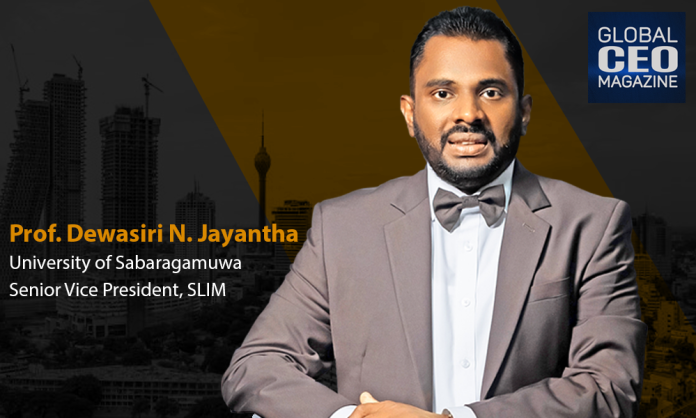
An extraordinary story of resilience, education and global impact. The Transformational Journey of Prof Dewasiri N. Jayantha
In a world where success is often equated with privilege and predictability, the journey of Professor Dewasiri N. Jayantha stands as a remarkable counter-narrative—one of grit, humility, and unrelenting pursuit of purpose.
From waiting tables in a small restaurant after missing out on university admission, to becoming a globally recognised academic, industry thought leader, and President of the Sri Lanka Institute of Marketing, Prof. Dewasiri’s path is anything but conventional.
In this exclusive cover story for Global CEO Magazine, we delve into his compelling life story—told in his own words—charting a course from the grassroots of Sri Lanka’s service industry to the frontiers of international finance research and educational leadership.
Through this interview, Prof. Dewasiri reflects on the setbacks that shaped his early years, the pivotal moments in his corporate ascent, and his mission to bridge academia and industry for the greater good of South Asia and beyond.
His journey is more than inspirational—it is transformational. A testimony to the power of education, applied experience, and unwavering resilience, Prof. Dewasiri’s story offers timeless lessons for aspiring professionals, entrepreneurs, and scholars alike.
GCEO: Professor Dewasiri, your story is truly inspirational. Can you tell us where it all started?
Prof. Dewasiri: My story began after completing my Advanced Level studies in the Bio Science stream. I passed with three credit passes, but unfortunately, I didn’t qualify for university entrance. It was a disheartening moment. Like many young students in Sri Lanka, I had placed great hope in the A/L exam as a gateway to a better future. When that door didn’t open, I was faced with a crossroads: dwell on the setback or find a new way forward.
I chose to act. I took up a job as a waiter in a small restaurant—not out of passion, but necessity. Yet in hindsight, that seemingly modest beginning was incredibly formative. It was my first experience with responsibility, service, and understanding human behaviour up close. I interacted with people from all walks of life, learned how to manage pressure, multitask, and communicate clearly—skills that would shape the foundation of my career.
Most importantly, it instilled in me humility and resilience. I realised early that life doesn’t always give you what you want right away, but if you stay focussed, keep learning, and maintain your dignity, you can carve your own path. That lesson has stayed with me ever since, whether I was closing a business deal, conducting academic research, or leading a national institution.
GCEO: That must have been a humbling experience?
Prof. Dewasiri: Absolutely. It was an incredibly humbling experience. Serving others—sometimes in the most demanding conditions—taught me more about human behaviour, humility, and emotional intelligence than any textbook ever could. I began to understand what truly made people happy, how to anticipate needs, and the subtle art of communication. I also learned the true value of hard-earned money, and that shaped the way I would later approach decisions in both life and business.
Those early lessons became foundational to how I eventually approached marketing, finance, and leadership. Throughout my career, I remained committed to learning by doing. I made it a point to apply what I learned in the classroom directly to the corporate world, and vice versa. My practical experience informed my academic journey, and my academic training helped me bring structure, strategy, and insight into my professional roles. Even as I transitioned into academia, I continued to engage in research not just for publication—but for meaningful knowledge creation and expansion that could bridge theory and practice.
GCEO: You spent 17 years in the industry before transitioning into academia. How did your corporate career unfold?
Prof. Dewasiri: I began my career in entry-level sales and customer-serving roles, starting at the very grassroots of the corporate world. Step by step, I progressed through functional responsibilities, moved into managerial positions, and eventually rose to strategic leadership roles at the corporate level. I had the opportunity to work across multiple dynamic sectors—including telecommunications, mobile payments, and mobile devices—which exposed me to a range of markets, technologies, and customer segments.
These roles offered far more than just career progression; they gave me hands-on experience in understanding market behaviour, operational challenges, and the nuances of organisational leadership. It was during my time in management that I truly began to appreciate the transformative power of higher education.
It was a decade-long journey of purpose-driven learning. Each qualification I pursued was not a credential, but a response to a practical need I encountered in my professional life. That blend of experience and education laid the groundwork for my eventual transition into academia, where I could integrate practice with theory in a meaningful way.
GCEO: What led you to make the shift from the corporate world to academia?
Prof. Dewasiri: Over time, I came to realise that my passion extended beyond achieving business targets or managing teams. I was increasingly drawn to the deeper questions—the “why” behind strategic decisions, market behaviours, and financial outcomes. I wanted to move from simply executing strategies to understanding and shaping the knowledge that informed them. That intellectual curiosity became the catalyst for my shift towards academia.
This led me to pursue higher education in a structured and progressive manner. I first completed some of the professional qualifications, then a postgraduate diploma, followed by an MSc in Applied Finance, and eventually a PhD in Finance. Each academic step allowed me to dig deeper into the theories and frameworks that governed the business world I had been part of for years.
Academia provided me with the space to pause, reflect, and contribute to meaningful research while mentoring the next generation of professionals. It wasn’t a break from industry—it was a natural evolution. It allowed me to merge real-world experience with academic rigour, and to contribute not just to organisational outcomes, but to the broader body of knowledge and societal development.
GCEO: You’re now a full professor in finance attached to the Sabaragamuwa University of Sri Lanka and also serving as the President of the Sri Lanka Institute of Marketing. What do these roles mean to you?
Prof. Dewasiri: These two roles allow me to contribute meaningfully across both academic and professional landscapes—each complementing the other in powerful ways. As a professor in finance, my focus is on nurturing critical thinkers, advancing rigorous research, and fostering a spirit of inquiry among students and scholars. It’s about creating knowledge and shaping future leaders with integrity and purpose.
In my capacity as President of the Sri Lanka Institute of Marketing (SLIM), I have the privilege of influencing the strategic direction of the marketing profession in the country. This role enables me to engage with industry stakeholders, promote ethical and forward-thinking marketing practices, and support the growth of professionals across sectors.
Serving in both academia and industry leadership positions provides a unique vantage point. It allows me to bridge the often-cited gap between theory and practice—ensuring that academic insights are grounded in real-world relevance, and that industry decisions are informed by evidence-based research. For me, it’s not just about holding titles; it’s about using them to create impact, build capacity, and inspire transformation.
GCEO: You’ve been recognised for introducing datatriangulation in finance research. Why is that significant?
Prof. Dewasiri: Traditional finance research has historically been dominated by quantitative methods, often relying on statistical models and numerical data to explain financial phenomena where actual behaviour is different from the proxy explanations. While valuable, this approach can sometimes oversimplify the complexities of real-world financial behaviour—particularly the behavioural and psychological dimensions that increasingly influence decision-making.
Recognising this limitation, I introduced the triangulation approach to finance research-an innovative methodology that involves combining multiple methods within the same research tradition, in a single study. This approach enables a deeper, more nuanced understanding of financial issues by capturing both measurable patterns and underlying human behaviours.
Triangulation has helped generate richer, more holistic insights and has significantly enhanced the practical relevance of academic findings. It allows researchers and practitioners alike to address real-world problems with greater clarity, depth, and contextual sensitivity. For me, it represents not just a methodological advancement, but a paradigm shift in how we understand and apply finance research.
GCEO: You’ve received many accolades and honorary roles, such as Brand Ambassador for Emerald Publishing and several adjunct professorships at various universities. What motivates your continued efforts in research and publishing?
Prof. Dewasiri: My motivation is rooted in one word: impact. I pursue research not for accolades, but for its potential to shape thinking, influence policy, guide corporate decision-making, and ultimately, improve lives. I believe that research should not be confined to academic circles—it should reach boardrooms, classrooms, and communities.
In that spirit, I introduced the first-ever weekly research column in South Asia in 2021, published in the Sunday Observer, Sri Lanka’s leading weekend newspaper, in collaboration with the Faculty of Management Studies at Sabaragamuwa University of Sri Lanka. This initiative created a platform for researchers to share their findings with the broader public, bridging the gap between academia and society in South Asia. Subsequently, I launched a weekly marketing column with the Sri Lanka Institute of Marketing and Ceylon Today newspaper in 2023, aimed at disseminating practical insights and lessons learned from the field to benefit marketing professionals and entrepreneurs. While the research column focused on scholarly communication, the marketing column was designed to translate hands-on experience into actionable strategies.
The honorary roles I have received are not ends in themselves, but platforms to amplify that impact—to inspire others, build research ecosystems, and create sustainable knowledge flows. Both initiatives reflect my core belief that knowledge—whether academic or practical—should serve and uplift society.
Equally important to me is the responsibility of mentorship. I consider it a personal mission to guide young scholars, helping them navigate the research process with purpose and integrity. South Asia, in particular, holds immense untapped potential, and I’m committed to strengthening the region’s research culture through capacity building, collaborative networks, and meaningful scholarly engagement.
Recognition is always appreciated, and I’m grateful for the awards and acknowledgments I’ve received. But for me, the true reward lies in knowing that my work contributes to positive, evidence-based change—whether in policy, practice, or thought leadership.
GCEO: You started at the grassroots level and are now a global academic leader. What is your message to those who may be starting from modest beginnings?
Prof. Dewasiri: Never underestimate the power of persistence. Your starting point does not determine your destination. Every experience—no matter how humble—adds depth and value to your journey. What matters most is staying focussed, continuously investing in your learning, and believing in your potential even when the odds seem against you. Education transformed my life—it opened doors I once thought were closed. I genuinely believe it has the power to do the same for anyone who is willing to persevere and grow.
GCEO: And finally, what’s next for you?
Prof. Dewasiri: I’m continuing to lead international research collaborations and academic publications. I’m also mentoring doctoral students and strengthening partnerships that advance both academic excellence and professional practice in South Asia. My goal is to keep contributing—quietly but meaningfully—to knowledge, leadership, and human development.
Looking ahead, one of my key priorities is to bridge the longstanding gap between academia and industry. In many Western countries, industries actively invest in postgraduate research, particularly PhD-level projects, to tackle real-world challenges and drive innovation. In Sri Lanka, however, such collaborations are still limited. I believe we must cultivate a culture of mutual engagement—where academic institutions and industries work together towards common goals. By encouraging the private sector to support and participate in university-led research, we can empower organisations to investigate and address their most pressing issues, while simultaneously advancing the country’s broader development agenda.
Another important objective on the horizon is to establish an entrepreneurship-focussed practical university. As I see it, this is the need of the hour. Our education system must evolve from producing job seekers to nurturing job creators. This envisioned university would focus on practical, interdisciplinary, and innovation-driven learning—equipping students with the entrepreneurial mindset, skills, and resilience needed to create sustainable ventures, drive inclusive growth, and contribute meaningfully to society. It’s about transforming education into a dynamic engine for entrepreneurship, economic progress, and long-term development.
GCEO: Thank you, Professor Dewasiri. Your story is a powerful example of how purpose, resilience, and vision can shape a remarkable career.
Prof. Dewasiri: Thank you. I hope my journey inspires others to create their own path—wherever it may begin.
