
AI is rapidly changing how we work, conduct business and go about our everyday lives. This presents an important opportunity for Sri Lanka to advance its technology sector.
Today, we are joined by Sampath Jayasundara, Chairperson of SLASSCOM and Director and CEO of hSenid Business Solutions, to discuss an exciting event coming up in Sri Lanka.
Welcome, Mr Jayasundara. It is a pleasure to have you with us.
Sampath Jayasundara: Thank you for inviting me.
Global CEO Magazine: There are many AI conferences and summits taking place. What makes the AI Asia Summit stand out?
Sampath Jayasundara: Many conferences and meet-ups focus primarily on raising awareness of AI. The AI Asia Summit is slightly different. We launched it in 2018, and we have now reached a stage where AI is moving from experimentation to practical implementation.
That is why this year’s theme is ‘AI: The Multiplier’. Companies are exploring how AI can multiply their results, with organisations looking to achieve productivity gains of three to ten times and stronger returns on investment.
The focus has shifted from experimentation to tangible business outcomes, and that is what we will explore this year.
We look forward to welcoming academics, business leaders and practitioners to learn and exchange ideas. It will be a valuable forum for participants from Sri Lanka and across Asia.
Global CEO Magazine: That is wonderful to hear. What opportunities does this global wave of AI present for Sri Lankans?
Sampath Jayasundara: It presents a tremendous opportunity. For years, we have focused on workforce numbers—for example, whether a business needs 300 or 400 employees. Today, the situation is different. A smaller team can achieve much more with AI.
As I mentioned earlier, the potential for productivity gains is considerable. This creates opportunities for Sri Lankan start-ups and engineers. Sri Lanka has a strong foundation in literacy and education. By acquiring AI skills, our professionals can become more competitive and create demand for their expertise in the global market.
They can develop their capabilities by working in the local market while also pursuing opportunities internationally.
My advice to Sri Lankans is to deepen their understanding of AI, learn as quickly as possible and build the skills needed to compete globally. The opportunities are immense.
Global CEO Magazine: That brings me to my next question. Alongside these opportunities, AI also creates considerable uncertainty, particularly around employment. What advice would you give young professionals and recent graduates preparing for this changing world of work?
Sampath Jayasundara: The World Economic Forum’s 2025 report discusses the disruption that technological change will bring to employment. Job losses are part of that transition, and we cannot ignore them.
AI is advancing so rapidly that people and organisations may struggle to adapt at the same pace. AI is increasingly being used to develop new products, including AI products themselves, which further accelerates progress.
This creates a gap between technological advancement and our ability to adapt. In the short term, that can lead to job losses. However, new roles and opportunities will also emerge.
Some forecasts suggest that job displacement could continue through 2028, with substantial new opportunities emerging in 2028, 2029 and beyond.
My advice to young professionals is to use this period to prepare. Start developing your AI skills now so that you are ready to take advantage of future opportunities.
Global CEO Magazine: To explore that further, is there a particular approach you would recommend for developing AI skills?
AI is a broad field, with so many tools and applications available. Where should someone who is just starting begin?
Sampath Jayasundara: I would divide my advice into two areas: those working in the software industry and those working in other fields.
For people in the software industry, the approach is changing. Traditionally, we have worked in separate areas such as software development, quality assurance and business analysis. Those boundaries are now becoming less distinct.
Engineers increasingly need to become builders who can manage the entire software development life cycle. They also need to act as orchestrators, coordinating multiple AI agents throughout the process.
For example, you might use one set of agents to help understand customer requirements, others to support software design, and others for coding, quality assurance, code reviews and deployment.
As AI becomes integrated across the life cycle, the engineer’s role is to guide and coordinate these activities.
If you can become an effective builder and orchestrator, supported by a deep understanding of AI tools and technologies, you will be well positioned for the future.
For those working outside IT, the approach is different. You may be studying agriculture, biological sciences or another discipline. You do not necessarily need the same depth of technical knowledge as a software engineer.
For instance, if you expect to become a doctor in three or four years, developing relevant AI skills alongside your medical knowledge could help you excel in your profession.
Similarly, an agricultural officer who understands how to use AI tools effectively can bring additional value to their work.
Whether you use ChatGPT, Gemini, Claude or another tool, you need to know how to communicate your intentions clearly, write effective prompts and assess the outputs. Learning how to use AI agents to support tasks within your role or department can also be valuable.
There is a substantial opportunity for professionals outside IT to combine their subject expertise with AI skills.
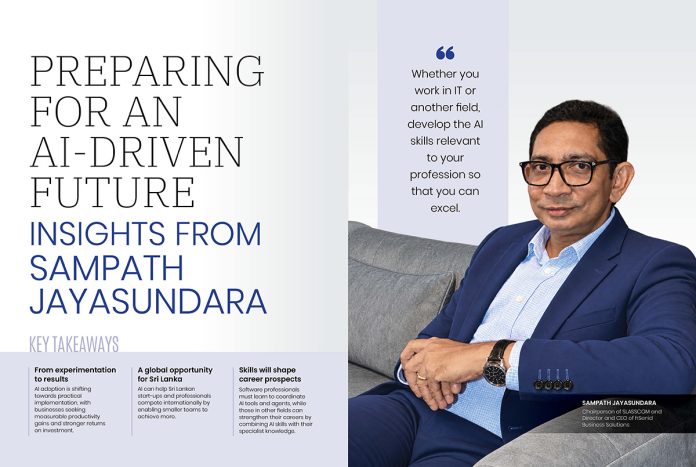
My recommendation is the same for everyone: whether you work in IT or another field, develop the AI skills relevant to your profession so that you can excel.
Global CEO Magazine: Thank you, Mr Jayasundara, for sharing these valuable insights and perspectives at a time when AI is influencing almost every industry.
Today, we explored the opportunities AI presents, the challenges it brings and how professionals can prepare for the changes ahead.
We hope this conversation has given our audience useful insights into developing their skills and navigating an increasingly AI-driven world.
Thank you once again, Mr Sampath Jayasundara, for joining us.
Sampath Jayasundara: Thank you. It has been a pleasure speaking with you.
Global CEO Magazine: Stay tuned for more exclusive conversations. This is Global CEO Magazine.
3 Key Takeaways
1. From experimentation to results: AI adoption is shifting towards practical implementation, with businesses seeking measurable productivity gains and stronger returns on investment.
2. A global opportunity for Sri Lanka: AI can help Sri Lankan start-ups and professionals compete internationally by enabling smaller teams to achieve more.
3. Skills will shape career prospects: Software professionals must learn to coordinate AI tools and agents, while those in other fields can strengthen their careers by combining AI skills with their specialist knowledge.
3 Pullouts
“The focus has shifted from experimentation to tangible business outcomes.”
“A smaller team can achieve much more with AI.”
“Whether you work in IT or another field, develop the AI skills relevant to your profession so that you can excel.”
