
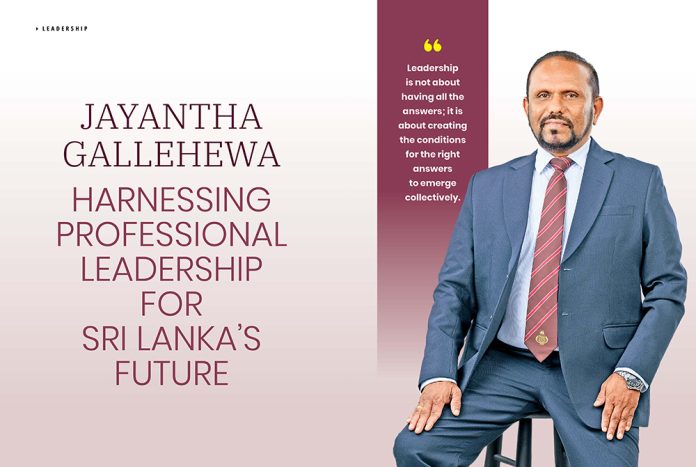
At a time when Sri Lanka needs stronger collaboration across professions, Mr. Jayantha Gallehewa brings a leadership perspective shaped by professional governance, corporate experience and national responsibility. As President of the Organisation of Professional Associations of Sri Lanka, he advocates leadership grounded in integrity, inclusiveness, strategic vision and the ability to build consensus across diverse disciplines. His approach places professional knowledge within a broader national context, emphasising trust, ethical judgement, institutional strength and the development of future leaders. In this interview, he reflects on how professional leadership can contribute meaningfully to policy, governance and Sri Lanka’s long-term progress.
Q: As President of the OPA, representing professionals across a wide range of disciplines, what do you believe are the most important leadership qualities required to unite diverse professions around a common national purpose?
The Organisation of Professional Associations (OPA) of Sri Lanka is the apex body of professionals, currently comprising 52 member associations across 32 disciplines, with a total membership of over 50,000. Leading an organisation that brings together professionals from diverse disciplines requires an appreciation that each profession has its own knowledge, priorities, and perspectives. However, beneath those differences lies a shared responsibility towards the country and its people.
I believe the most important leadership qualities are integrity, inclusiveness, humility, strategic vision, and the ability to listen. A leader must be able to bring people together without imposing personal views and create an environment in which different perspectives are respected. Leadership is not about having all the answers; it is about creating the conditions for the right answers to emerge collectively.
As President of the OPA, I see our role as building bridges among professional bodies and encouraging them to look beyond their individual disciplines towards the wider national interest. Sri Lanka has an immense pool of professional knowledge and experience. If we can bring that collective expertise together and channel it towards national priorities, professional leadership can make a meaningful contribution to the country’s progress.
Q: Professional leadership today extends beyond technical expertise. How can leaders in fields such as medicine, engineering, law, management, finance, and other professions strengthen their strategic, ethical, and people leadership capabilities?
Technical competence will always remain fundamental to any profession, but it is no longer sufficient on its own. Today’s professionals operate in an environment characterised by rapid technological change, economic uncertainty, shifting expectations, and increasingly complex social challenges.
Professionals therefore need to continuously develop their strategic thinking, communication, emotional intelligence, ethical judgement, and people-management capabilities. We must move from simply being experts in our respective fields to becoming leaders who can understand the broader implications of our decisions.
Ethics is particularly important. Professional knowledge gives us influence, and that influence must be exercised responsibly. Trust is built through consistency, transparency, and accountability.
Professional associations have a major role to play in this development by providing continuing professional education, leadership programmes, mentoring opportunities, and platforms for knowledge sharing. We must also encourage professionals to learn across disciplines because many of the challenges facing Sri Lanka cannot be solved by one profession alone.
Q: You have held leadership roles across professional associations, the corporate sector, and national institutions. What lessons have these diverse experiences taught you about leading effectively in environments with different expectations, cultures, and responsibilities?
My journey within the Organisation of Professional Associations of Sri Lanka has been one of the most valuable leadership experiences of my professional career. Over the years, I have had the opportunity to serve the OPA in several capacities, including as Vice President, Chairman of the Membership Committee, Convenor of the Annual Conference Committee, and Chairman of the Supply Chain, Logistics and Transport Committee, before taking on the responsibility of serving as its President. Each of these roles exposed me to different aspects of professional leadership and provided me with the opportunity to work closely with leaders representing a wide range of disciplines.
These experiences have taught me that leadership within a diverse professional organisation requires the ability to listen, understand different perspectives, build consensus, and place the interests of the institution above individual or professional interests. The OPA brings together professionals from many fields, each with their own expertise and expectations. Working with such diversity has strengthened my belief that effective leadership is not about directing people, but about creating a platform where people can contribute meaningfully towards a shared objective.
My leadership journey with the Institute of Supply and Materials Management (ISMM) has also been an important part of my professional development. Having served in various capacities, including as President and subsequently Immediate Past President, I gained valuable experience in professional governance, institutional development, and working with diverse stakeholders within the supply chain and management profession.
My corporate career has complemented these experiences by giving me exposure to organisational strategy, operational decision-making, performance management, and accountability. Bringing together these experiences has taught me that leadership must be adaptable to the environment while remaining firmly grounded in integrity, responsibility, and respect for people.
The most important lesson I have learned is that leadership is a responsibility built on trust. Regardless of the position or organisation, a leader must be willing to listen, make decisions in the best interests of the institution, accept accountability, and ensure continuity for those who follow. My experiences with both the OPA and ISMM have reinforced this principle and have shaped the way I approach leadership today.
Q: How can Sri Lanka’s professional bodies play a stronger role in developing the next generation of leaders and ensuring that young professionals are prepared to take on senior leadership positions locally and internationally?
I strongly believe that leadership development must begin well before a person reaches a senior position. Young professionals need opportunities to lead, make decisions, participate in committees, manage projects, and engage with experienced professionals.
Professional bodies are uniquely positioned to provide these opportunities. We should create structured mentoring and leadership development programmes that connect young professionals with experienced practitioners. We should also encourage greater youth participation in professional associations, rather than viewing young members simply as future leaders.
At the same time, young professionals must be encouraged to develop an international outlook. The world of work is increasingly interconnected, and Sri Lankan professionals must be able to compete and collaborate globally.
Exposure to international professional networks, technology, emerging business practices, and cross-cultural environments can significantly broaden their capabilities.
As professional leaders, our responsibility is not simply to lead today, but to prepare those who will lead tomorrow. Succession planning and developing the next generation must therefore be considered a core responsibility of every professional institution.
Q: Looking ahead, what role should professional leaders and organisations such as the OPA play in influencing national policy, strengthening institutional governance, and contributing to Sri Lanka’s long-term economic and social development?
I believe professional organisations must play a much more active and constructive role in national development. Sri Lanka has professionals with considerable expertise in virtually every field, and that knowledge should be effectively utilised in policy formulation and national decision-making.
The OPA, as an umbrella organisation representing a broad spectrum of professional disciplines, has the ability to facilitate dialogue among professionals and provide policymakers with independent, evidence-based perspectives. Our contribution should be constructive and focused on solutions rather than criticism alone.
Good governance, institutional accountability, professionalism, and evidence-based decision-making are essential for sustainable national development. Professional bodies can contribute by promoting these principles within their own institutions and by engaging constructively with government, industry, and other stakeholders.
Ultimately, I believe Sri Lanka’s future depends on how effectively we utilise the knowledge, experience, and integrity of our people. Economic development cannot be separated from strong institutions, ethical leadership, professional competence, and social responsibility.
As President of the OPA, my vision is to strengthen the platform through which Sri Lankan professionals can come together, share their expertise, and contribute meaningfully to the country’s future. We may represent different professions, but our ultimate responsibility is common: to use our knowledge and leadership not only for professional advancement, but for the sustainable progress of Sri Lanka.
