
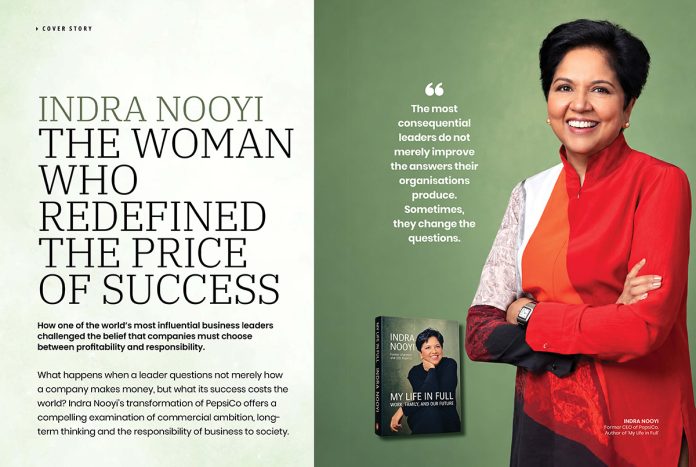
How one of the world’s most influential business leaders challenged the belief that companies must choose between profitability and responsibility.
What happens when a leader questions not merely how a company makes money, but what its success costs the world? Indra Nooyi’s transformation of PepsiCo offers a compelling examination of commercial ambition, long-term thinking and the responsibility of business to society.
The Woman Who Redefined the Price of Success
A packet of crisps carries a price. A bottle of soft drink carries another. But what of the water consumed in production, the packaging left behind, or the consequences of changing dietary habits?
For most consumers, these questions remain invisible at the checkout counter. For Indra Nooyi, they became central to a remarkable experiment in corporate leadership.
The challenge was formidable. How could one of the world’s largest food and beverage businesses continue satisfying shareholders while responding to growing concerns about nutrition, environmental sustainability and social responsibility?
Her answer was not to abandon commercial ambition. It was to reconsider what sustainable commercial success should mean.
When Nooyi became Chief Executive Officer of PepsiCo in 2006, she inherited an enormously successful enterprise with some of the world’s most recognisable consumer brands. Yet she believed that yesterday’s formula for success could become tomorrow’s vulnerability.
Changing consumer expectations, environmental pressures and the growing influence of public health concerns were reshaping the industry’s future.
Ignoring these forces might protect short-term earnings. Responding to them required something more difficult: persuading a global organisation to invest in a future that could not be measured entirely through the next quarterly report.
Nooyi called her philosophy Performance with Purpose
The phrase sounded deceptively simple. Its implications were anything but.
She wanted PepsiCo to improve the nutritional profile of its products, reduce its environmental footprint and strengthen the communities and people connected to its operations.
These ambitions demanded more than corporate philanthropy. They required changes to products, manufacturing processes, resource management and organisational priorities.
In her 2017 sustainability report, Nooyi explained that Performance with Purpose concerned the way the company made money, rather than simply how it spent money.
That distinction revealed the intellectual foundation of her leadership.
Responsibility, in her view, should not be an activity conducted after profits had been earned. It should influence the decisions through which profits were generated.
The Courage to Think Beyond the Quarter
The difficulty of such a philosophy lies in its timing.
Shareholders can measure earnings every quarter. The benefits of healthier products, more efficient water consumption or stronger environmental practices may take years to emerge.
Leaders therefore face an uncomfortable choice between what is immediately measurable and what may ultimately prove indispensable.
Nooyi attempted to bridge that divide
Under her leadership, PepsiCo invested in product innovation, pursued reductions in resource consumption and established sustainability objectives across its operations.
The company also continued to expand commercially.
Between 2006 and 2017, PepsiCo’s annual net revenue increased from approximately US$35 billion to US$63.5 billion. Its total shareholder return over the period cited by the company reached 162 per cent.
These figures do not establish that every sustainability initiative generated financial returns. They do, however, demonstrate that pursuing a broader corporate purpose did not prevent substantial business growth.
The distinction matters
Purpose without performance risks becoming an expensive promise. Performance without purpose risks creating prosperity that cannot endure.
Nooyi’s contribution was to argue that the two should reinforce one another.
The Human Cost of Corporate Ambition
Yet perhaps the most revealing dimension of her leadership emerged beyond the factory, the boardroom and the balance sheet.
Nooyi understood that organisations do not employ abstract units of productivity. They employ people whose professional responsibilities exist alongside families, relationships and obligations that cannot always be postponed.
Her own experience of combining a demanding executive career with family responsibilities informed a broader concern about the structures supporting working parents.
In her memoir, My Life in Full: Work, Family, and Our Future, she examines the pressures confronting families and the need for stronger systems of childcare, eldercare, paid leave and workplace flexibility.
Her argument extends beyond individual wellbeing
When talented people, particularly women, struggle to remain economically active because care responsibilities are unsupported, the consequences reach businesses and national economies.
For Nooyi, the question was not simply how women could adapt to demanding workplaces. It was how workplaces and societies could evolve to make fuller use of human potential.
Here, her leadership philosophy acquired a more personal dimension
The executive who challenged a multinational corporation to reconsider its relationship with society was also challenging society to reconsider its relationship with working families.
Both questions arose from the same conviction: institutions cannot prosper indefinitely while overlooking the people and systems upon which they depend.
When Purpose Meets Reality
Nooyi’s approach was ambitious, but it was not free from contradictions.
PepsiCo continued selling products associated with public health concerns, even as it invested in nutritional improvements and expanded its sustainability commitments.
That tension is important because it prevents her story from becoming a simplistic account of corporate virtue.
Transforming an established business is rarely a matter of replacing one model with another overnight.
Companies must navigate existing customer preferences, competitive pressures, shareholder expectations and operational realities.
For Nooyi, transformation meant attempting to move a commercially successful enterprise towards a different future without sacrificing the economic strength required to sustain that journey.
The results were substantial, though the underlying challenges were not eliminated.
Her legacy therefore lies less in having resolved every contradiction than in making those contradictions legitimate subjects of corporate strategy.
She helped advance an argument that has become increasingly significant in global business: environmental and social consequences are not necessarily external to commercial decision-making.
They can shape competitiveness, resilience and long-term value
When Nooyi stepped down as CEO in October 2018, she left behind more than a record of revenue growth and shareholder returns. She had demonstrated how a leader could broaden the questions an organisation asks about success.
And perhaps that is the most enduring lesson of her journey
A balance sheet can reveal what a company has earned. It cannot, by itself, explain whether the foundations of those earnings are sustainable.
The question Nooyi placed before business leaders remains as relevant as ever.
What is the true value of prosperity if the world supporting it is gradually diminished?
Her leadership suggests that the most consequential executives do not merely improve the answers their organisations produce.
Sometimes, they change the questions.
FIVE LEADERSHIP LESSONS
