
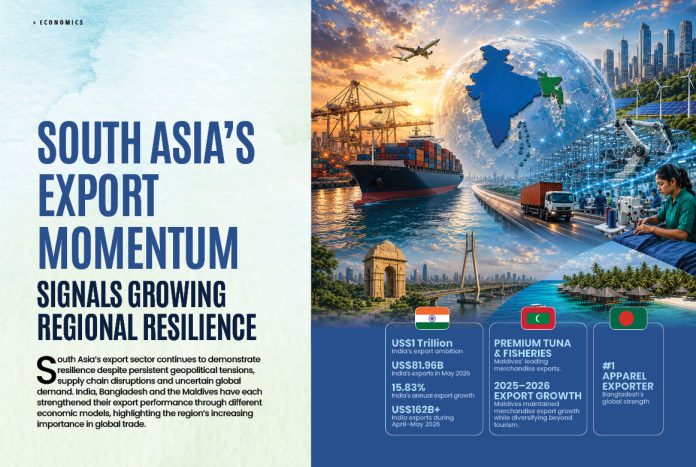
South Asia’s export sector continues to demonstrate resilience despite persistent geopolitical tensions, supply chain disruptions and uncertain global demand. India, Bangladesh and the Maldives have each strengthened their export performance through different economic models, highlighting the region’s increasing importance in global trade.
While manufacturing remains the principal driver for India and Bangladesh, the Maldives is gradually broadening its export base beyond fisheries while continuing to benefit from its globally competitive tourism services.
India: Driving Towards a US$1 Trillion Export Economy
India remains the region’s dominant export powerhouse and has set an ambitious target of achieving US$1 trillion in merchandise and services exports. The country’s combined exports reached approximately US$81.96 billion in May 2026, representing year-on-year growth of 15.83%, while exports during April and May exceeded US$162 billion.
Growth has been driven by engineering products, petroleum products, electronics, chemicals, pharmaceuticals, gems and jewellery, and rapidly expanding services exports including information technology, business process management and financial services. Government initiatives such as Production Linked Incentive schemes, expanding Free Trade Agreements, improved logistics infrastructure and digital trade facilitation continue to strengthen India’s competitiveness.
Although global trade uncertainties and rising imports remain challenges, India’s diversified industrial base and expanding services sector position the country as one of the world’s fastest growing export economies. Officials remain confident that continued manufacturing expansion and deeper integration into global value chains will support long-term export growth.
Bangladesh: Expanding Beyond Ready Made Garments
Bangladesh has consolidated its position as one of the world’s leading apparel exporters while gradually diversifying into higher value manufacturing sectors. Ready made garments continue to account for the overwhelming majority of export earnings, supplying major international retailers across Europe and North America.
The country is also expanding exports of pharmaceuticals, leather goods, footwear, jute products, information technology services and light engineering products. Continued investment in special economic zones, industrial infrastructure and export processing zones is supporting this transition.
Bangladesh’s export competitiveness is strengthened by its skilled workforce, improving manufacturing capabilities and strategic efforts to attract foreign direct investment. At the same time, policymakers continue to focus on preparing exporters for the country’s eventual graduation from Least Developed Country status by increasing productivity, innovation and product diversification.
Challenges remain, including global demand fluctuations, rising production costs and evolving sustainability requirements from international buyers. Nevertheless, Bangladesh continues to strengthen its position as one of Asia’s most competitive export manufacturing hubs.
Maldives: Diversifying Beyond Tourism
Although tourism remains the cornerstone of the Maldivian economy and its largest source of foreign exchange through services exports, the country is gradually expanding its merchandise export portfolio. Fisheries continue to dominate goods exports, with premium tuna products maintaining strong international demand, while marine products, processed seafood and niche agricultural products contribute additional export revenue.
Official data indicate that merchandise exports have remained resilient, with goods exports recording growth during 2025 and continuing into 2026 despite monthly fluctuations that reflect the country’s relatively small export base.
The Maldives is also investing in fisheries value addition, sustainable seafood certification, digital services and logistics improvements to reduce dependence on tourism alone. Strong environmental credentials and premium product positioning provide opportunities to access high value international markets.
As infrastructure development continues and economic diversification gathers pace, the Maldives aims to build a more balanced export economy capable of withstanding external shocks while supporting sustainable long-term growth.
Regional Outlook
The export performance of India, Bangladesh and the Maldives illustrates the diversity of South Asia’s economic landscape. India is leveraging advanced manufacturing and knowledge-based services to pursue global scale, Bangladesh continues to strengthen its world class manufacturing capabilities while broadening its industrial base, and the Maldives is steadily diversifying beyond tourism through fisheries, value added processing and niche exports.
Despite continuing global economic uncertainty, all three countries are investing in competitiveness, innovation, sustainability and market diversification. These efforts are expected to enhance export resilience, attract greater investment and reinforce South Asia’s growing role in international trade. Together, they demonstrate that export-led growth remains a central pillar of economic development across the region, creating employment, generating foreign exchange and strengthening long-term economic prosperity.
References
1. Government of India, Ministry of Commerce and Industry. (2026, June 15). India’s total exports (merchandise and services) during April–May
2026–27. Press Information Bureau. https://pib.gov.in/PressReleasePage.aspx?PRID=2273044
2. Export Promotion Bureau of Bangladesh. (2026). Export statistics. https://epb.gov.bd/
3. Bangladesh Bank. (2026). Monthly economic trends. https://www.bb.org.bd/
4. Maldives Monetary Authority. (2026). Statistics database: Export of goods. https://database.mma.gov.mv/viya/series/3465
5. World Trade Organization. (2025). World trade statistical review 2025. https://www.wto.org/
6. World Bank. (2026). World Development Indicators. https://data.worldbank.org/
