
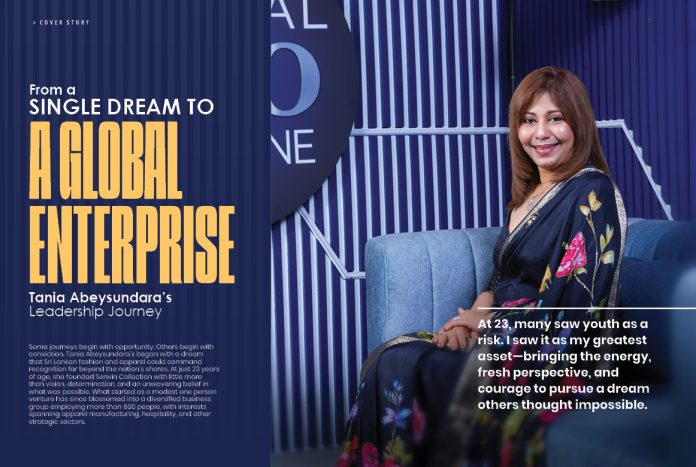
Some journeys begin with opportunity. Others begin with conviction. Tania Abeysundara’s began with a dream that Sri Lankan fashion and apparel could command recognition far beyond the nation’s shores. At just 23 years of age, she founded Senvin Collection with little more than vision, determination, and an unwavering belief in what was possible. What started as a modest one person venture has since blossomed into a diversified business group employing more than 600 people, with interests spanning apparel manufacturing, hospitality, and other strategic sectors.
pioneer of Sri Lanka’s one-stop apparel manufacturing solution, Tania has woven innovation, uncompromising quality, and customer-centred thinking into the very fabric of her enterprise. Through economic uncertainty, global competition, and supply chain disruptions, resilience has been the thread that has bound every chapter of her remarkable journey. Yet her influence reaches well beyond the boardroom through initiatives such as the Ceylon United Business Alliance (CUBA), reflecting a leadership philosophy rooted in purpose as much as performance.
In this exclusive interview with Global CEO Magazine, Tania Abeysundara reflects on the milestones that shaped her entrepreneurial journey, the values that define her leadership, and the vision that continues to guide her towards new horizons.
You founded Senvin Collection at the age of 23 with a vision and determination. Looking back, what inspired you to take such a bold entrepreneurial leap at a young age?
When I returned to Sri Lanka after completing my higher education at the Sydney Designer College in Australia, I brought back a deep passion for fashion and technical apparel design. At 23, many see youth as a risk, but I saw it as my greatest asset—I had the energy, a fresh perspective, and a refusal to be deterred by the fear of failure.
I strongly believe that trying and failing is simply a stepping stone to ultimately succeeding. My inspiration came from a desire to see Sri Lankan-designed apparel stand proudly on its own, shifting the local industry from just executing third-party orders to actively creating, designing, and launching high-demand fashion collections.
From a single-person operation to a group of companies employing more than 600 people, what have been the most significant milestones in your entrepreneurial journey?
The journey since 1998 has been an incredible evolution. Setting up our first small production line and proving we could deliver premium quality was our first major test.
Growing from that initial stage into an operation that now spans five specialised garment factories across Biyagama, Kalutara, and Matara—while supporting over 600 families—is a profound milestone cultivating successful, high-selling in-house and partner brands.
Most recently, establishing our upcoming, export-focused factory in Kurunegala and representing Sri Lanka on the global stage at the Source Fashion Exhibition in London are milestones that reflect how far we’ve come.
You were among the pioneers who introduced the concept of a one-stop solution for the garment industry in Sri Lanka. What market gap did you identify, and how did this innovation help transform the industry?
Early on, I realised that retailers and brands faced massive friction because the supply chain was incredibly fragmented. A client had to go to one place for fabric sourcing, another for pattern development, a third for manufacturing, and somewhere else entirely for packing and quality control.
We stepped into that gap to become a true ‘one-stop shop’ where ideas are brought to life under a single roof.
By specialising heavily in fabrics—helping clients source, direct-supply, and inspect materials right at the
start—and pairing that with end-to-end OEM/ODM manufacturing, we transformed the client experience. We took the logistical headache away from brands so they could focus entirely on marketing and scaling.
Senvin Collection has built a reputation for quality, design innovation, and client-focused solutions. What leadership principles have been most critical in sustaining growth and maintaining excellence over the years?
First and foremost it is an unwavering commitment to operational ethics and strict quality benchmarks, which is why our factories adhere tightly to international SEDEX and 7S standards. Second is maintaining a collaborative, family-driven corporate structure. Working alongside my co-founder Prasad Abeysundara, and now seeing the next generation—Senuri, Kavindu and Vinura—step into core operational and business development roles reinforces the principle of long-term continuity. Finally, I lead with the belief that a leader must create an agile, solution-oriented environment. When a client encounters a problem, our immediate team culture is engineered to turn that problem into a tailored product solution.
The Senvin Collection Group today spans multiple businesses, from apparel manufacturing to hospitality and other ventures. How do you approach diversification while maintaining strategic focus?
Diversification succeeds only when your core foundation is unshakeable. For us, our core strength is process optimisation, quality management, and client relationships. Whether we are operating in apparel manufacturing or expanding into new business ecosystems like hospitality, the operational
discipline remains the exact same. I ensure strategic focus by delegating dedicated leadership teams to each sector. While I provide the overarching visionary leadership and corporate governance, our operational heads ensure that the unique requirements of each business line are executed flawlessly without distracting them from our primary manufacturing engine.
The garment industry has experienced numerous challenges, including global competition, economic fluctuations, and supply chain disruptions. How has resilience shaped your leadership approach during difficult times?
Resilience isn’t just about surviving a storm; it’s about adapting your sails while the wind is blowing. The apparel sector is notoriously cyclical and highly sensitive to global economic shifts. Over the years, supply chain shocks and intense regional competition taught me to lead with proactive agility rather than reactive panic. We diversified our manufacturing capabilities across multiple facilities to mitigate localised risks, and we focused heavily on fabric mastery so we weren’t entirely dependent on rigid, traditional supply routes. Hard times have taught me to view disruptions as an invitation to innovate, optimise our waste, and tighten our internal efficiencies.
During the pandemic, you established the Ceylon United Business Alliance (CUBA) to support businesses and communities. What motivated this initiative, and what lessons did it teach you about leadership and social responsibility?
When the pandemic hit, it brought unprecedented uncertainty to Sri Lanka’s business community, particularly to small and medium enterprises (SMEs) that lacked corporate safety nets. The motivation behind founding CUBA was simple: collective survival. We needed a unified voice to advocate for businesses, protect jobs, and keep local commerce from collapsing. That experience taught me that true leadership extends far beyond the walls of your own factories. Social responsibility isn’t a corporate checkbox; it is a duty to use your platform, networks, and voice to shield the wider community when the economic fabric of the country is under threat.
As a highly recognised business leader and recipient of numerous national and international awards, what do these achievements mean to you personally, and how do they influence your future ambitions?
Personally, accolades are a humbling validation of the hard work, sacrifices, and dedication of our entire workforce—no leader wins an award alone. But more than a reflection on the past, these recognitions act as a responsibility for the future. They fuel my ambition to push the boundaries of what a Sri Lankan apparel manufacturer can achieve on the global stage. They serve as a reminder that we have built a reputation of trust, and it inspires me to continue driving corporate governance, sustainable manufacturing, and industrial growth to keep that trust alive.
Senvin Collection is expanding its capabilities, including new manufacturing investments and international market ambitions. What is your long-term vision for the Group and its global footprint?
Our long-term vision is to position Senvin Collection as a premier global apparel partner, empowering international brands through world-class, ethical manufacturing. Strategically, we are aggressively targeting expansion into key global markets, specifically Australia, the UK, the USA, and Singapore. Our upcoming export-oriented factory in Kurunegala is a massive piece of this puzzle, giving us the scale and advanced production capabilities required to meet stringent international demands. We want to leverage modern trade advantages—such as the UK’s Developing Countries Trading Scheme—to deliver premium chiffon, cotton, and casual collections directly to global retail doorsteps.
As one of Sri Lanka’s most successful women entrepreneurs, what advice would you offer to young business leaders, particularly women, who aspire to build impactful and sustainable enterprises?
My most vital piece of advice is to never let anyone define your limits based on your age or gender. Cultivate a healthy balance between your personal life, family, and professional ambitions, and find your internal serenity—for me, my children, my faith, and a balanced lifestyle are what keep me grounded. Most importantly: do not be afraid to take risks. The only thing you should genuinely fear is not trying at all. Build businesses that solve real problems, anchor your operations in strict ethics and sustainability, and remember that real impact is measured by how many people you lift up along the way as you climb.
