
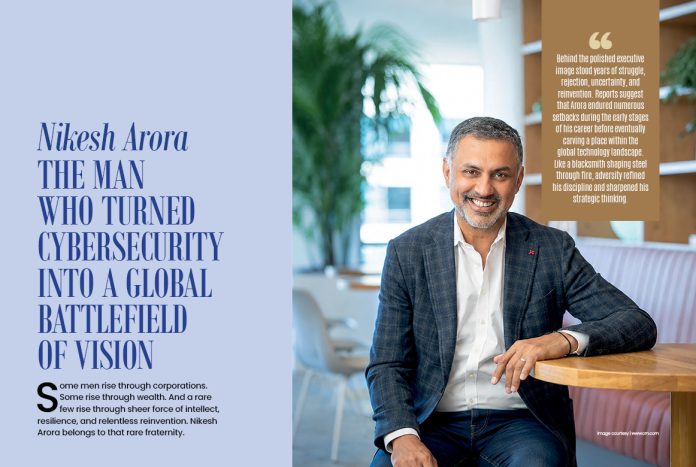
Some men rise through corporations. Some rise through wealth. And a rare few rise through sheer force of intellect, resilience, and relentless reinvention. Nikesh Arora belongs to that rare fraternity.
Born in Ghaziabad, Uttar Pradesh, India, in 1968, Arora’s story did not begin amid the glamour of Silicon Valley boardrooms or billion-dollar valuations. It began in the disciplined atmosphere of a middle-class Indian household where ambition was not loudly celebrated but quietly expected. Like countless young Indians of his generation, he grew up believing that education was the ladder capable of lifting ordinary lives towards extraordinary destinies.
That ladder first led him to Indian Institute of Technology (BHU), where he earned his Bachelor’s degree in Electrical Engineering. But Nikesh Arora was never destined to remain confined within one geography or one identity. The world itself became his classroom. He later pursued a Master’s degree in Finance from Boston College and an MBA from Northeastern University. Those academic foundations sharpened not only his technical understanding, but also his global business instincts.
Yet success did not arrive overnight
Behind the polished executive image stood years of struggle, rejection, uncertainty, and reinvention. Reports suggest that Arora endured numerous setbacks during the early stages of his career before eventually carving a place within the global technology landscape. Like a blacksmith shaping steel through fire, adversity refined his discipline and sharpened his strategic thinking.
His rise through the corporate world soon became remarkable
From Fidelity Investments to Deutsche Telekom, from Google to SoftBank, Nikesh Arora transformed himself into one of the most influential technology executives of the modern era. At Google, he became one of the company’s most powerful business leaders, helping expand its global advertising empire during a period when the internet itself was reshaping civilisation. Later, at SoftBank Group, he earned record-breaking compensation packages that stunned corporate Japan and established him among the world’s highest-paid executives.
But perhaps his most defining chapter emerged when he took over as Chairman and CEO of Palo Alto Networks in 2018. At that time, cybersecurity was already important. Under Arora’s leadership, it became indispensable.
He recognised before many others that the digital age would not merely create opportunities — it would create wars fought invisibly through code, networks, and artificial intelligence. While others focused on isolated security products, Arora envisioned integrated cyber ecosystems capable of defending entire digital civilisations.
Like a battlefield strategist surveying an approaching storm, he prepared his company for an era where cyber defence would become as critical as national defence itself.
The results were extraordinary
Under his leadership, Palo Alto Networks expanded dramatically in valuation, influence, and technological relevance. The company emerged as one of the world’s dominant cybersecurity giants serving governments, corporations, hospitals, banks, and critical infrastructure providers globally. Arora’s compensation packages — including reported figures exceeding US$150 million in certain years — reflected not merely executive reward, but investor confidence in his strategic foresight and transformational leadership.
Yet what truly distinguishes Nikesh Arora is not money alone
It is mindset.
In interviews, he often speaks not merely about technology, but about adaptation, learning, and the future of human capability in an AI-driven world. Even amid fears that artificial intelligence will eliminate jobs, Arora argues that innovation creates new possibilities and demands stronger talent rather than weaker ambition.
His story therefore transcends corporate achievement
It is the story of a young Indian boy who crossed continents carrying little more than education, discipline, and audacity — and eventually stood among the world’s most influential technology leaders.
Today, Nikesh Arora represents a modern archetype of leadership: global in outlook, fearless in transformation, and relentlessly future-focused. He did not merely build a career. He built strategic influence. And in doing so, he helped redefine how the modern world protects itself in the digital age.
