
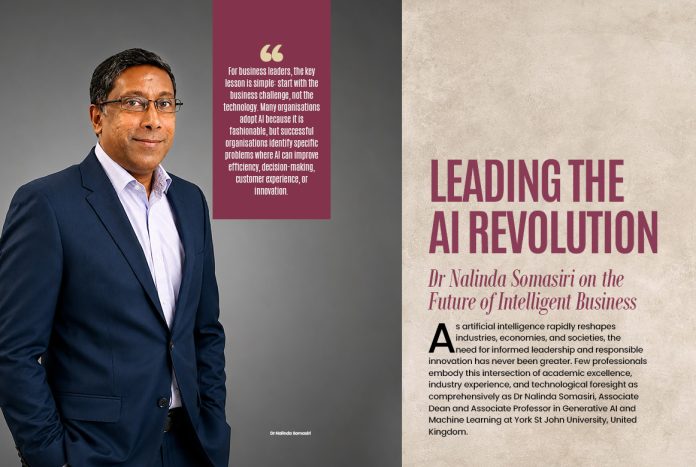
As artificial intelligence rapidly reshapes industries, economies, and societies, the need for informed leadership and responsible innovation has never been greater. Few professionals embody this intersection of academic excellence, industry experience, and technological foresight as comprehensively as Dr Nalinda Somasiri, Associate Dean and Associate Professor in Generative AI and Machine Learning at York St John University, United Kingdom.
With more than two decades of experience spanning artificial intelligence, machine learning, blockchain, mobile communications, and Generative AI, Dr Somasiri has built an impressive international career that bridges the worlds of research and real-world application. Before entering academia, he contributed to pioneering projects at globally renowned organisations including Motorola Solutions, Jaguar Land Rover, and MBDA, where he worked on advanced technologies ranging from public safety systems and autonomous vehicles to mission-critical defence programmes.
Today, Dr Somasiri leads the AI for Climate and Disaster Resilience Research Group, advancing AI-driven solutions for hazard forecasting and disaster risk reduction while collaborating with leading technology organisations such as AWS, IBM, and Motorola.
In this exclusive interview with Global CEO Magazine, Dr Somasiri shares his insights on Generative AI, business transformation, climate resilience, and the skills required to build the next generation of AI leaders.
You have worked with leading global organisations such as Motorola Solutions, Jaguar Land Rover, and MBDA before transitioning into academia. How have these industry experiences shaped your approach to research, and what lessons can business leaders learn about turning advanced technologies such as Generative AI into practical, real-world solutions?
My experience in industry has taught me that technology is only valuable when it solves a real problem.
At Motorola Solutions, I worked on AI-driven public safety systems, facial recognition, video analytics, and mission-critical communications. At Jaguar Land Rover, I contributed to autonomous driving and intelligent vehicle systems. These environments demanded solutions that were reliable, scalable, and capable of delivering measurable outcomes. When I transitioned into academia, I carried that mindset with me.
My research focuses not only on advancing Generative AI and Machine Learning but also on ensuring that innovations can be deployed responsibly in healthcare, finance, cybersecurity, education, and public services.
For business leaders, the key lesson is simple: start with the business challenge, not the technology. Many organisations adopt AI because it is fashionable, but successful organisations identify specific problems where AI can improve efficiency, decision-making, customer experience, or innovation.
The most successful AI projects combine technical excellence with strong governance, clear objectives, and measurable business value.
Generative AI is transforming industries at an unprecedented pace. In your view, how will Generative AI reshape the way organisations operate over the next five years, and what should CEOs and senior executives do today to remain competitive in this rapidly evolving landscape?
Over the next five years, Generative AI will move from being a productivity tool to becoming a strategic business partner. We will see AI-powered assistants supporting decision-making, automating complex workflows, generating content, enhancing customer engagement, and accelerating research and development.
However, the biggest transformation will not be automation alone—it will be augmentation. Employees will increasingly work alongside AI systems that help them make faster and better decisions. Organisations that successfully integrate AI into their operations will gain significant competitive advantages.
For CEOs and senior executives, preparation must begin now. First, invest in AI literacy across the organisation. Second, establish robust AI governance frameworks that address ethics, security, privacy, and compliance. Third, focus on high-impact use cases that align with strategic objectives.
Finally, build a culture of innovation where experimentation is encouraged but guided by responsible AI principles.
The organisations that thrive will be those that view AI as a long-term capability rather than a short-term technology project.
As the leader of the AI for Climate and Disaster Resilience Research Group, you are developing AI-driven solutions for hazard forecasting and disaster risk reduction. How can governments, businesses, and communities leverage artificial intelligence to build greater resilience against climate-related challenges, particularly in developing nations such as Sri Lanka?
Climate change is one of the greatest challenges facing humanity, and AI has a critical role to play in addressing it. Through our AI for Climate and Disaster Resilience Research Group, we are exploring how AI can support hazard forecasting, early warning systems, disaster risk assessment, and resource optimisation.
For developing nations such as Sri Lanka, AI offers an opportunity to leapfrog traditional infrastructure limitations.
Machine learning models can analyse weather patterns, satellite imagery, environmental sensors, and historical disaster data to predict floods, landslides, droughts, and other climate-related risks.
These insights can help governments allocate resources more effectively and enable communities to respond proactively rather than reactively.
Businesses also have a role to play.
Organisations can use AI to improve supply-chain resilience, monitor environmental risks, and support sustainable operations.
Collaboration between governments, universities, industry, and local communities is essential. The future of climate resilience will depend on making AI solutions accessible, affordable, and locally relevant.
Having spent over two decades in both industry and academia, what skills, mindsets, and ethical considerations do you believe are essential for the next generation of AI professionals and business leaders?
Technical skills remain important, but they are no longer enough. Future AI leaders must combine expertise in data science, machine learning, and software development with creativity, critical thinking, communication, and ethical decision-making.
I believe the most important mindset is lifelong learning. AI is evolving so rapidly that today’s knowledge may become outdated within a few years.
Professionals must remain curious, adaptable, and willing to continuously develop new skills. Ethics must also be central to AI leadership. Issues such as bias, transparency, explainability, privacy, and accountability cannot be treated as afterthoughts. Responsible innovation will define the next generation of successful AI leaders.
What advice would you offer to young Sri Lankans aspiring to build successful careers in artificial intelligence and emerging technologies?
My advice to young Sri Lankans is to think globally while solving local problems. Build strong foundations in mathematics, computing, and problem-solving. Gain practical experience through projects, internships, and research.
Most importantly, focus on creating solutions that improve lives and contribute to society. The future of AI will belong not only to those who develop powerful technologies, but also to those who use them responsibly to create meaningful impact.
