
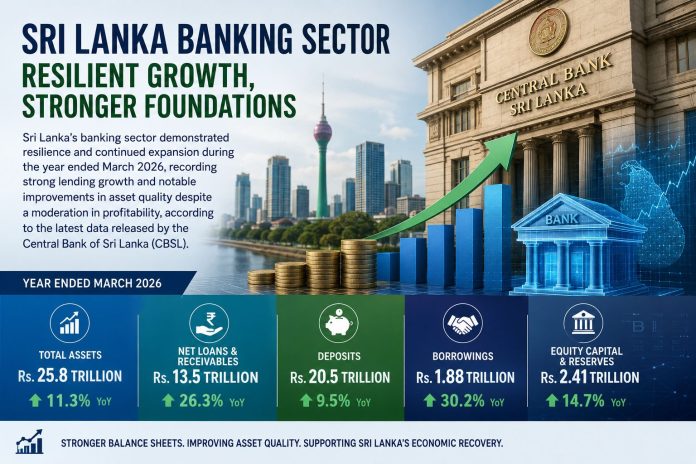
Sri Lanka’s banking sector demonstrated resilience and continued expansion during the year ended March 2026, recording strong lending growth and notable improvements in asset quality despite a moderation in profitability, according to the latest data released by the Central Bank of Sri Lanka (CBSL).
The sector’s total assets increased by 11.3% year-on-year to Rs. 25.8 trillion, while net loans and receivables surged by 26.3% to Rs. 13.5 trillion, reflecting a significant recovery in credit demand across the economy. Deposits grew by 9.5% to Rs. 20.5 trillion, while borrowings rose by 30.2% to Rs. 1.88 trillion. Equity capital and reserves strengthened by 14.7% to Rs. 2.41 trillion.
Net interest income increased by 9.7% to Rs. 270.3 billion. However, profitability came under pressure as impairment charges climbed by 35.5% to Rs. 31.3 billion and operating expenses rose by 16.4% to Rs. 131.3 billion. Consequently, Profit Before Tax declined by 4.1% to Rs. 136.4 billion, while Profit After Tax fell by 4.6% to Rs. 86.4 billion.
Asset quality indicators showed substantial improvement, with the Stage 3 loan ratio declining to 9.4% from 12.7% a year earlier. Meanwhile, Stage 3 impairment coverage improved to 59.5%.
Although capital and liquidity ratios moderated from the previous year, they remained comfortably above regulatory requirements. The banking sector’s Credit-to-Deposit ratio increased to 71.2%, underscoring renewed lending momentum and growing confidence in Sri Lanka’s economic recovery.
