
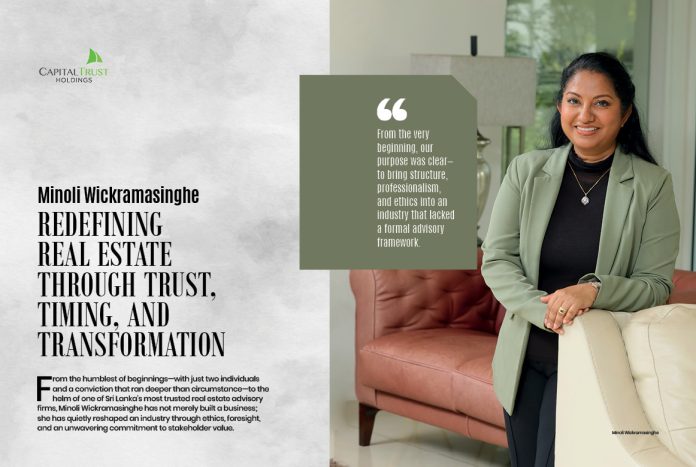
From the humblest of beginnings—with just two individuals and a conviction that ran deeper than circumstance—to the helm of one of Sri Lanka’s most trusted real estate advisory firms, Minoli Wickramasinghe has not merely built a business; she has quietly reshaped an industry through ethics, foresight, and an unwavering commitment to stakeholder value.
The story of an industry is often told through its cycles—its peaks of optimism and its troughs of uncertainty. Yet, occasionally, it is shaped by individuals who do not merely respond to these cycles, but redefine how they are navigated. In Sri Lanka’s real estate sector, Minoli Wickramasinghe stands among that rare class of leaders.
Her journey did not begin with grand declarations or sweeping ambitions. It began with observation. As one of the youngest trainees at DFCC Bank, she was immersed in an environment that demanded discipline, analytical thinking, and an understanding of systems that governed value creation.
She carried that same distinction into her next chapter, joining Maersk Logistics as one of its youngest employees and only person working within the finance division at the very moment the company established its presence in Sri Lanka. It was across these formative years that she developed an instinct for structure, an ability to see not just what exists, but what is missing.
That instinct would later become her compass
When she founded Capital Trust Properties in 2010, Sri Lanka stood at the threshold of a new economic chapter. The end of conflict had opened the door to investment and expansion. Yet, within the real estate sector, a curious paradox prevailed. There was opportunity, but little structure. Transactions were frequent, but advisory was scarce. Investors moved, but often without guidance.
Where others saw a fragmented market, Wickramasinghe saw an unfinished system.
She did not set out merely to participate in it. She set out to refine it.
The early days were modest in every sense. Two people. Limited resources. No established blueprint. But what Capital Trust Properties lacked in scale, it possessed in clarity. From the outset, the firm was anchored in principles that would later define its identity—
professionalism, due diligence, and trust.
These were not aspirational ideals. They were operational standards
In an industry where speed often eclipsed scrutiny, Wickramasinghe insisted on process. Every project was examined. Every developer evaluated. Every decision measured against a simple yet uncompromising question: does it meet the standard?
That discipline, in time, became distinction
As Sri Lanka’s real estate market evolved, so too did Capital Trust Properties. What began as a focused advisory gradually expanded into a comprehensive platform—offering legal guidance, valuations, property management, interior solutions, and market intelligence. Yet, growth was never pursued for its own sake. It was guided by relevance.
Each service was an answer to a gap. Each expansion, a response to need
More importantly, each step reinforced trust. Today, Capital Trust Properties occupies a unique position within the industry. It is not merely a facilitator of transactions; it is a participant in strategy. Corporates, developers, and investors turn to the firm not only to execute, but to interpret—to make sense of a market that is constantly shifting beneath their feet.
This role, however, carries weight. It demands not only expertise, but judgement.
And judgement is often tested in times of uncertainty.
The COVID-19 pandemic presented one such test. As global markets contracted and local realities shifted, Sri Lanka’s real estate sector experienced a sharp downturn. Commercial occupancy rates fell dramatically, touching nearly 30 per cent. Confidence weakened. Momentum slowed.
For many, the instinct was to wait
For Wickramasinghe, the instinct was to understand. Rather than reacting to surface-level disruption, she and her team turned to deeper analysis. They examined currency trends, macroeconomic signals, and structural vulnerabilities within the sector. What emerged from this analysis was a clear and concerning insight: a currency crisis was not a distant possibility—it was an imminent risk.
The implications were significant
Developers who had structured their rental models in local currency faced potential erosion of value. Stability, in such a scenario, would depend on a shift in thinking.
The recommendation that followed was both strategic and bold—standardise rental pricing in US dollars.
It was not an easy proposition. It required developers to rethink established practices and adapt to a new framework. Yet, those who recognised the merit of the advice acted swiftly.
The results were transformative
As the market adjusted, stability returned. Occupancy levels, once depressed, began to recover. Today, they stand between 90 and 100 per cent—a remarkable rebound that reflects not only resilience, but recalibration.
A similar pattern unfolded within the luxury residential segment. Rental yields, which had fallen to approximately 4 per cent during the height of the crisis, have since improved to around 7 per cent. Once again, the shift was not accidental. It was guided.
Yet, beyond the metrics lies a more nuanced narrative
During that period, many of the advisory services provided by Capital Trust Properties were offered without immediate financial return. They were, in essence, investments in relationships. Expressions of a belief that value, when created for stakeholders, ultimately strengthens the entire ecosystem.
“Our relationships often go beyond financial benefit,” Wickramasinghe reflects. “They are built on solid trust, integrity, and professionalism.”
It is a philosophy that may appear simple in articulation, yet demands consistency in execution. It requires a willingness to prioritise long-term credibility over short-term gain. It calls for discipline in moments where compromise may seem convenient. This, perhaps, is the defining characteristic of her leadership.
She does not seek visibility. She builds credibility. She does not chase growth. She sustains value. And in doing so, she has created something that extends beyond enterprise—a standard.
Global CEO Magazine recently sat down with Minoli Wickramasinghe for an exclusive conversation
Capital Trust Properties has built a reputation as one of Sri Lanka’s leading real estate service providers. What has been the guiding philosophy behind creating a brand trusted by thousands?
From the very beginning, our purpose was clear—to bring structure, professionalism, and ethics into an industry that lacked a formal advisory framework. Trust is not something you claim; it is something you earn over time. We have built our brand by consistently doing what is right, even when it is not the easiest path.
Your journey began with a very small team. What shaped those early years?
We focused on building systems rather than chasing volume. We were deliberate about the relationships we cultivated, understanding early on that trust with stakeholders was not a byproduct of success but a precondition for it.
Every client relationship, every partner we engaged, was approached with long-term intent rather than transactional thinking. Those early decisions, and the relationships built through them, created the foundation for everything that followed.
Your company is recognised for ethical practices and personalised service. How do you ensure these values are consistently upheld?
Ethics is not a statement—it is a system. It is embedded into how we operate, from project selection to client engagement. Every member of our team understands that integrity is non-negotiable.
Capital Trust Properties is known for strict due diligence. Why is this so important?
Because credibility matters. We assess developers, quality, and alignment of values before taking projects forward. If it does not meet our standards, we do not proceed.
What trends do you see shaping Sri Lanka’s real estate market in the coming years?
Sri Lanka has immense potential. With consistent policies, lower interest rates, and improved ease of doing business, the sector can experience significant growth. The fundamentals are strong.
Capital Trust Properties played a key advisory role during the COVID-19 crisis. What did that experience teach you?
It reinforced the importance of foresight and research. In uncertain times, stakeholders need clarity. Our focus was always on long-term sustainability.
Many of your interventions prioritised stakeholders over immediate returns. Why?
Because sustainability depends on the success of all stakeholders. If they succeed, we succeed. That belief has guided us from the beginning.
What is your leadership philosophy as you continue to grow the business?
Leadership is about responsibility. It is about creating value, maintaining trust, and staying consistent in principles regardless of circumstances.
