
By Dr Eranga Jayasekara
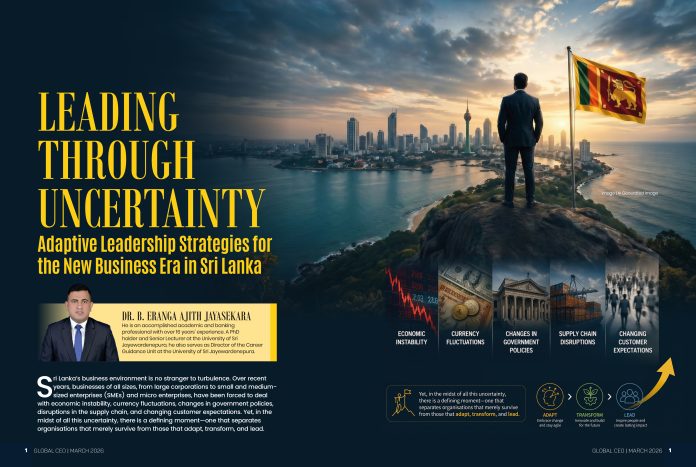
Sri Lanka’s business environment is no stranger to turbulence. Over recent years, businesses of all sizes, from large corporations to small and mediumsized enterprises (SMEs) and micro enterprises, have been forced to deal with economic instability, currency fluctuations, changes in government policies, disruptions in the supply chain, and changing customer expectations. Yet, in the midst of all this uncertainty, there is a defining moment—one that separates organisations that merely survive from those that adapt, transform, and lead.
With over 15 years of experience in corporate banking and financial services, and my current role in academia mentoring future business leaders, I have observed the significant impact of leadership styles on organisational performance, resilience, innovation, and longterm sustainability. In today’s rapidly changing environment, Sri Lankan enterprises must reassess traditional leadership approaches and adopt strategies that meet contemporary challenges. This article examines the leadership styles best suited to Sri Lanka’s current business landscape, focusing on corporates, SMEs, and micro-enterprises.
The Changing Context: Why Leadership Must Evolve?
In Sri Lanka, leadership has always been based on hierarchy, authority, and a fear of taking risks. These kinds of strategies may have worked in the past when things were stable, but they are increasingly inadequate in today’s dynamic and uncertain conditions.
Organisations now face rapid economic shifts and financial constraints, increased global competition and digital disruption, a workforce that values purpose, flexibility, and inclusivity, and heightened expectations for ethical and responsible business practices.
In such a context, leadership is not about being in charge anymore; it is about being flexible, understanding, and having a plan for the future.
1. Transformational Leadership: Inspiring Change in Corporates
Rigid structures, resistance to change, and legacy systems are common issues for large corporations in Sri Lanka. For these organisations, transformational leadership is not optional—it is essential.
Transformational leaders often challenge the current status quo, inspire a common vision, and push staff to step beyond expectations. Instead of emphasising immediate profits, they concentrate on creating long-term value.
In the Sri Lankan corporate setting, transformational leadership is particularly relevant in driving digital transformation initiatives, restructuring organisations to improve efficiency, and building a culture of innovation and continuous improvement.
A compelling local example is John Keells Holdings. Over the years, the group has consistently reinvented itself, moving beyond traditional sectors into integrated resorts, digital ventures, and sustainability-driven initiatives.
Transformation necessitates more than just a vision; it requires trust. Employees need to have confidence in their leaders and feel empowered to contribute. Achieving this hinges on open communication, transparency, and ongoing engagement. Servant leaders put the needs of others— workers, clients, and the community—before their own. They have compassion, modesty, and a sincere desire to serve others.
A corporate leader who effectively communicates a compelling vision and aligns teams accordingly will stabilise the organisation and position it for growth amid uncertainty.
2. Adaptive Leadership: Navigating Complexities in SMEs
Small and medium enterprises (SMEs) are essential to Sri Lanka’s economic landscape but frequently face significant challenges due to their limited resources and operational f lexibility.
For SMEs, the concept of adaptive leadership is invaluable. Adaptive leaders do not depend on rigid solutions; they focus on continuously assessing changing conditions, experimenting with new approaches, learning quickly from failures, and engaging teams in problemsolving.
Considering the journey of Spa Ceylon, originally rooted in the local market, the brand expanded internationally by continuously adapting its product offerings, branding, and distribution strategies to suit diverse markets. Its leadership’s ability to adapt to shifting consumer preferences is just as important to its success as the quality of its products.
In contrast to traditional leadership, adaptive leadership distributes accountability. Critical thinking, sharing ideas, and taking responsibility for solutions are all encouraged among staff members. In the context of Sri Lankan small and medium enterprises, adaptive leadership serves as an effective equaliser. Despite limited resources, agility and responsiveness can confer a competitive advantage, emphasising the necessity of leading through instability rather than awaiting stability.
3. Servant Leadership: Empowering Micro Enterprises
At the grassroots level of Sri Lanka’s economy, leadership takes on a more personal and human dimension. Micro enterprises are built not on systems, but on relationships—trust with customers, commitment to employees, and connection to the community. For such enterprises, servant leadership is especially effective.
Servant leaders put the needs of others— workers, clients, and the community—before their own. They have compassion, modesty, and a sincere desire to serve others.
In the micro-enterprise context, this translates to building strong customer relationships based on trust and reliability, supporting employees (often family members) with care and respect, and contributing positively to the local community.
One inspiring local example is Heladiv, which integrates ethical sourcing and community empowerment into its business model. While operating beyond micro scale today, its foundation reflects servant leadership principles—uplifting stakeholders rather than exploiting them.
Though servant leadership may seem gentle in nature, it serves as a potent catalyst for fostering loyalty and ensuring long-term sustainability. During crises, companies with robust stakeholder relationships are better positioned to endure.
4. Ethical Leadership: Rebuilding Trust Across All Sectors
One of the most significant issues in the Sri Lankan economic context is rebuilding trust among investors, consumers, employees, and the general public. This is where ethical leadership becomes indispensable.
Ethical leaders demonstrate integrity in decision-making, ensure transparency in operations, and uphold accountability at all levels.
Recent years have highlighted the detrimental effects of inadequate governance and unethical practices across various sectors, necessitating that organisations integrate ethics into their leadership frameworks rather than merely viewing it as a compliance issue.
Sri Lanka has seen organisations that have maintained strong reputations through ethical practices. Commercial Bank of Ceylon, for instance, has consistently emphasised governance, transparency, and customer trust, enabling it to remain resilient even in uncertain times.
The message is clear for Sri Lankan businesses of all sizes: ethical leadership establishes trust, draws in capital, and cultivates enduring partnerships. In times of uncertainty, people tend to lean towards trustworthy organisations.
Integrating Leadership Styles: A Contextual Approach
In diverse organisational settings, including corporations, SMEs, and micro enterprises, a singularly “perfect” leadership style does not exist. While each leadership style has its strengths, no single approach is sufficient on its own. The most successful leaders are those who effectively understand their context and adapt their strategies accordingly.
A corporate executive must adopt a transformational approach to strategy, uphold ethical governance, and demonstrate agility in execution. Similarly, a small and mediumsized enterprise (SME) owner should integrate adaptive thinking with servant leadership to nurture a cohesive team. Meanwhile, a micro-entrepreneur may effectively combine servant leadership with agility to address local market dynamics. Thus, leadership is inherently contextual.
A Call to Action: Leading Sri Lanka Forward
Leadership is essentially about people, not just structures and tactics. The labour force in Sri Lanka is changing. Younger generations demand meaningful work, personal development, and a sense of belonging in addition to financial incentives. Leaders must respond by creating inclusive and supportive work environments, recognising and developing talent, and communicating purpose and direction clearly.
Empathy is no longer a “soft skill”—it is a leadership necessity.
During uncertain times, employees seek guidance and reassurance from their leaders. A leader who actively listens, comprehends, and supports their team fosters resilience that transcends any single strategy.
Sri Lanka stands at a critical juncture. The challenges are real, but so are the opportunities.
The path forward requires leaders who are:
* Visionary, yet grounded in reality
* Decisive, yet open to learning
* Ambitious, yet ethical
* Confident, yet humble
Your leadership style will not only affect the success of your organisation, but also its impact on the economy as a whole, whether you run a large company, a small business, or a micro-business.
Sri Lanka’s business future will not only be shaped by external forces; the choices leaders make today will also have an impact.
For SMEs, the concept of adaptive leadership is invaluable. Adaptive leaders do not depend on rigid solutions; they focus on continuously assessing changing conditions, experimenting with new approaches, learning quickly from failures, and engaging teams in problem-solving.
Conclusion
In my journey from the corporate world to academia, one realisation remains: organisations do not change; people do. And people are guided by leaders. Leadership will be the driving force behind Sri Lanka’s economic revival and expansion, transforming uncertainty into opportunity. Therefore, the question is not whether change will happen, but whether we are ready to spearhead it. For a new corporate era, it is necessary to reconsider, rethink, and reinvent leadership. Because ultimately, being a leader is about making a difference, not about maintaining a position.
The writer is a Senior Lecturer in the Department of Science for Technology, Faculty of Technology, University of Sri Jayewardenepura.
